Explorer
Rajnath Singh Lauds BrahMos; Here Are The Other Weapons Used In In Operation Sindoor
During Operation Sindoor, the Indian Armed Forces deployed a range of powerful weapons and air defence systems to counter aerial threats. Check out this gallery.
Defence Minister Rajnath Singh in Bhuj on May 16.
1/11
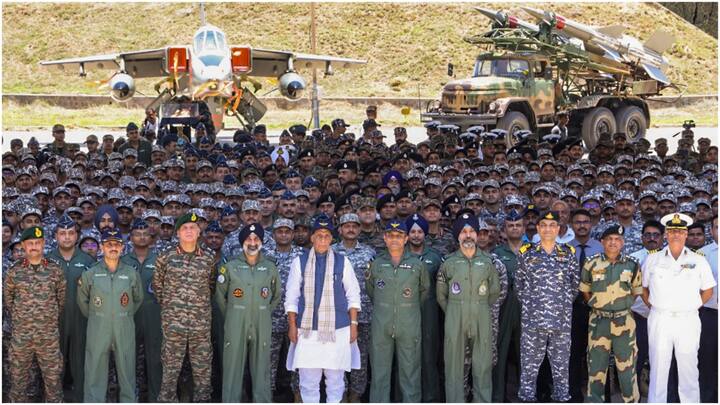
Defence Minister Rajnath Singh on May 16 visited the Bhuj Air Force Station. He praised the Armed Forces for the success of Operation Sindoor and hailed the BrahMos missile for its decisive role. (Image Source: PTI)
2/11
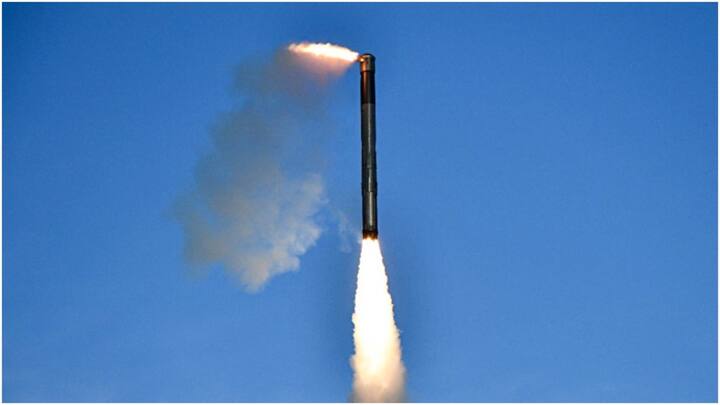
The BrahMos is a supersonic cruise missile. In this pic, it is seen engaging a target with pinpoint accuracy during a test.
3/11

The Dassault Rafale, a twin-engine, multirole fighter, was the backbone of India’s aerial offensive in Operation Sindoor. The Rafale conducted high-altitude ingress to evade enemy radar, delivered precise strikes on terrorist infrastructure, and returned to base with minimal exposure. (Image Source: PTI)
4/11

During Operation Sindoor, India used SCALP and HAMMER missiles from Rafale jets to strike terror infrastructure deep inside Pakistan. SCALP’s 500+ km range-enabled precision struck fortified targets without crossing the border, while the HAMMER missiles, with a 70 km range and jammer resistance, flattened Jaish and Lashkar HQs linked to the Pulwama and Pahalgam attacks. (Image Source: Wikimedia Commons)
5/11

During the operation, India also deployed HAROP loitering drones manufactured in Israel to target enemy radar sites and mobile command centre. These kamikaze drones can loiter over targets and strike with precision, making them ideal for suppressing air defences and disrupting enemy coordination deep inside hostile territory. (Image Source: Wikimedia Commons)
6/11

India also used the S-400 Triumf, also known as Sudarshan Chakra, to counter Pakistan's aerial threats. This advanced Russian-made air defence system can detect and neutralize targets up to 400 km away, including aircraft, drones, and ballistic missiles. (Image Source: PTI)
7/11

India's Akashteer missile system successfully intercepted Pakistani missiles. The Air Defence System, developed by Bharat Electronics, was deployed as part of the operation to protect Indian cities from potential aerial threats. (Image Source: Wikimedia Commons)
8/11

During Operation Sindoor, India’s Akash missile system also successfully intercepted Pakistani missiles and drones, protecting key cities. Designed by DRDO, Akash, an indigenous medium-range surface-to-air missile system, can track and hit multiple aerial threats at once. (Image Source: Wikimedia Commons)
9/11

Indian Army deployed upgraded Bofors L-70 anti-aircraft guns along the western border to counter drone threats. Originally built in the 1960s, these guns were modernised with digital controls, thermal imaging, and drone-targeting systems. (Image Source: Wikipedia by Wikimedia)
10/11

The Indian Army also used the upgraded ZSU-23-4 Shilka systems to tackle drone threats. These modernised self-propelled anti-aircraft units, equipped with radar, optical sensors, and anti-drone guns, provided an effective defense by detecting and neutralizing low-flying drones. (Image Source: Wikimedia Commons)
11/11

The Indian Air Force (IAF) deployed the SAMAR-1 (Surface to Air Missile for Assured Retaliation) system to counter low-flying aerial threats, including drones and helicopters.(Image Source: X/@alpha_defense AstraShakti-2023)
Published at : 16 May 2025 05:46 PM (IST)

View More
Advertisement
Trending News
Advertisement
Advertisement
Top Headlines
India
World
Technology
World