Google's OG April Fool's Prank: Why No One Believed Gmail Was Real
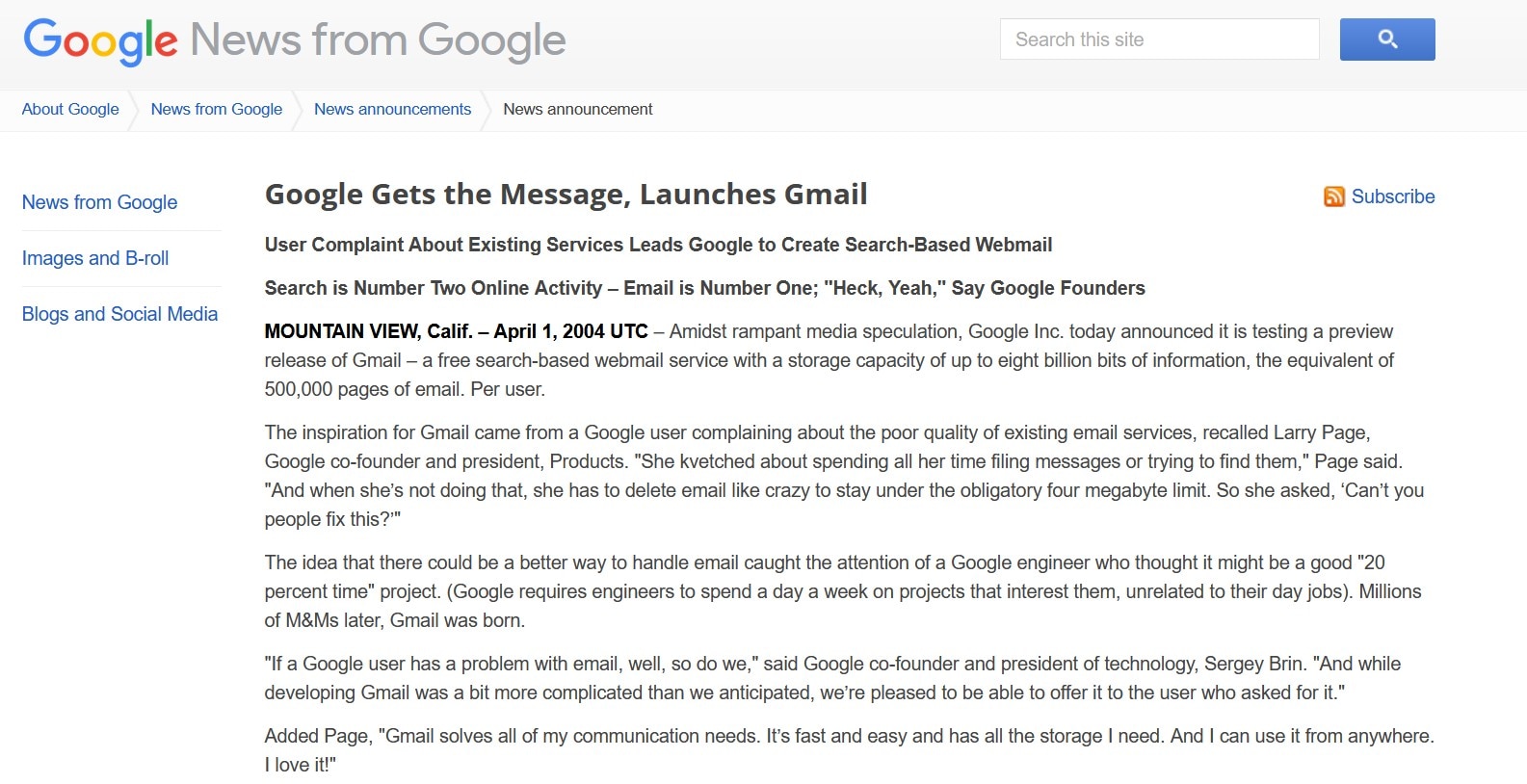
When The Associated Press published an article about Gmail on April 1, 2004, readers flooded the newsroom with messages claiming they had fallen for Google’s joke.

April 1, 2004, was a day of disbelief for many internet users. Google, known for its elaborate April Fool’s Day pranks, announced the launch of a new email service called Gmail. Given the company’s history of outlandish jokes — like a job posting for a research center on the moon — people naturally assumed this was another hoax. But Gmail was real, and it would go on to revolutionise email forever.
Too Good to Be True?
At a time when webmail services from Yahoo and Microsoft offered users barely enough storage to hold 30 to 60 emails, Google’s promise of 1GB of free space seemed absurd. That was 250 to 500 times more than what was available, allowing users to store around 13,500 emails without running out of space.
But Gmail didn’t just change storage expectations. It also introduced powerful search features that allowed users to instantly retrieve old emails, photos, or other saved information. The service even grouped related emails into conversation threads, making inboxes more organised and user-friendly.
“The original pitch we put together was all about the three ‘S’s’ — storage, search, and speed,” recalled Marissa Mayer, a former Google executive who helped design Gmail.
The Launch That Fooled Everyone
When The Associated Press published an article about Gmail on April 1, 2004, readers flooded the newsroom with messages claiming they had fallen for Google’s joke. It was only after journalists visited Google’s headquarters and saw the service firsthand that the skepticism began to fade.
Google co-founder Larry Page, demonstrating Gmail on his laptop, confidently told reporters, “I think people are really going to like this.”
And he was right. Today, Gmail boasts approximately 1.8 billion active accounts, each with 15GB of free storage shared across Google services. That’s still not enough for many users, leading to a booming business in cloud storage subscriptions — a model that tech giants like Google and Apple profit from today.
From Exclusive Invite to Global Phenomenon
At first, Gmail was an exclusive service due to limited server capacity. The team behind the project, known internally as “Caribou” (a nod to a running joke in the Dilbert comic strip), had only 300 aging computers to support early users. As a result, Gmail accounts were invitation-only, making them a coveted online commodity. At one point, invites were selling for as much as $250 on eBay.
“It became a bit like a social currency,” said former Google engineer Paul Buchheit. “People would say, ‘Hey, I got a Gmail invite, you want one?’”
Gmail finally became available to the public on February 14, 2007. Ironically, just weeks later on April 1, Google released an actual joke — "Gmail Paper," a fictional service that promised to print out users’ emails on organic paper and deliver them via mail.
While Gmail may have started as a too-good-to-be-true announcement, it ultimately transformed how people use email, paving the way for Google’s expansion into cloud storage, online productivity tools, and beyond.

Top Headlines