Airbus in Bremen, Germany, built a critical component of the Orion spacecraft's European Service Module, which provides essential functions for the mission.
Explorer
Artemis II Lifts Off, Carrying Humans Back Toward The Moon: Why It Matters Now
The four astronauts aboard the Artemis II are headed toward a historic journey around the moon. The test flight marks a major step in NASA's ambitious program of establishing a long-term presence on the lunar surface.
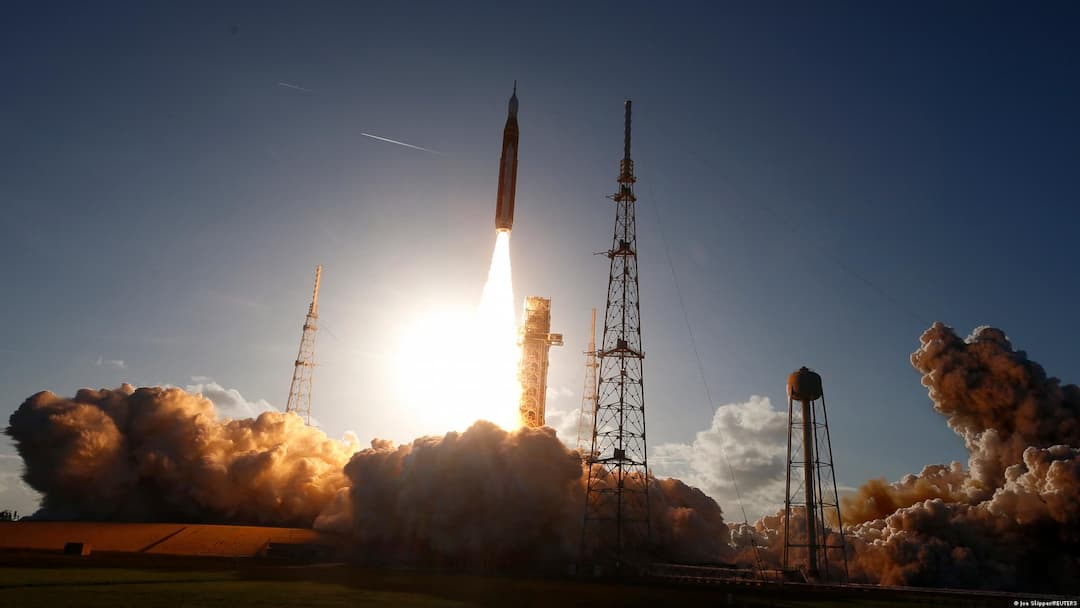
The Artemis II mission launched with four astronauts aboard the Orion spacecraft, propelled by NASA's Space Launch System.
Source : DW
- German-built European Service Module powers the Orion spacecraft.
Reported by: Roshni Majumdar and Jenipher Camino Gonzalez with AP, Reuters| Edited by: Srinivas Mazumdaru, Alex Berry
The Artemis II mission rocket lifted off from NASA's Kennedy Space Center in Florida on Wednesday evening, carrying four astronauts on a historic mission to the moon.
Tens of thousands of people hugged on Cocoa Beach Pier and its surrounding sand as the 32-story rocket shot above into the blue sky on its journey toward the moon for the first time since 1972.
Crowds also jammed the surrounding roads and beaches, reminiscent of the Apollo moonshots in the 1960s and ’70s.
What is the goal for Artemis II?
The astronauts, three Americans and a Canadian, are set to test the Orion spacecraft or the exploration vehicle that carries astronauts to the moon and back.
The astronauts aboard Artemis II were also launched into space by NASA's new and most powerful rocket yet, the Space Launch System rocket.
Artemis II is the second mission in NASA's Artemis program of moon exploration, with Artemis I having sent an uncrewed Orion to lunar orbit and back in 2022.
Under Artemis, NASA hopes to send astronauts on increasingly difficult missions to explore the moon for scientific discovery and to build on that foundation for the first crewed mission to Mars.
The agency hopes for a proper moon landing near the lunar south pole in 2028. And, if all goes according to plan, the thinking in the community is that could go to Mars in the 2030s or 2040s.
What do we know about the rocket and astronauts?
NASA led the design of the Space Launch System rocket and the Orion capsule and it hired private companies SpaceX and Blue Origin to provide the lunar landers for Artemis missions in the future.
On NASA's Artemis II test flight, astronauts will take the controls of the Orion spacecraft and periodically fly it manually during the flight around the moon and back.
NASA astronauts Christina Koch, Victor Glover and Reid Wiseman and Canadian astronaut Jeremy Hansen, landed in Florida from Houston on Friday after a two-week quarantine leading up to liftoff.
What does Germany have to do with Artemis II?
A critical component of the Orion spacecraft's European Service Module (ESM) was built by Airbus in Bremen, Germany, on behalf of the European Space Agency.
Acting as the powerhouse for Artemis moon missions, the ESM provides propulsion, power, thermal control, water, and oxygen, utilizing 33 engines including a repurposed Shuttle orbital maneuvering engine.
How many days will the Artemis II mission last?
The Artemis II test flight is set to last for 10 days.
It would mark the farthest humans have ever traveled in space, sending them some 252,000 miles (406,000 km).
NASA is also hoping to make sure it stays ahead of the curve, with China hoping to land astronauts on the moon by the end of 2030.
Liftoff.
— NASA (@NASA) April 1, 2026
The Artemis II mission launched from @NASAKennedy at 6:35pm ET (2235 UTC), propelling four astronauts on a journey around the Moon.
Artemis II will pave the way for future Moon landings, as well as the next giant leap — astronauts on Mars. pic.twitter.com/ENQA4RTqAc
Are astronauts going to land on the moon?
Astronauts aren't going to land on the moon this time.
But on the flight, as we mentioned above, they are expected to test critical life-support systems of the Orion capsule, crew interfaces and communications.
The Artemis II mission ultimately represents the opening shot of NASA's plans for a permanent moon base.
Disclaimer: This report first appeared on Deutsche Welle, and has been republished on ABP Live as part of a special arrangement. Apart from the headline, no changes have been made in the report by ABP Live.
Frequently Asked Questions
What role does Germany play in the Artemis II mission?

Top Headlines
Science

Inside Rajasthan’s Sustainable Hospitality: Solar Power, Water Recycling And Local Sourcing
Science

Quote Of The Day | Jane Goodall's Inspiring Words On Creating A Positive Impact
Science

SpaceX's Starship Flight 13 Completes Soft Indian Ocean Splashdown After Starlink Launch. VIDEO
Science

PM Modi's Postcard Reaches Space: What Else Did Skyroot's Vikram-1 Carry?














See Today's Weather 
powered by