Explorer
EXPLAINED: Is Alien Life Detected On Planet Venus?
Scientist have clearly stated about the discovery that some exotic process is producing phosphine, and understanding of Venus needs work.
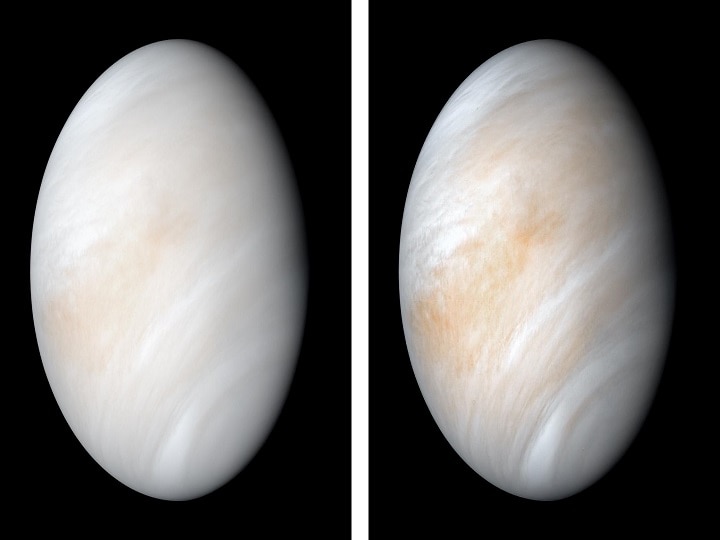
FILE PIC/solarsystem.nasa.gov
At a time when the world attention is centred on Coranavirus that has threatened the existence of human life, there is an exciting discovery hinting at the possibility of the presence of lifeforms on the neighbouring planet. A team of international team of astronomers revealed about the findings of a gas called phosphine in the harshly acidic clouds of Venus. The presence of phosphine indicates that microbes may inhabit Earth’s inhospitable neighbor, a tantalizing sign of potential life beyond Earth, as per the news agency Reuters. Also Read: After Victory In LDP Election, Yoshihide Suga Set To Replace Shinzo Abe As Japan's Prime Minister The existence of extraterrestrial life long has remained one of the most intriguing aspect of science. Scientists have used probes and telescopes to seek “biosignatures” – indirect signs of life – on other planets and moons in our solar system and beyond. Let us dig a bit more to understand the possibility of life in Venus. What is the exact finding? As per the paper published in Nature Astronomy, a team of scientists have reported traces of phosphine in a concentration of approximately 20 parts per billion, thousands to millions of times more than what could otherwise be expected. The international scientific team first spotted the phosphine using the James Clerk Maxwell Telescope in Hawaii and confirmed it using the Atacama Large Millimeter/submillimeter Array (ALMA) radio telescope in Chile. What is phosphine gas? Phosphine – a phosphorus atom with three hydrogen atoms attached – is highly toxic to people. Apart from being produced in industrial processes, phosphine, a colourless but smelly gas, is known to be made only by some species of bacteria that survive in the absence of oxygen. What is the possibility of life? There has no detection of actual life forms yet. However, the study points out that Earth phosphine is produced by bacteria thriving in oxygen-starved environments. In fact, this discovery was made in 2017, and the scientists checked and re-checked their data over the last three years before deciding to make it public. The discovery pointed out the presence of a chemical which is known to be produced only through biological process instead of any naturally occurring chemical process. Although the gas can also be produced in other ways such as in the underbelly of volcanoes or meteorite activity, but the concentration would have been much lower. These causes have been ruled out by scientists. “This is important because, if it is phosphine, and if it is life, it means that we are not alone. It also means that life itself must be very common, and there must be many other inhabited planets throughout our galaxy,” said co-author Clara Sousa-Silva of Massachusetts Institute of Technology molecular astrophysicist and study. However, scientists were extremely careful about the announcement and reiterated that it was not a confirmation of the presence of life on Venus. The findings of the gas in the planet is crucial because it is considered the most credible evidence hinting at the possibility of life other than Earth. In fact, the findings are significant from the view of scientist community than the discovery of water on the Moon or Mars. Can Venus actually support life? Among other things that are known to us about Venus is the temperature of the planet is extremely high besides atmosphere is highly acidic that makes it impossible for life to sustain. “But a long time ago, Venus could have had life on its surface, before a runaway greenhouse effect left the majority of the planet completely uninhabitable,” emphasised Sousa-Silva. In fact there is a possibility that phosphine could be remnants from a time when Venus was a much more hospitable place, believe scientist. It is too early to arrive at any conclusion of an exta terrestrial life in Venus. Scientist have clearly stated about the discovery that some exotic process is producing phosphine, and understanding of Venus needs work.
Top Headlines
Lifestyle

Mercury Sets Today, August 18: Professionals And Business Owners Should Avoid These Mistakes For The Next 32 Days
Lifestyle

Pet First | Is Your Cat Stressed? 10 Signs And Symptoms To Watch For
Lifestyle

Tulsidas Jayanti 2026: Date, Significance And Why Ramcharitmanas Was Written In Awadhi
Lifestyle

Raksha Bandhan 2026 Has A Rare Coincidence After Years; Here Are 5 Best Choghadiya For Rakhi














See Today's Weather 
powered by