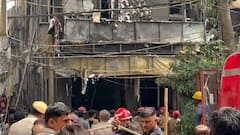
There are alleged illegal encroachments in the vicinity of the Faiz-e-Ilahi mosque near Turkmen Gate. When the matter reached the Delhi High Court, directions were issued to remove these encroachments, leading to a chaotic situation.
Explorer
Delhi Demolition Drive: Turkman Gate’s History And Why Bulldozers Returned After Decades | Explained
The 17th-century Mughal era structure had been a flashpoint in the past when slums were forcefully demolished during the Emergency.

A dispute over encroachments near Delhi's historic Faiz-e-Ilahi mosque at Turkmen Gate, built during Shah Jahan's reign and named after Sufi saint Shah Turkman, led to court-ordered removals and subsequent clashes.
Encroachment on government land is hardly new in India, stretching from major cities to small towns. Often, authorities act only after courts step in. A similar dispute has now unfolded in the national capital, reviving memories linked to one of Delhi’s most sensitive historic sites.
The controversy centres on the Faiz-e-Ilahi mosque near the historic Turkmen Gate and alleged illegal encroachments in its vicinity. When the matter reached the Delhi High Court and directions were issued to remove the encroachments, the subsequent action triggered chaos on the ground. Heavy police deployment, stone-pelting and the use of tear gas once again brought Turkmen Gate into the spotlight.
Turkman Gate: A Mughal-era landmark
Turkman Gate is one of the prominent gateways of Shahjahanabad, or Old Delhi, established by Mughal emperor Shah Jahan. Built in the 17th century, the gate dates back to a period when Delhi was being developed as a fortified imperial capital.
The structure is named after the Sufi saint Shah Turkman, whose dargah is located nearby. An annual urs is held in his memory, underscoring the area’s long-standing religious and cultural significance. Architecturally, Turkman Gate is a rectangular structure with three arched entrances and two-storey bastions, regarded as a notable example of Mughal design.
Separating History From Myth
Questions are often raised about a possible connection between Turkman Gate and Mughal ruler Aurangzeb. Historians note that there is no direct link. The gate was constructed during Shah Jahan’s reign, and while Aurangzeb was his son, Turkmen Gate has no specific historical association with him. Experts say the confusion is largely fuelled by incomplete historical knowledge and social media claims.
When Bulldozers First Arrived In 1976
Turkman Gate first became a national flashpoint on April 13, 1976, during the Emergency. Under the directions of Sanjay Gandhi, a large-scale slum clearance drive was launched in Delhi. Bulldozers reached the Turkmen Gate area, initially removing jhuggis amid limited resistance.
The decision soon sparked widespread anger across Old Delhi, including Jama Masjid, Chandni Chowk and Turkmen Gate. Calls for a general strike followed, with labour unions and Left-leaning groups organising protests. On April 19, 1976, the area turned into a battleground. As bulldozers advanced again, crowds poured onto the streets. Police responded with baton charges and tear gas, and several people were injured. The episode remains one of the most painful chapters in Delhi’s history.
Frequently Asked Questions
What is the current controversy surrounding the Faiz-e-Ilahi mosque?
What is Turkmen Gate and its historical significance?
Turkmen Gate is a prominent 17th-century gateway of Old Delhi, built by Mughal emperor Shah Jahan. It is named after Sufi saint Shah Turkman and is considered a notable example of Mughal architecture.
Is there a historical connection between Turkmen Gate and Aurangzeb?
Historians state there is no direct historical link between Turkmen Gate and Mughal ruler Aurangzeb. The gate was constructed during Shah Jahan's reign, and any perceived connection is likely due to incomplete historical knowledge.
What happened at Turkmen Gate in 1976?
During the Emergency, a large-scale slum clearance drive led to bulldozers being deployed at Turkmen Gate. This triggered widespread anger and protests, which escalated into clashes with police, marking a painful chapter in Delhi's history.

Top Headlines
Cities

Delhi Wakes Up To Cool Morning After Late-Night Rain; AQI Sees Improvement
Cities

‘Pakistan Is Protecting Kashmiris’: Farooq Abdullah's Remark Sparks Political Row
Cities

One Dead After Massive Fire Engulfs Over Four Shops In Noida Sector 126
Cities

'Dissatisfied? You're Not Alone': FIR Filed After Posters Questioning Govt Found Inside Delhi Metro Train






See Today's Weather 
powered by