




Explorer
Scientists Clone Monkeys For The First Time, Use The Same Process That Made Dolly The Sheep
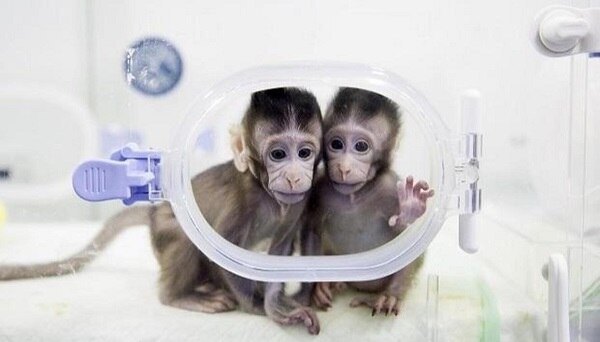
The birth of the now six and eight-week-old macaque babies also raises ethical questions about how close scientists have come to one day cloning humans.
PTI
Beijing: Scientists in China have created the first monkeys cloned by the same process that produced Dolly the sheep more than 20 years ago, a breakthrough that could boost medical research into human diseases. The two long-tailed macaques (Macaca fascicularis) named Hua Hua and Zhong Zhong were born at the Chinese Academy of Sciences (CAS) Institute of Neuroscience in Shanghai, and are the fruits of years of research into a cloning technique called somatic cell nuclear transfer.
"The barrier has been broken by this work," co-author Muming Poo, director of the Institute of Neuroscience of CAS Center for Excellence in Brain Science and Intelligence Technology, said. Until now, the technique has been used to clone more than 20 different animal species, including dogs, pigs and cats, but primates have proven particularly difficult.Chinese monkeys become the first primates in the world to be cloned https://t.co/c4INWDchiX
— Daily Mail Online (@MailOnline) January 24, 2018
The birth of the now six and eight-week-old macaque babies also raises ethical questions about how close scientists have come to one day cloning humans. Humans could be cloned by this technique, in principle, said Poo, though this team's focus was on cloning for medical research.
#signsfromthefuture: after the cloning of a sheep, that of a monkey. An additional step towards the cloning of a human being. And do not say it's impossible! Only a global governance contract may prevent it. Like so many other things!https://t.co/oy1h8ZxZoG — Jacques Attali (@jattali) January 25, 2018One day, the approach might be used to create large populations of genetically identical monkeys that could be used for medical research -- and avoid taking monkeys from the wild."In the United States alone they are importing 30,000 to 40,000 monkeys each year by drug companies," said Poo "Their genetic backgrounds are all variable, they are not identical, so you need a large number of monkeys. For ethical reasons I think having cloned monkey will greatly reduce the (number of) monkeys used for drug tests." Monkeys are commonly used in medical research on brain diseases like Parkinson's, cancer, immune and metabolic disorders. "The method used for these experiments is similar to that used to clone Dolly," in 1996 but with several "updates," said William Ritchie, an embryologist on the team that cloned Dolly the sheep at the Roslin Institute of the University of Edinburgh.
The process involves removing the nucleus from a healthy egg, and replacing it with another nucleus from another type of body cell. The clone becomes the same as the creature that donated the replacement nucleus. "We tried several different methods, but only one worked," said senior author Qiang Sun, Director of the Nonhuman Primate Research Facility at the Chinese Academy of Sciences Institute of Neurosciences. "There was much failure before we found a way to successfully clone a monkeyChina became the #first country to #clone a #monkey using non-reproductive cells, reducing the need to breed lab monkeys and paving the way for more accurate, effective and affordable animal tests for new #drugs. https://t.co/5TuiQY2fiQ
— China Daily (@ChinaDailyUSA) January 24, 2018
Top Headlines
World

EU Unveils New Arctic Strategy Amid Russia’s Military Build-Up, Trump’s Greenland Ambitions
News

‘Zero Tolerance For Terror’: Jaishankar To Rubio At Freedom 250 Reception In Mumbai
News

‘Very, Very Close’: Marco Rubio Says India-US Trade Deal Near Finalisation
India

Marco Rubio Pays Tribute To 26/11 Victims At Mumbai’s Taj Hotel









See Today's Weather 
powered by



