




Bhagwad Gita’s War Wisdom — 10 Verses That Go Beyond The Battlefield
In the stillness before battle, the Bhagavad Gita unfolds — not as a call to violence, but as a guide to duty, detachment, and the inner war every soul faces. Here are 10 Gita verses on what war means

When Arjun was torn between duty and despair, facing his own in the battlefield of Kurukshetra at the beginning of the Mahabharat war, his charioteer, Lord Krishna, the divine incarnate, stopped for a dialogue. What unfolded was not merely a conversation between two individuals, but a profound spiritual treatise on war, morality, and the human conditioning.
The Bhagavad Gita, delivered in the calm before battle, is not a glorification of violence, but a confrontation with inner conflict. It speaks to every age — not just of external war, but of the wars within: between action and inaction, righteousness and attachment, self-doubt and higher purpose. Across its 18 chapters and 700 verses, the Gita offers a moral compass in times of ethical uncertainty.
Here are ten pivotal verses that encapsulate the Gita’s core principles of war — not just as armed conflict, but as a metaphor for life’s greatest struggles, shedding light on dharma (duty), detachment, fearlessness, the idea of righteous action without the desire for a reward, and what it means to fight with purpose, and more importantly, with clarity.
1. "Sribhagwan uvacha:
Ashochyananvashochastwam pragyavadanshcha bhashase
Gatasunagatasunshcha naanushochanti panditah."
(You grieve for those who should not be grieved for, yet you speak words of wisdom. The wise mourn neither for the living nor the dead.) — Chapter 2, Verse 11
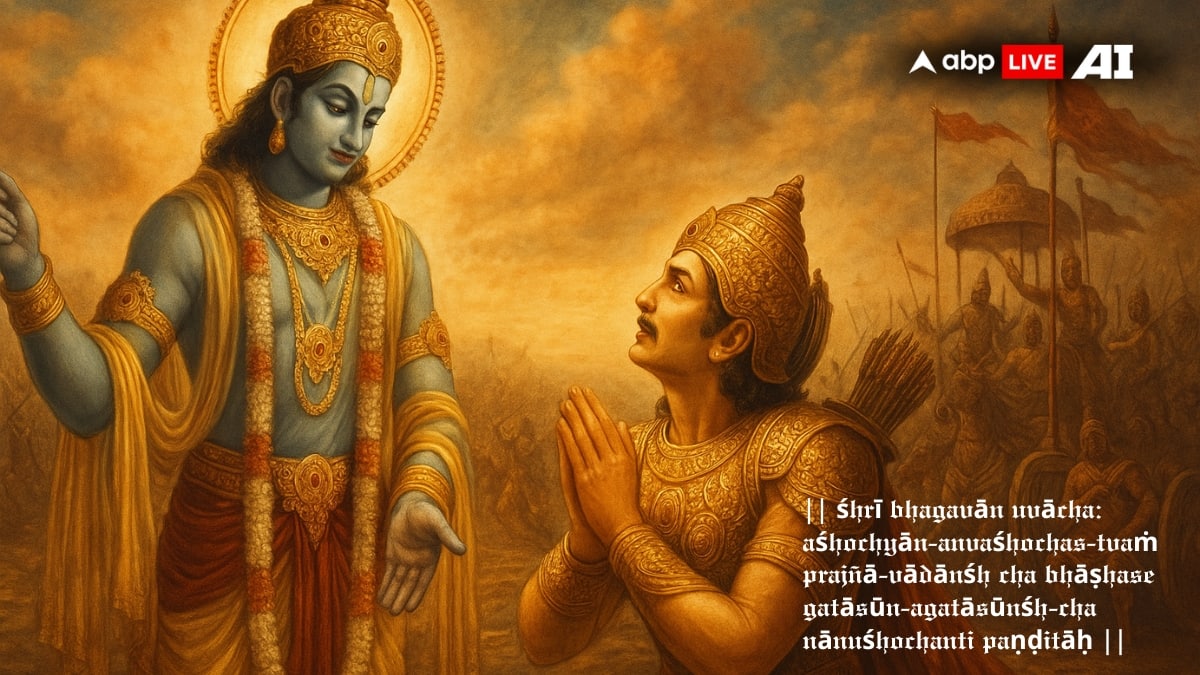
This verse marks the beginning of Lord Krishna’s profound response to Arjuna’s inner turmoil, laying the philosophical foundation of the Gita. Arjuna, overwhelmed by sorrow at the thought of killing his kin, is gently but firmly rebuked by Krishna who points out that war, when fought in the service of duty, must not be clouded by personal emotions like sorrow, fear, or attachment.
2. "Yadrichchhaya chopapannam swarga-dwaramapavritam
sukhinah kshatriyah partha labhante yuddhamidrisham."
(O Partha (Arjuna), happy are the Kshatriyas who gain such a battle that comes of its own accord, opening for them the doors to heaven.) — Chapter 2, Verse 32
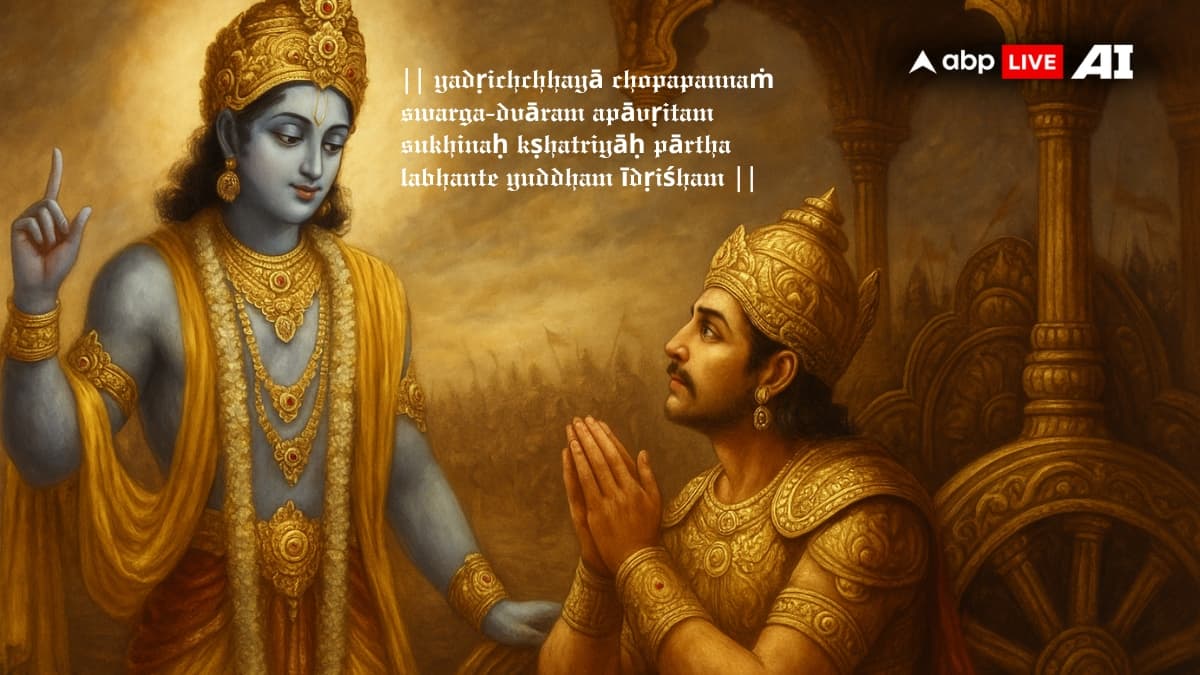
In this verse, Krishna tells Arjuna that the opportunity to fight a righteous war — especially one that arises uninvited — is a rare and honourable one for a Kshatriya (warrior class). Such a battle is likened to a gateway to heaven, suggesting that fulfilling one’s duty with courage and detachment leads to spiritual merit.
3. "Atha chetatvamimam dharmyam sangramam na karishyasi
Tatah sva-dharmam kirtim cha hitva paapamavapsyasi."
(But if you do not engage in this righteous battle, then, abandoning your own duty and honor, you will incur sin.) — Chapter 2, Verse 33
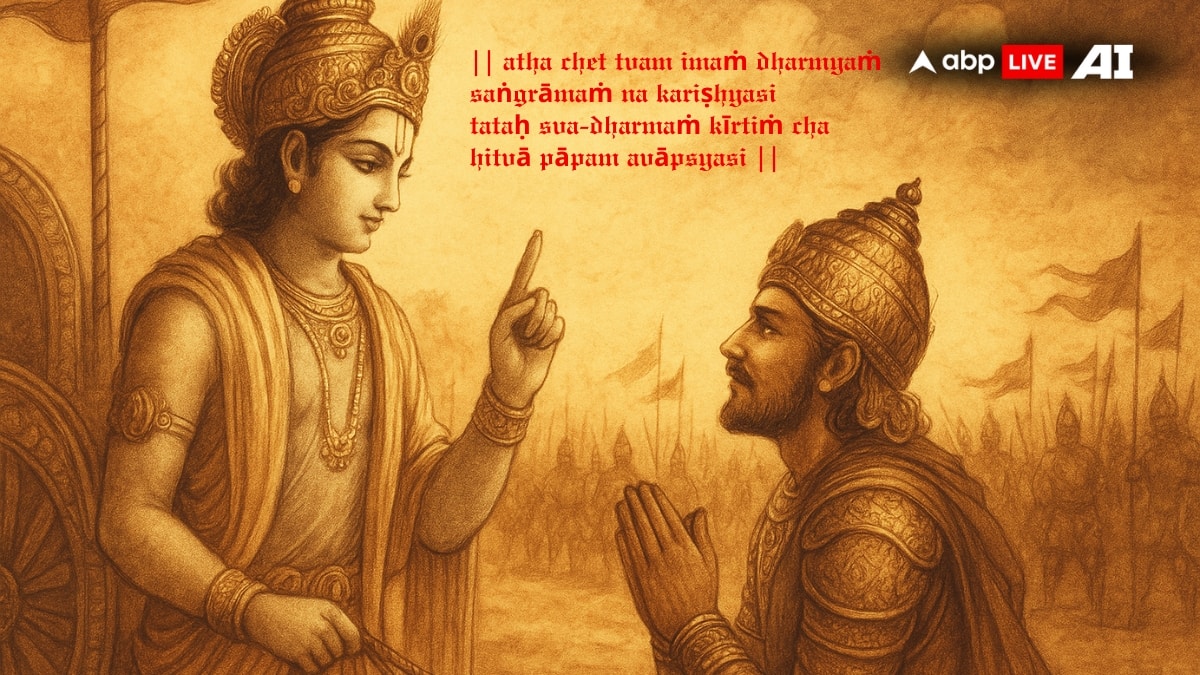
This verse follows immediately after Krishna talks about the value of a righteous war in Verse 32. In this one, he warns of the consequences of inaction, saying if Arjun refuses to fight, not out of spiritual renunciation but due to confusion and attachment, he will be turning his back on his "svadharma", which is his personal and social duty as a Kshatriya. Such abandonment would not be seen as virtue, but as moral failure, because failing to act rightly in the face of a just cause leads not to peace, but to guilt and loss of purpose, He said.
4. "Akirtim chapi bhutani kathayishyanti te’vyayaam
Sambhavitasya chakirtirmaranadatirichyate"
(People will forever speak of your infamy, and for one who has been honoured, dishonour is worse than death.) — Chapter 2, Verse 34
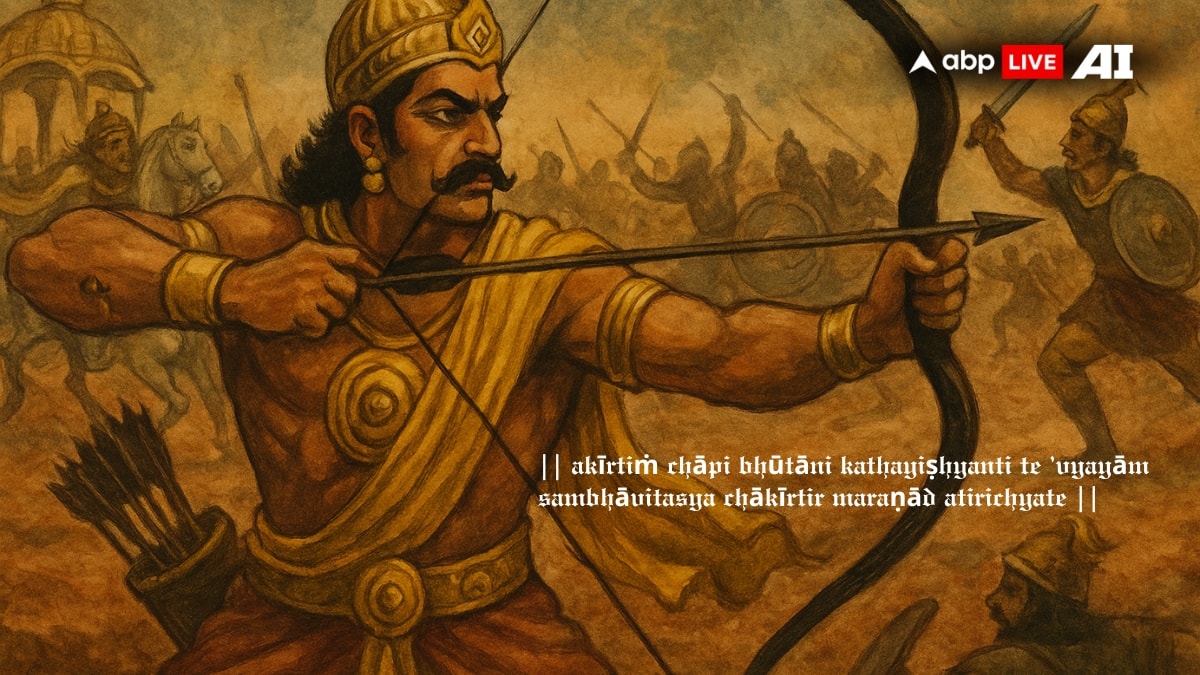
Krishna now appeals to Arjun's sense of honour and legacy, addressing worldly repercussions — how society perceives a warrior who shuns righteous action. He says that dishonour would be more unbearable than death, because the shame of turning away from duty, especially in front of those who look up to him, would not fade and instead become a stain on his name forever.
5. Hato va prapsyasi swargam jitva va bhoksyase mahim
Tasmaaduttistha kaunteya yuddhaya krita-nischayah.
(If you are slain, you will attain heaven; if you conquer, you will enjoy the earth. Therefore, O Kaunteya (Arjuna), rise up with a firm resolve to fight!) — Chapter 2, Verse 37

In this verse, Krishna drops all ambiguity. He presents both possible outcomes of war — not in terms of fear or loss, but as equally noble paths: If slain in battle, Arjun, as a warrior dying for dharma, would ascend to heaven, which is the reward for valour and righteousness; and if he emerges victorious, he would rule and enjoy the earthly fruits of his effort. Essentially, either path leads to dignity and purpose, and not defeat.
6. "Sukha-duhkhe same kritvaa labhalabhau jayajayau
Tato yuddhaya yujyasva naivam paapamavapsyasi"
(Having made pleasure and pain, gain and loss, victory and defeat the same, then engage in battle. Thus, you shall not incur sin.) — Chapter 2, Verse 38

This verse strikes at the heart of the Bhagavad Gita’s philosophy of detached action. Krishna instructs Arjuna to rise above dualities such as 'pleasure and pain', 'gain and loss', and 'victory and defeat', and act without clinging to outcomes. By doing so, Krishna assures, one will not incur sin — because that's done in the spirit of dharma, without selfish attachment.
7. "Karmaṇyevaadhikaraste ma phaleshu kadaachana
Ma karma-phala-heturbhurma te sango’stvakarmani"
(You have the right to perform your prescribed actions, but never to the fruits of those actions. Let not the fruits of action be your motive, nor let your attachment be to inaction.) — Chapter 2, Verse 47
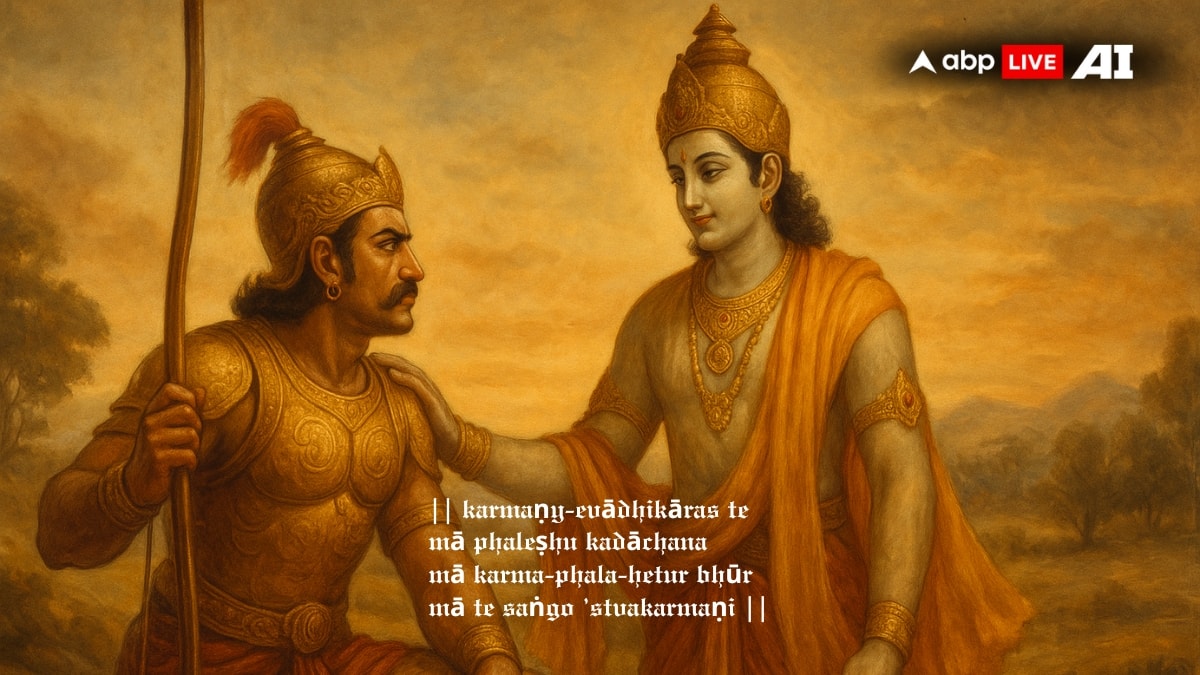
A cornerstone of the Gita's teaching, this verse talks of selfless action. In the context of war, this teaching is considered revolutionary as Krishna tells Arjun to perform his duty as a warrior — not for glory, revenge, or even peace, but because that's his righteous path.
These words are Krishna’s ultimate guide to doing one’s dharma with detachment, focusing on the 'purity of intention and effort, rather than success or failure.
8. "Dronam cha Bhishmam cha Jayadratham cha
Karnam tathaanyanapi yodha-veeran
mayaa hatanstvam jahi ma vyathishthaa
yudhyasva jetasi rane sapatnan"
(Dron, Bhishma, Jayadrath, Karn, and other brave warriors have already been slain by Me. Therefore, do not hesitate, just fight. You will conquer your enemies in battle.) — Chapter 11, Verse 34
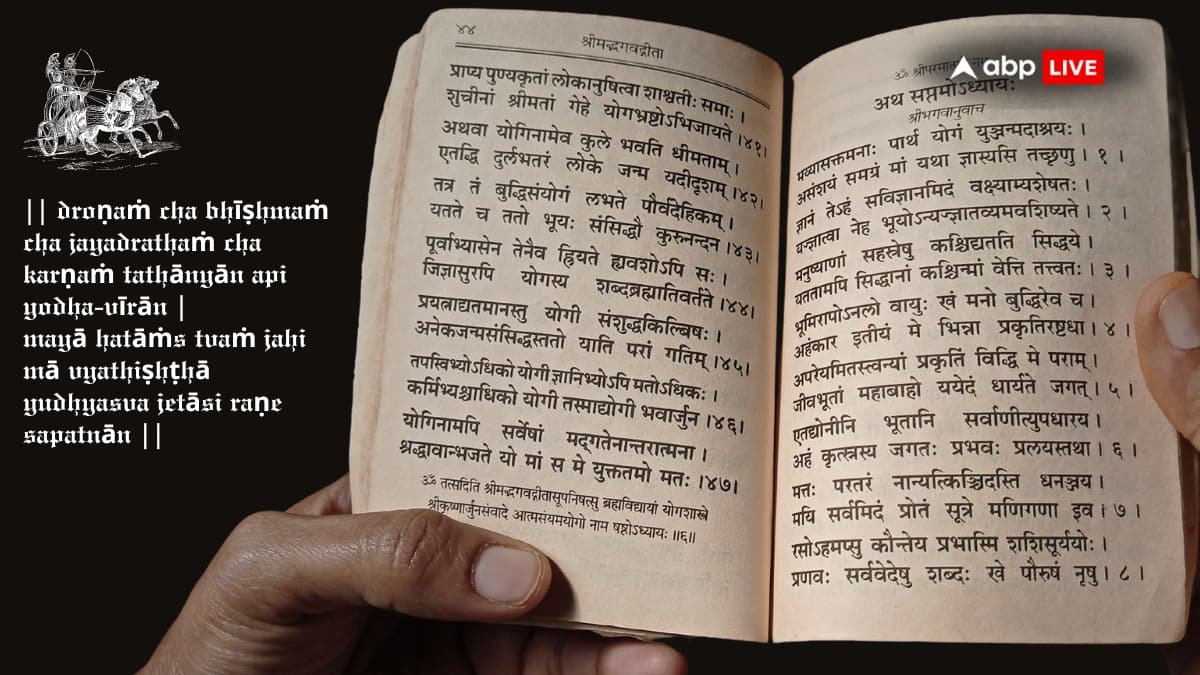
This verse is a climactic moment in the Gita. Krishna, having now revealed in his 'Vishwaroop' (universal form), tells Arjun that the key warriors he fears — Dron (his guru), Bhishma (his grandsire), Karn, and others — are already doomed by divine will. Their destruction is inevitable, and Arjun is merely the instrument (nimitta-maatra). The words redefine the battlefield as a divine stage, where human beings are channels of cosmic will. Krishna tells Arjun that moral hesitation must give way to righteous execution when the cause is just and aligned with Dharma — war is no longer personal, but part of a larger order.
9. "Yadahankaaramashritya na yotsya iti manyase
Mithyaisha vyavasayaste prakritistvam niyokshyati"
(If, out of ego, you think 'I will not fight', this decision of yours is in vain. Your very nature will compel you to fight.) — Chapter 18, Verse 59
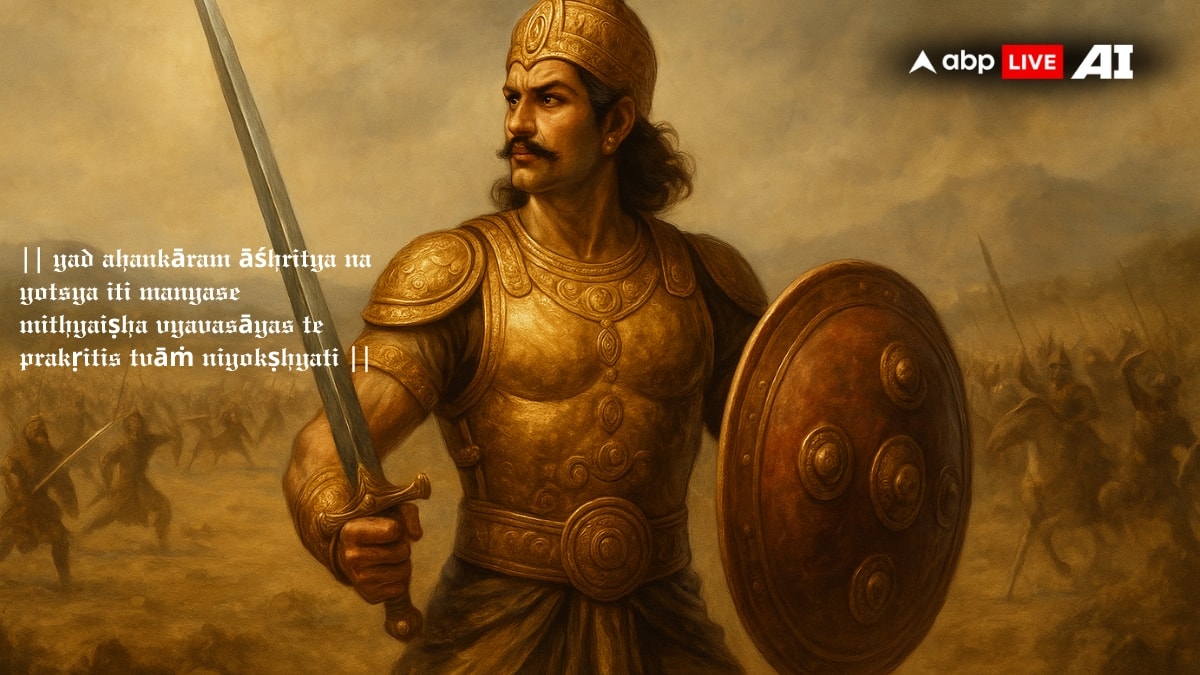
This verse is a sharp reminder from Krishna to Arjun, who was overwhelmed by sorrow at the thought of killing his kin, that he could not deny their destiny. "Your own essential nature — prakriti — will ultimately pull you toward it," he says. For Arjun, who was born a warrior, this means he cannot avoid battle because renouncing action out of ego would be escapism and not liberation.
10. "Svabhava-jena kaunteya nibaddhah swena karmana
Kartum nechchhasi yan-mohatkarishyasyavasho’pi tat"
(O Kaunteya (Arjun), bound by your own duty born of your nature, that which you do not wish to do due to delusion — you will still do it, helplessly, being driven by your own nature.) — Chapter 18, Verse 60
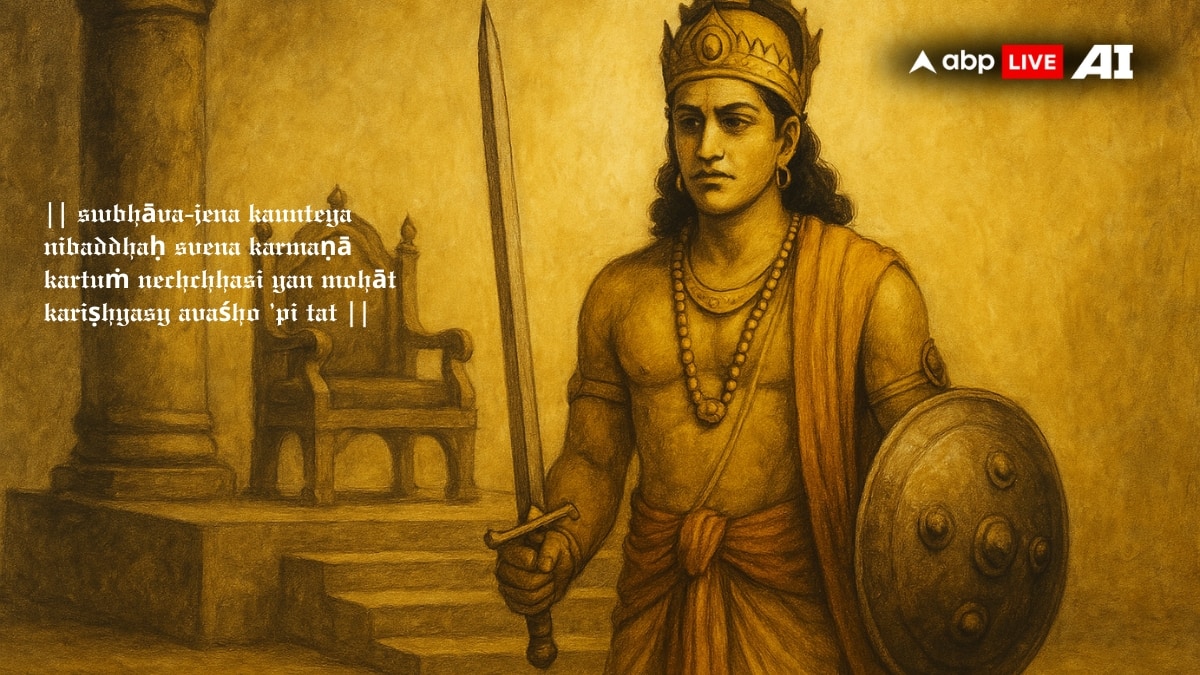
In a follow-up to His previous verse, Krishna continues the assertion that Arjun’s very being is inseparably tied to his duty as a warrior. This is one of the Gita’s strongest declarations of psychological realism that we may rationalise or resist, but we are shaped and moved by the deep undercurrents of our inner nature.
Top Headlines






