Ukraine and Saudi Arabia are actively developing a strategic security arrangement in three key areas: export of Ukrainian security expertise in air defense, energy cooperation for Ukraine's resilience, and food security.
Explorer
Volodymyr Zelenskyy In Saudi Arabia: Key Talks On Security, Energy And Food Cooperation
Russian President Putin "may or not may not" attend the G20 in Miami in December, says the Kremlin. Meanwhile, after securing an EU loan, Ukrainian President Zelenskyy continued his diplomatic offensive in Saudi Arabia.
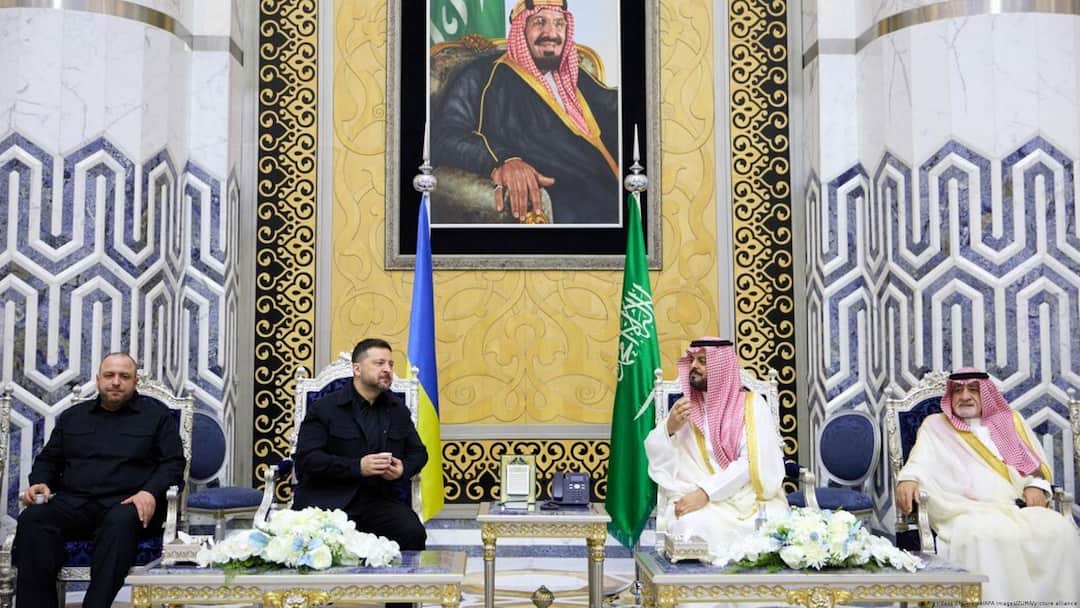
Volodymyr Zelenskyy meets Mohammed bin Salman in Jeddah to discuss security, energy, and strategic cooperation.
Source : DW
- Zelenskyy and Saudi Crown Prince discuss security, energy, and food cooperation.
- Russia invited to December G20 meeting, Putin's attendance uncertain.
- EU approves loan for Ukraine, but immediate membership remains distant.
Edited by: Dmytro Hubenko
Ukrainian President Volodymyr Zelenskyy arrived in Jeddah, Saudi Arabia, on Friday where he said he held a "very productive meeting" with Crown Prince Mohammed bin Salman.
"There is a strategic security arrangement that we are actively developing across three key areas," Zelenskyy wrote on social media.
"The first is the export of Ukrainian security expertise and capabilities in air defense. The second is energy cooperation, which makes Ukraine more resilient in this difficult time. The third is the area of food security," he added.
For Zelenskyy, who is being accompanied by Ukrainian Foreign Minister Andrii Sybiha and national security adviser Rustem Umerov, it's a second visit to Saudia Arabia in a matter of weeks.
"Today, we are advancing our agreements with Saudi Arabia in the areas of security, energy, and infrastructure," Zelenskyy said, adding that he appreciated the "substantive cooperation" between the two countries.
Since the start of the US-Israeli war with Iran and the resulting Iranian drone strikes on US allies across the Middle East, including Saudi Arabia, Ukraine has launched a diplomatic offensive in the region, offering Gulf states its hard-earned expertise in anti-drone warfare in return for financial, military and diplomatic support in its own fight against the ongoing Russian invasion.
"It is important that the strengthening is mutual," said Zelenskyy, especially since Russia is also looking to restore its diplomatic standing globally — with the helpful of a sympathetic United States.
Miami G20: will Vladimir Putin attend?
The Reuters news agency reported on Friday, citing a US official, that Russia had accepted an invitation to the annual Group of 20 (G20) meeting which Washington is hosting in Miami, Florida, in December.
"As a member of the G20, Russia has been invited to all working-level meetings to date," a State Department spokesperson said on Thursday. "President [Donald] Trump has been clear that Russia is welcome to attend all G20 meetings as the United States focuses on delivering a successful and productive summit."
Whether Russia would be represented by President Vladimir Putin in person, however, is another question.
Putin has not attended a G20 summit since 2019 due first to the COVID-19 pandemic and then to his diplomatic isolation following the full-scale invasion of Ukraine in 2022. But he did travel to Anchorage, Alaska, to meet US President Trump on US territory in August 2025.
"President Putin may go to Miami as a member of the G20, or he may not go," Kremlin spokesman Dmitry Peskov told Russian state on Friday. "Or another Russian representative may go."
Trump said on Thursday that Putin's personal attendance would be "helpful" and that it had been a mistake to expel Russia from the G8.
"He was very offended by that," he said. "I'd venture to say you probably wouldn't be having these problems if you didn't throw him out." Trump said he believed in talking to "everybody" but added: "I doubt he'd come, to be honest with you."
Ukraine and the EU: Merz rules out immediate accession
With Trump's second administration appearing increasingly sympathetic towards Russia, Ukraine continues to boost diplomatic ties elsewhere — not only in the Middle East, but closer to home in Europe.
Following the electoral defeat of right-wing populist Hungarian Prime Minister Viktor Orban earlier this month, Budapest dropped its veto on a €90 billion ($105 billion) European Union loan to Kyiv, which was formally approved on Thursday.
"This money is for our army, and we are ready to buy weapons with it, including air defense," said Zelenskyy, thanking the EU. "It is also funding that will help us prepare for [next] winter, and work has already started to protect our energy system."
He has also used the opportunity to reiterate his call for full Ukrainian membership of the EU, telling journalists after an EU summit in Cyprus earlier on Friday: "We are defending common European values. I believe that we deserve full-fledged EU membership."
European Council chief Antonio Costa, who chairs EU summits, said Kyiv had taken "very impressive" strides to implement pro-democratic and anti-corruption reforms even during wartime.
However, he cautioned that the painstaking negotiations towards membership were "a long process, a very hard one" and declined to put any timeframe on eventual Ukrainian accession, saying: "We cannot try to fix artificial moments."
Simultaneously, German Chancellor Friedrich Merz also insisted there was no prospect of fast-track Ukrainian accession to the bloc. "It is clear to everyone that an immediate accession of Ukraine to the EU is, of course, not possible," he said.
Nevertheless, Merz also called on European allies not to let up in their support Kyiv.
"I have appealed to my colleagues not to use [the approval of] this loan as an opportunity to row back on or even abandon bilateral agreements with Ukraine," he said, rejecting the notion that Germany would cut its planned €11.5 billion of military aid to Ukraine this year.
"We need cooperation on the bilateral level between Ukraine and individual member states and we need the collective effort as the European Union [in the form of] this loan," he added.
European Commission President Ursula Von der Leyen said: "While Russia doubles down on its aggression, we are doubling down on our support to the brave Ukrainian nation, enabling Ukraine to defend itself and putting pressure on Russia's war economy."
Russian economy under strain
And Russian economy is showing signs of strain, contracting by 1.8% in the first two months of 2026, as President Putin admitted this week, demanding measures from his cabinet to arrest the slowdown.
The Russian Central Bank had previously predicted 1.6% growth in the first quarter but its Board of Directors have now been forced to cut the interest rate by 50 basis points to 14.5% in an attempt to reinvigorate the economy.
Inflation in Russia is officially just over 5%, but Russians are feeling the effects of over five years of war in Ukraine, especially in the disproportionately increased costs of basic everyday products.
Increasing Ukrainian drone attacks on the Russian oil industry are also making themselves felt as Kyiv continues to carry the war back into the country which launched it. In addition to the impact on oil production itself, the frequent disruption to internet connections is also causing problems for sectors that rely heavily on digital technology.
Russia has benefited slightly from increased demand for its oil given the ongoing closure of the Strait of Hormuz, but central bank governor Elvira Nabiullina urged caution on the impact of the conflict in the Middle East.
"The situation in the Middle East remains a factor of uncertainty," she said. "If the conflict drags on, the adverse effects for the Russian economy will be strengthening."
Ukraine-Russia prisoner swap
Meanwhile, Russia and Ukraine have concluded a prisoner swap involving 193 captured soldiers each.
Members of the Ukrainian army, National Guard, Border Guard and National Police have returned home, Zelenskyy confirmed on Friday, saying: "They defended Ukraine on various fronts. It is important that exchanges are taking place and that our people are returning home."
The Russian Ministry of Defense said that the released Russian servicemen were still in Belarus, where the exchange, mediated by the United States and the United Arab Emirates, had taken place.
Elsewhere, however, two senior Ukrainian officers have reportedly been removed from their posts after falsifying battlefield situation reports and failing to ensure that adequate supplies reached front line troops.
Ukraine's General Staff said on Friday that the commanders had "lost a number of positions and made mistakes in sending supplies to soldiers."
According to the statement, the affected front sections are east of the Oskil river near the city of Kupiansk in northeastern Ukraine.
A day earlier, the daughter of a service member had drawn attention to the difficult supply situation by publishing images of emaciated soldiers. "The boys don't have food or water!" she wrote. "The fighters are fainting from hunger, drinking rainwater."
Another woman claimed her husband's unit had gone 17 days without food. "When the lads arrived at the frontlines, they weighed over 80–90 kilograms (170-200lbs), but now they weigh around 50 kilograms (110lbs)," she said. "They weren't listened to on the radio, or perhaps no one wanted to listen to them."
The army acknowledged logistical problems in the sector, where the Russians actively target Ukrainian supply and evacuation drones.
"Everything is done by drone," said a spokesman. "The Russians pay maximum attention to the deliveries of food, ammunition and fuel. They intercept and shoot down as much as possible. Sometimes they are not so interested in our military equipment as in logistics."
Disclaimer: This report first appeared on Deutsche Welle, and has been republished on ABP Live as part of a special arrangement. Apart from the headline, no changes have been made in the report by ABP Live.
Before You Go
Jharkhand: Jharkhand Government Holds Third Round of Talks With Student Groups Ahead of Assembly Gherao
Frequently Asked Questions
What are the key areas of security cooperation between Ukraine and Saudi Arabia?
What is the current status of Ukraine's potential accession to the EU?
While Ukraine has made impressive strides, EU membership is a long and difficult process. Immediate accession is not possible, and no timeframe has been set for eventual membership.
How is the Russian economy being affected by the war?
The Russian economy is showing signs of strain with a contraction in early 2026. Inflation is present, and increased costs of basic products are being felt by citizens.

Top Headlines
World

Canada Declares Emergency In British Columbia As Wildfire Forces 20,000 To Flee
World

Indian-Origin Woman's Partner Arrested Seven Months After Her Murder In Canada
World

Pakistan Bows To PoK Resistance, Defers Polls In 7 Poonch Seats After Aman Khan's Aug 5 Ultimatum
World

Iran Issues List Of Demands For Hormuz Reopening As Oman Deal Nears 'Final Stages'








See Today's Weather 
powered by