What Makes Nehru's 'Tryst With Destiny' Speech In 1947 Relevant For India Even Today? VIDEO
Jawaharlal Nehru’s iconic 'Tryst with Destiny' speech still speaks to India in 2025 — on unity, justice, and responsibility. Read how PM Modi's speech adheres to those core ideas of India.

On the night of August 14-15, 1947, Pandit Jawaharlal Nehru, India's first Prime Minister, stepped before the newly formed Constituent Assembly at the stroke of midnight. His inaugural address, "Tryst with Destiny", still rings loud.
Scholars still count "Tryst with Destiny" among the greatest speeches of the 20th century. There's clarity, rhythm, and poetry; but no artifice. Sentiment, insight, rhythm, all delivered in calm, deliberate tones.
Why Nehru's speech still holds good? We shall look at that in a bit. But first, let's revisit his words on the intervening night of August 14 and 15, 1947.

What Did Nehru Say In His 'Tryst With Destiny' Speech?
"Long years ago, we made a tryst with destiny, and now the time comes when we shall redeem our pledge, not wholly or in full measure, but very substantially. At the stroke of the midnight hour, when the world sleeps, India will awake to life and freedom."
He didn't just celebrate liberation; he challenged the nation and framed independence not as an end, but a beginning: "That future is not one of ease or resting but of incessant striving so that we might fulfil the pledges we have so often taken and the one we shall take today. The service of India means the service of the millions who suffer. It means the ending of poverty and ignorance and disease and inequality of opportunity."
He did not isolate India in its celebration. He pulled the vision wider and predicted India would not stand alone: "We have to labour and to work and work hard to give reality to our dreams. Those dreams are for India, but they are also for the world, for all the nations and peoples are too closely knit together today for any one of them to imagine that it can live apart."
Then came the tone setters: "This is no time for petty and destructive criticism, no time for ill-will or blaming others. We have to build the noble mansion of free India where all her children may dwell."
And, his closing note still echoes: "A new star rises, the star of freedom in the East... May the star never set and that hope never be betrayed."
Watch The Speech Below:
Why Nehru's 1947 Speech Still Resonates in 2025
Vision Beyond Politics
Nehru's appeal wasn't inked in geography or religion. It was humanist, idealist, globalist. His speech threaded a universal urgency: social justice, unity, uplift. That's why leaders, activists, and even schools return to it every Independence Day and still feel its pull. Even in 2025, PM Narendra Modi spoke about social justice and upliftment of farmers, fishermen, animal herders, and others. He also spoke about how India has become a self-reliant beacon in the world and how he is working for the upliftment of the poor, Dalits, and victims of social inequality.
Ethos of Equality & Responsibility
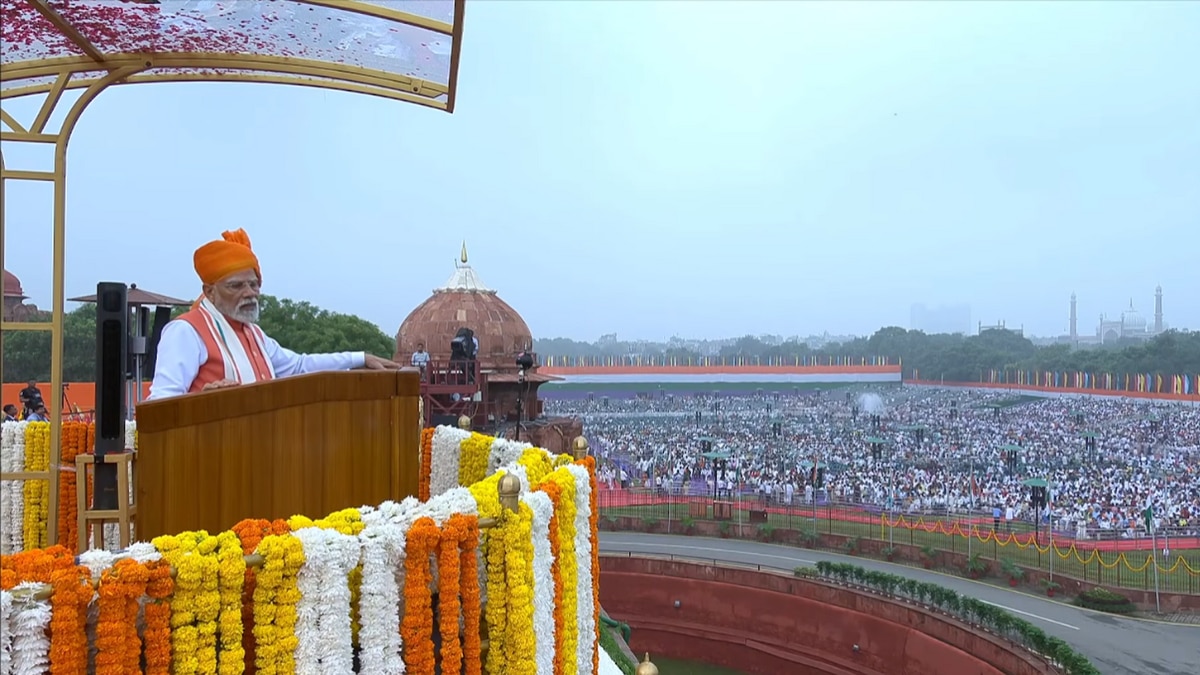
Turn on any election debate, and phrases like "serve the suffering," "wipe every tear," "no petty criticism," feel pulled straight from Nehru. In times of polarisation, his urgency for broad-minded leadership still speaks. PM Modi, in his Red Fort speech on August 15, 2025, too, praised Nehru for his contribution to India's Constitution, which ensures equality for all and sets in place responsibility for every citizen of India.
Endurance Of Nehru's Ideals
The speech is aspirational without being naïve. It accepts that the work is hard and unfinished, but insists it must be done. That mix of hope and realism is still relevant in today's political discourse — a trait seen in Prime Minister Narendra Modi. In his August 15, 2025, Independence Day speech, he called on citizens not just to contribute to the development of the nation, but also towards a healthy India.
Relevance Of Nehru's Global View In Today's World
In a globally networked age, his line that prosperity, peace and even disasters are indivisible, matters more than ever. Whether it's climate change, pandemics, or refugee crises — Nehru's sense of shared fate is eerily timely. In the present times, alliances have become more important than ever. But more than that, Nehru's policy of non-alignment has become crucial. Today, as India negotiates Donald Trump's tariff impositions, while striking a balance with other nations, Nehru's words echo louder.
Nehru didn’t stop at independence. He began the conversation. In 2025, it's ours to continue.
Watch PM Modi's 2025 Independence Day Speech Below:
Before You Go
Mountain Rain Havoc: Heavy Rains Trigger Flash Floods and Landslides in Hills, One Missing, Seven Rescued in J&K

Top Headlines