Explorer
Ayodhya Verdict Explainer: 10 Major Takeaways
A five-judge bench led by Chief Justice Ranjan Gogoi unanimously decided that the disputed land must be given to Hindus and ordered the Central government to form a trust for the construction of a temple, bringing to a close the longest-drawn controversy in the country's history that has become one of the most defining aspects of its polity.
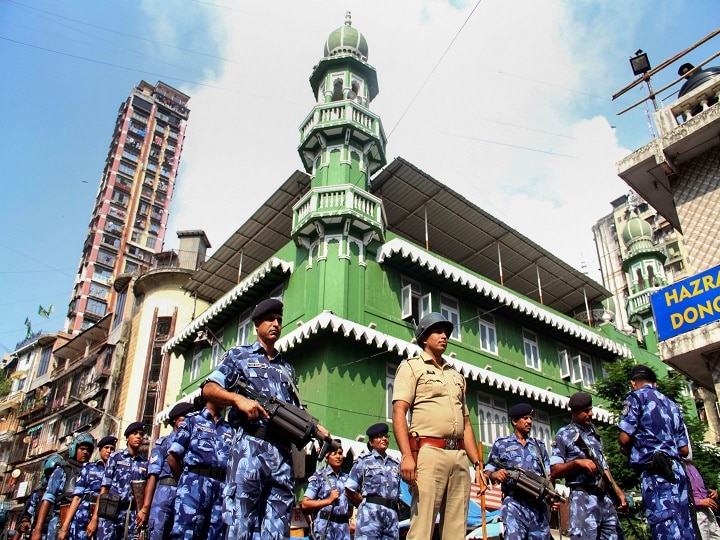
Mumbai: Rapid Action Force (RAF) personnel deployed on street as a precautionary measure ahead of Supreme Court's historic judgement on the Ayodhya land dispute, in Mumbai, Saturday, Nov. 9, 2019. The apex court on Saturday cleared the way for the construction of a Ram Temple at the disputed site at Ayodhya, and directed the Centre to allot a 5-acre plot to the Sunni Waqf Board for building a mosque. (PTI Photo)
New Delhi: In what will go down in history as one of its most landmark verdicts, the Supreme Court on Saturday granted the ownership of the 2.77 acres of disputed land in Ayodhya to the Hindus, paving the way for the construction of a Ram Temple, and ruled that the Muslims will get 5 acres of land at an alternative site. A five-judge bench led by Chief Justice Ranjan Gogoi unanimously decided that the disputed land must be given to Hindus and ordered the Central government to form a trust for the construction of a temple, bringing to a close the longest-drawn controversy in the country's history that has become one of the most defining aspects of its polity. Here are the 10 salient points from the SC verdict:
- The apex court ruled that Hindus will get the disputed land subject to conditions. The 2.77-acre complex will be handed over to the trust, which has to be formed within three months. The management of of the temple construction will be monitored by the trust. The Centre must appoint a board of trustees within three months.
- Muslims will get alternative land of 5 acres for the construction of a mosque. The apex court ruled that Muslims couldn't prove exclusive possession of the inner courtyard, which was in contention, while the outer courtyard was in exclusive possession of the Hindus.
- The SC held that the Allahabad High Court was wrong to divide the land between the three main parties -- Ram Lalla Virajman, Nirmohi Akhara and the Sunni Waqf Board -- as the complex was a composite whole.
- The landmark verdict was read out by a five-judge bench led by Chief Justice of India Ranjan Gogoi and also comprising CJI-designate S.A. Bobde, D.Y. Chandrachud, Ashok Bhushan and S. Abdul Nazeer.
- CJI Ranjan Gogoi, who retires on November 17, decided the date of the verdict in consultation with the four other judges after 40 days of daily hearing, making it the second longest hearing in the top court.
- Under Article 142, the SC directed, in the scheme to be framed, Nirmohi Akhara, an order of ascetics, will also get representation. The Akhara's suit, one of the main parties in the case, was dismissed as the bench held that it was barred by limitation. The SC also rejected that Nirmohi Akhara is a shebait (manager) of the complex. "Land to remain vested in statutory receiver till trust is formed," ruled the court.
- The five-judge bench unanimously rejected the Shia Waqf Board petition, claiming that the rights on the Babri Masjid on the disputed land in Ayodhya were over that of the Sunni Waqf Board.
- The Supreme Court said that the 2003 Archaeology Survey of India's (ASI) report can't be dismissed as conjecture or just a guess work and junked the theory of pre-existence of an Idgah at the disputed site. "Babri mosque wasn't constructed on a vacant land. An underlying structure did exist," it said.
- The apex court also said that the underlying structure was not of Islamic religion. Artefacts, architectural evidence had distinct non-Islamic nature, said CJI Gogoi. At the same time, the top court also said, "But ASI report hasn't said the underlying structure was a specific temple."
- The apex court said that Hindus consider Ayodhya as the birthplace of Lord Ram. "Faith of Hindus is undisputed that Lord Ram was born in Ayodhya," ruled the court. Faith, the judgement read, is a matter of individual belief.
Top Headlines
India

CJP Protest Live: Dipke Leaves For Delhi Ahead Of Jantar Mantar Protest Today
India

Panama-Flagged Oil Tanker Hit In Drone Attack Off Sharjah; All 22 Indian Crew Members Safe
India

Victory smiles on those who anticipate changes in character of warfare: IAF chief
India

'Matter of pride for all Indians': Cong hails Pillay on Nobel Peace Prize win







See Today's Weather 
powered by