Jupiter's Temperature Shifts Have 'Unexpected Patterns', 40-Year NASA Study Finds
As temperatures went up at specific latitudes in the northern hemisphere, they went down at the same latitudes in the southern hemisphere, like mirror images on either side of the equator.
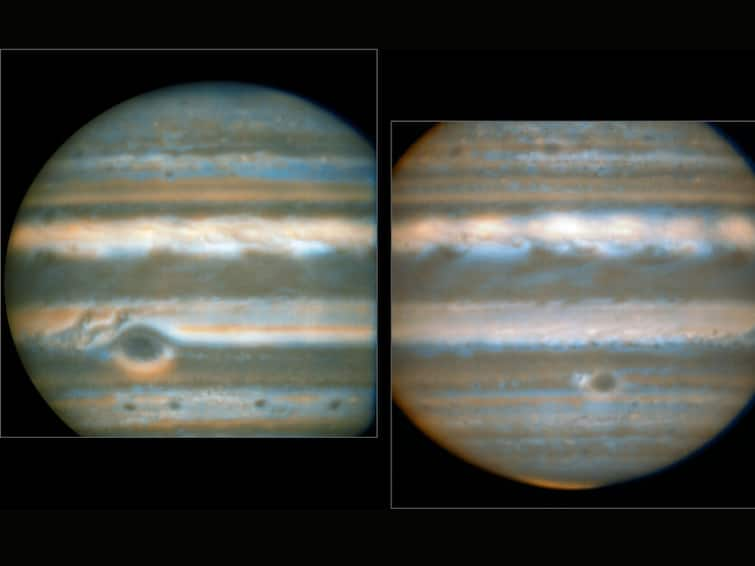
Jupiter's temperature changes occur in unexpected and mysterious patterns, the longest-ever study tracking temperatures in the gas giant's upper troposphere has found. Jupiter's troposphere is the region where the planet's weather occurs, and where its signature colourful striped colours form.
The study, conducted over forty years by collecting data from NASA spacecraft and ground-based telescope observations, was published December 19 in the journal Nature Astronomy.
Unexpected patterns in Jupiter’s temperature shifts
There are unexpected patterns in the manner in which temperatures of Jupiter's belts and zones change over time. The findings of the study could help scientists better understand what drives the weather at the solar system's largest planet, and might eventually help them forecast it.
Similar to Jupiter's troposphere, clouds form and storms churn in Earth's counterpart. Scientists studied properties such as wind, humidity, pressure and temperature to understand Jupiter's weather activity. Since NASA's Pioneer 10 and 11 missions in the 1970s, it was known in general that colder temperatures are associated with Jupiter's lighter and whiter bands, called zones, while warmer temperatures are associated with the gas giant's darker brown-red bands, called belts.
However, there were not enough data sets to understand how the temperatures of Jupiter's belts and zones vary over the long-term. The new research is a breakthrough because it reveals how scientists studied images of the bright infrared glow that rises from warmer regions of Jupiter's atmosphere. Also, scientists directly measured Jupiter's temperatures above the colourful clouds. These images were collected at regular intervals over three of Jupiter's orbits around the Sun, each of which lasts 12 Earth years.
Temperature changes appear like mirror images on either side of Jupiter’s equator
The scientists found that Jupiter's temperatures rise and fall following definite periods that are not tied to the seasons or any other cycles scientists know about. They did not expect to find temperatures on Jupiter varying in regular cycles because the gas giant has weak seasons. This is because Jupiter is tilted on its axis only three degrees, while Earth is tilted 23.5 degrees.
The scientists found a mysterious connection between temperature shifts in regions thousands of kilometres apart. According to the study, as temperatures went up at specific latitudes in the northern hemisphere, they went down at the same latitudes in the southern hemisphere, like mirror images on either side of the equator.
In a statement released by NASA, Glenn Orton, senior research scientist at NASA's Jet Propulsion Laboratory and lead author on the paper, said the temperature shifts occurring in mirror image patterns was the most surprising of all. He added that the scientists found a connection between how the temperatures varied at very distant latitudes. The manner in which temperatures change at very distant latitudes is similar to a pattern seen on Earth, where weather and climate patterns in one region can have a noticeable influence on weather elsewhere. The patterns of variability are seemingly 'teleconnected' across vast distances through the atmosphere, Orton explained.
Next, scientists aim to find out the reason behind these cyclical and seemingly synchronised changes.
Leigh Fletcher of the University of Leicester in England, one of the co-authors on the paper, said the study found that Jupiter's atmosphere shows natural cycles, and scientists need to explore both above and below the cloudy layers to understand what is driving these patterns.
The scientists found that temperature variations in the stratosphere appeared to rise and fall in a pattern that is opposite to that in which temperatures behave in the troposphere. This suggests that changes in the stratosphere influence changes in the troposphere. Similarly, changes in the troposphere could influence changes in the stratosphere.
How the study was conducted
The study was started in 1978, and was conducted with the help of observations from ground-based telescopes including the Very Large Telescope in Chile, NASA's Infrared Telescope Facility and the Subaru Telescope at the Maunakea Observatories in Hawaii.
Then, the scientists combined observations from several telescopes and science instruments made over multiple years to search for patterns.
Significance of the study
The study authors hope the findings will help them predict the weather on Jupiter. Also, the study could help scientists create climate models that can predict the temperature of not just Jupiter, but also of all giant planets across the cosmos.

Top Headlines