Explorer
US security assistance to Pakistan declines
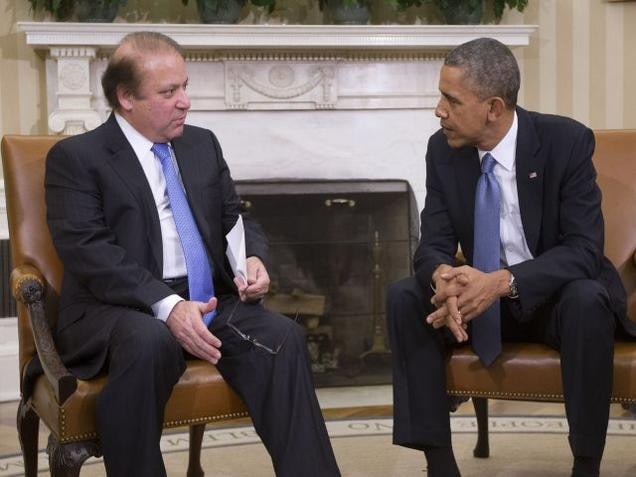
Washington: US security assistance to Pakistan declined by 73 per cent since 2011, Congressional Research Service (CRS) report said. The report, prepared for the US Congress, covers both military and economic assistance given between 2002 and 2015 as well as those earmarked for fiscal years 2016 and 2017, Dawn online reported on Tuesday. It also showed a 53 per cent decrease in economic assistance since 2011, when relations between the US and Pakistan began to deteriorate after the discovery of Al-Qaeda leader Osama bin Laden in Abbottabad and a US air strike on a Pakistani border post in Salala that killed 24 soldiers. The Pentagon had earlier this month decided not to pay $300 million military reimbursement to Pakistan over Islamabad's reluctance to act against the Haqqani network. The country had immediately rejected the charge. Security aid fell from nearly $1.3 billion in 2011 to $343 million last year. Economic aid had declined from nearly $1.2 billion in 2011 to $561 million last year. US magazine The Atlantic's news service, The Wire, on Saturday said the "apparent US-Pakistan estrangement could bring Islamabad closer to its all-weather friend China". The Wire noted that the suspension of $300 million military aid "was seen as the latest sign of strained relations between the once major allies, which is a matter of significance for India". The cancelled $300 million payments were in the form of Coalition Support Fund (CSF) under which Pakistan has received over $14 billion since 2002. The CSF accounted for "as much as one-fifth of Pakistan's total military expenditures" from 2002 to 2014, said the US government news and analysis service for Congress. Another indication of tension between the US and Pakistan was the cancellation of an aircraft deal. Under its Foreign Military Financing (FMF) programme, the US planned to sell Pakistan eight F-16 fighter jets at a cost of $270 million. But the proposed sale faced a strong, bipartisan opposition in the US Congress and was cancelled in May this year. Pakistan can still buy the aircraft if it agrees to pay the actual cost of $700m. Pakistan did not purchase the aircraft, as it could not afford them. The CRS report, however, shows that Pakistan has or still is in the process of receiving nearly $1.2 billion worth of weapon systems from the US since 2001. In April last year, the US State Department approved a $952 million foreign military sales deal to give Pakistan 15 AH-1Z Viper attack helicopters and 1,000 Hellfire II missiles. On April 5, the US agreed to pay $170 million for nine of these helicopters and additional fuel kits for Pakistan.
Top Headlines
World

Indian national killed; at least 10 others among over 300 injured in attack on Saudi airport
World

Riyadh Airport Attacked Again: Indian National Killed Of Injuries, 10 Injured
World
Poland Detains Man Accused Of Plotting To Assassinate PM Donald Tusk, Defence Minister
World
Djibouti Boat Capsize: 139 Migrants Dead, 84 Missing After Vessel Carrying 305 Capsizes





See Today's Weather 
powered by