Waqf (Amendment) Bill Now Law After President Murmu’s Assent Amid Oppn Backlash
President Murmu approved the Waqf (Amendment) Bill while several opposition parties and Muslim organisations are challenging its provisions in the Supreme Court.

President Droupadi Murmu has given her assent to the Waqf (Amendment) Bill, 2025, which was passed by both Houses of Parliament following intense debates. The legislation, aimed at curbing misuse and encroachments on Waqf properties, has triggered significant backlash, with several opposition parties and Muslim organisations challenging its provisions in court.
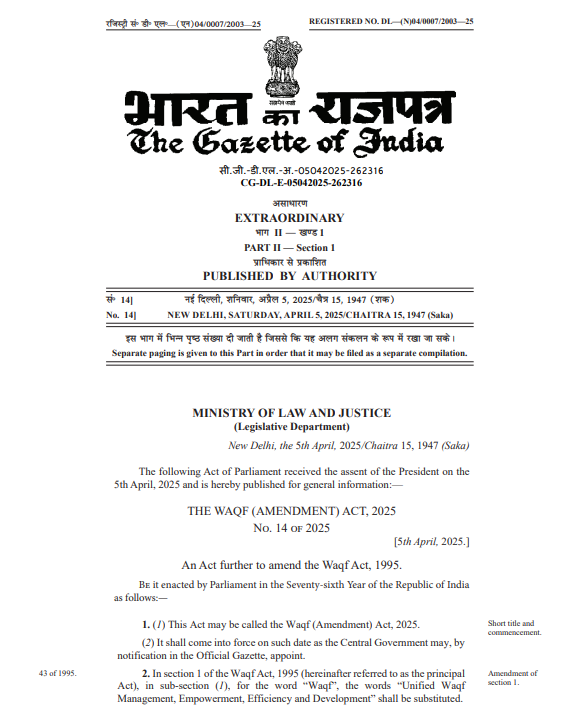
According to the official Gazette notification, the Waqf (Amendment) Act, 2024, introduces several structural reforms, including:
- Mandatory representation of Pasmanda and poor Muslims on State Waqf Boards.
- Stricter provisions for the registration, protection, and utilisation of Waqf properties.
- Time-bound disposal of encroachment cases through special Waqf Tribunals.
- Audit and accountability mechanisms, making annual audits of Waqf Boards compulsory with reports to be submitted to the State Government.
- A bar on “unverified or fraudulent registration” of properties as Waqf.
The Act amends multiple sections of the Waqf Act, 1995, especially Section 14 and Section 32, to expand the composition of Waqf Boards and strengthen oversight.
The Gazette further notes that the amendment aims to “bring transparency in the administration of waqf properties, safeguard the interest of the genuine waqf beneficiaries, and ensure that marginalised Muslim communities are given proper representation.”
Chairman of the Joint Parliamentary Committee (JPC) on the Bill and BJP MP Jagdambika Pal said, “A historic bill has been passed. The poor and Pasmanda Muslims will hugely benefit from it… Some people are trying to mislead the people… Poor and Pasmanda Muslims will get representation in the Waqf Board… The bill is very transparent… The properties of the Waqf were being misused and the poor were deprived of its benefits.”
#WATCH | Lucknow, UP | On the Waqf (Amendment) Bill, Chairman of the JPC of Waqf (Amendment) Bill and BJP MP Jagdambika Pal says, "A historic bill has been passed. The poor and pasmanda muslims will hugely benefit from it...Some people are trying to mislead the people...Poor and… pic.twitter.com/3BV4eJH9jq
— ANI (@ANI) April 5, 2025
While the government hailed the amendment as a step towards inclusivity and reform, opposition parties and some Muslim organisations have raised concerns, alleging that the law might lead to centralisation and politicisation of religious trusts.
AAP, AIMIM, Congress, RJD Leaders Move Supreme Court Against Waqf Amendment
Leaders from the Aam Aadmi Party (AAP), Congress, and the All India Majlis-e-Ittehadul Muslimeen (AIMIM) have filed separate petitions in the Supreme Court questioning the constitutional validity of the new law. AAP MLA Amanatullah Khan argued in his petition that the Bill violates Articles 14, 15, 21, 25, 26, 29, 30, and 300-A of the Constitution, alleging that it curtails religious and cultural autonomy, enables arbitrary executive interference, and undermines minority rights.
Congress MP Mohammad Jawed, a former member of the Joint Parliamentary Committee on the Bill, also moved the top court. He alleged that the law imposes “arbitrary restrictions” on the management of Waqf properties and discriminates against the Muslim community by imposing constraints not applicable to other religious endowments.
The petition, filed through advocate Anas Tanwir, contended that the Bill’s provisions, particularly those restricting the creation of Waqfs based on the duration of religious practice, lack any basis in Islamic law or tradition and infringe upon the right to religious freedom under Article 25.
AIMIM president Asaduddin Owaisi also filed a separate plea through advocate Lzafeer Ahmad, stating that the legislation “diminishes the legal protections granted to Waqfs” while retaining those for Hindu, Jain, and Sikh religious endowments. He further objected to the appointment of non-Muslims to the Central Waqf Council and State Waqf Boards, claiming it infringes upon the rights of Muslims to manage their religious affairs.
Meanwhile, Rashtriya Janata Dal (RJD) leader Tejashwi Yadav confirmed on Saturday that his party had also approached the Supreme Court against the controversial law.
The All India Muslim Personal Law Board (AIMPLB) declared the Bill a “severe assault on Islamic values, religion and Shariah, religious and cultural freedom, communal harmony and the foundational structure of the Indian Constitution.” In a statement issued on Saturday, the Board criticised political parties supporting the Bill, accusing them of exposing their “so-called secular facade” by aligning with what it called the Bharatiya Janata Party’s (BJP) “communal agenda”.
The AIMPLB also announced plans to launch a nationwide campaign in collaboration with religious, community-based, and social organisations. “The objective is to secure a complete rollback,” the Board said, while urging Muslims, particularly youth, to maintain calm and avoid emotionally charged actions that could be misused by sectarian elements.
“He [Board secretary] urged them not to take any action driven by emotions that might provide opportunities for sectarian and disruptive forces,” the statement added.
AIMPLB General Secretary Maulana Mohammed Fazlurrahim Mujaddidi outlined the protest strategy during a meeting of Board officials and special invitees. He said the movement would include legal efforts in the Supreme Court as well as peaceful democratic protests like wearing black armbands, conducting roundtable discussions, and holding press briefings.
In a Friday press release, the AIMPLB also said it had sought an “urgent appointment” with President Droupadi Murmu to express its “deep concern” over the newly enacted law. The Board called the amendment “thoroughly unconstitutional” and described it as an “attack on the Muslims of the country”. The General Secretary’s letter stated that the act “requires serious reconsideration as they are inconsistent with the fundamental rights guaranteed under the Constitution of India.”
The Parliament passed the Waqf (Amendment) Bill, 2025, after a 13-hour debate in the Rajya Sabha, where 128 members voted in favour and 95 against. The Lok Sabha had earlier cleared the Bill with 288 votes in support and 232 opposed. The ruling National Democratic Alliance (NDA) has maintained that the legislation is not anti-Muslim and is aimed at protecting Waqf properties from misuse and encroachment.
Related Video
Delhi News: Why Bulldozer Action Was Conducted at Night? DCP Nitin Valson Explains Key Reasons



Top Headlines