NASA Reveals Stunning 3I/ATLAS Photos: Fastest-Ever Interstellar Comet Displays Unusual Jet Structure
NASA has released new images of interstellar comet 3I/ATLAS, revealing massive jets, unusual behaviour, and a briefly vanished tail, deepening scientific mystery ahead of its close approach.

- NASA utilizes multiple spacecraft to observe interstellar visitor 3I/ATLAS.
- Mars orbiters and solar probes capture initial comet images.
- Asteroid missions and Webb telescope provide further observations.
NASA has finally released the eagerly awaited images of 3I/ATLAS, only the third confirmed visitor from interstellar space to enter our Solar System, following ‘Oumuamua in 2017 and 2I/Borisov in 2019. The comet’s unusual path ignited online speculation about “alien technology”, pushing anticipation for NASA’s official data to unprecedented levels.
A Global Effort Despite US Shutdown Delays
In an extraordinary move, NASA turned the inner Solar System into a massive, multi-spacecraft observatory, pointing nearly every available probe at the interstellar object. However, a six-week US government shutdown delayed the public release of images.
Even so, the space agency confirmed that 12 missions had already captured and processed data on the comet since its discovery on 1 July. More spacecraft continue to observe the object as it sweeps through the Solar System, offering fresh vantage points along its path.
For astronomers, this is a rare — perhaps once-in-a-lifetime — opportunity to study material that has travelled billions of kilometres from a different star system.
Mars Probes Deliver the Closest Views Yet
NASA revealed that the closest images came from the Red Planet.
- Perseverance rover’s Mastcam-Z imaged the comet on 4 October.
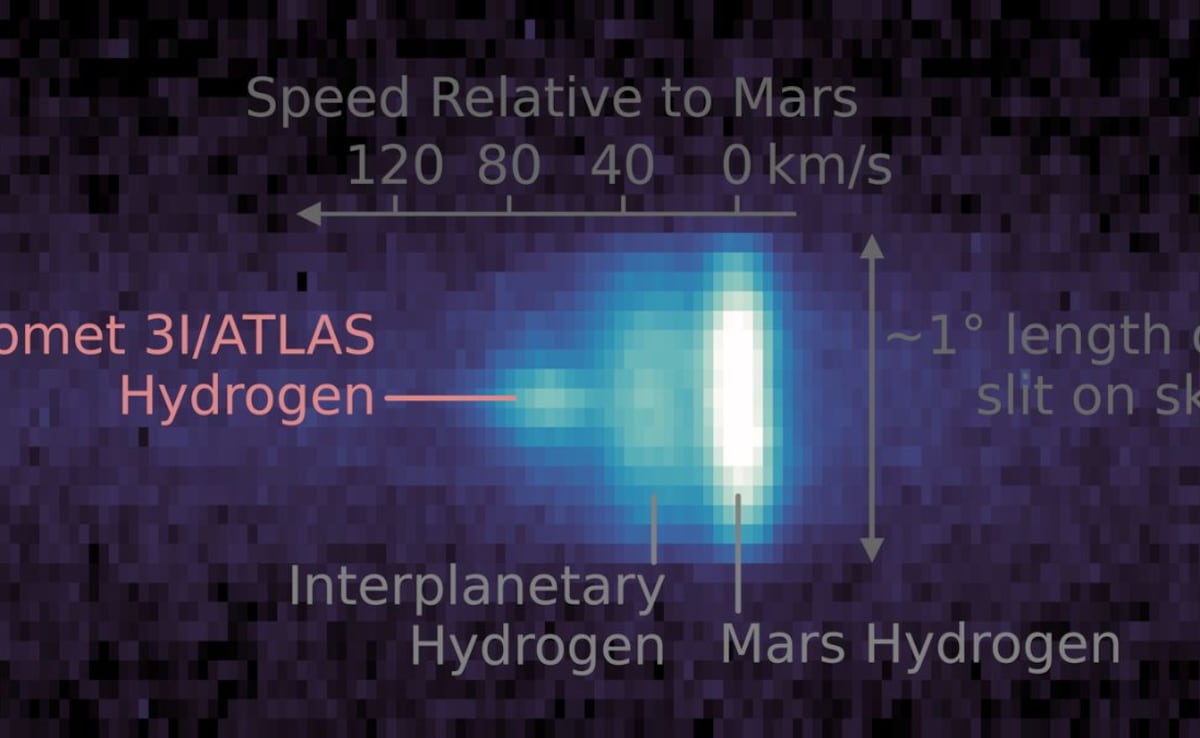
- MAVEN captured ultraviolet views on 9 October.
- Mars Reconnaissance Orbiter’s HiRISE camera photographed 3I/ATLAS on 2 October from roughly 19 million miles away.
These observations from Mars provided some of the most detailed early glimpses of the interstellar object.
Solar Probes Track the Comet’s Dramatic Approach
The Sun-observing fleet also played a crucial role.
- NASA’s STEREO spacecraft recorded the comet from 11 September to 2 October.
- The joint SOHO mission between NASA and ESA observed it from 15–26 October.
- Between 28 September and 10 October, STEREO-A, SOHO, and the PUNCH imager traced its motion as it travelled 231–235 million miles from Earth.
These solar probes offered long-range tracking that helped scientists map its unusual trajectory.
Asteroid Explorers Join In
Further high-resolution images came from two deep-space missions:
- NASA’s Lucy spacecraft used its L’LORRI imager on 16 September.
- The Psyche mission captured images from 8–9 September.
Meanwhile, the James Webb Space Telescope is preparing for a December observation window expected to yield the most detailed chemical analysis of the comet so far.
A Fast, Mysterious Traveller
Early findings show that 3I/ATLAS is moving at 30,000 mph, faster than any known Solar System comet. It contains carbon dioxide, water ice, and an unexpectedly strong nickel signal, mirroring what was seen in 2I/Borisov.
Its exact size remains difficult to determine due to surrounding dust, but estimates range from a few hundred metres to several kilometres. As it passed perihelion on 29 October, the comet brightened significantly and developed a faint visible-light tail.
Closest Approach to Earth in December
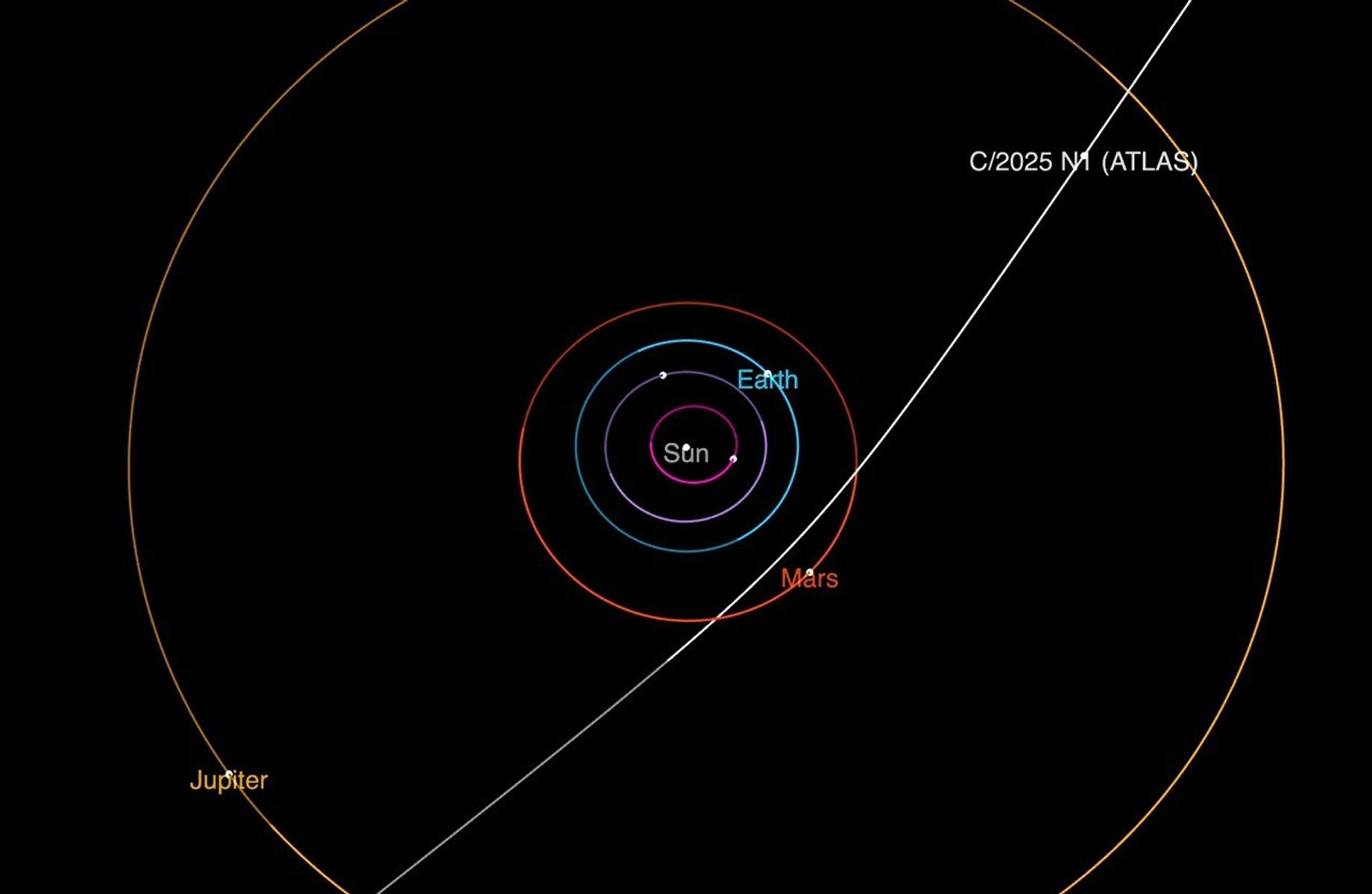
NASA expects 3I/ATLAS to make its closest pass by Earth on Friday, 19 December, at a distance of 170 million miles — nearly double the Earth-Sun distance.
British Astronomers Capture New Jet Structures
British astronomers Michael Buechner and Frank Niebling recently published fresh observations via the British Astronomical Association. Their “heavily processed” image from 9 November revealed massive anti-tail jets streaming towards the Sun, along with a longer jet extending in the opposite direction.
Harvard astrophysicist Avi Loeb analysed these findings, noting that the twin anti-tail jets stretch nearly 0.95 million kilometres sunward, while the opposing tail jet extends 2.85 million kilometres away, a sign of a remarkably powerful and organised material outflow.

The discovery is striking because the comet had briefly appeared tail-less after perihelion, confounding expectations.
Estimating the Comet’s Size and Mass Loss
Loeb wrote that the angular extent of the jets, up to 30 arcminutes, indicates a mass-loss rate of around 50 billion tonnes per month. This suggests a nucleus diameter of at least 5–10 kilometres, assuming a typical cometary density.
Additional images captured on 8 November by astro-photographers M Jager, G Rhemann and E Prosperi revealed at least seven distinct jets, reaffirming the unusual nature of the object.
Is 3I/ATLAS a Strange Natural Comet — or Something Else?
The comet’s behaviour has prompted speculation, with some questioning whether it could be advanced interstellar technology. Loeb outlined several anomalies, including:
Key Anomalies Observed So Far
- Retrograde trajectory unusually aligned with planetary orbits (0.2% likelihood).
- A sunward jet in July–August, unlike typical comet behaviour.
- A larger and faster nucleus than known interstellar objects.
- Perfect timing that brought it near Mars, Venus and Jupiter despite its unknown origin (0.005% likelihood).
- A gas plume richer in nickel than iron, resembling industrial alloys (<1% likelihood).
- Extremely low water content — just 4% by mass.
- Extreme negative polarisation, not seen in other comets (<1% likelihood).
- Its arrival direction lined up near the famous “Wow!” signal (0.6% likelihood).
- Rapid, unusual brightening near perihelion and a shift to a blue-green colour.
- Unexplained acceleration without visible signs of mass evaporation.
A Tail That Vanished, and Reappeared
Complicating matters further, images from Spain’s R Naves Observatory on 5 November showed 3I/ATLAS without a tail, despite significant brightening and signs of mass shedding. Typically, any comet approaching the Sun should display a strong dust-and-gas tail shaped by the solar wind.
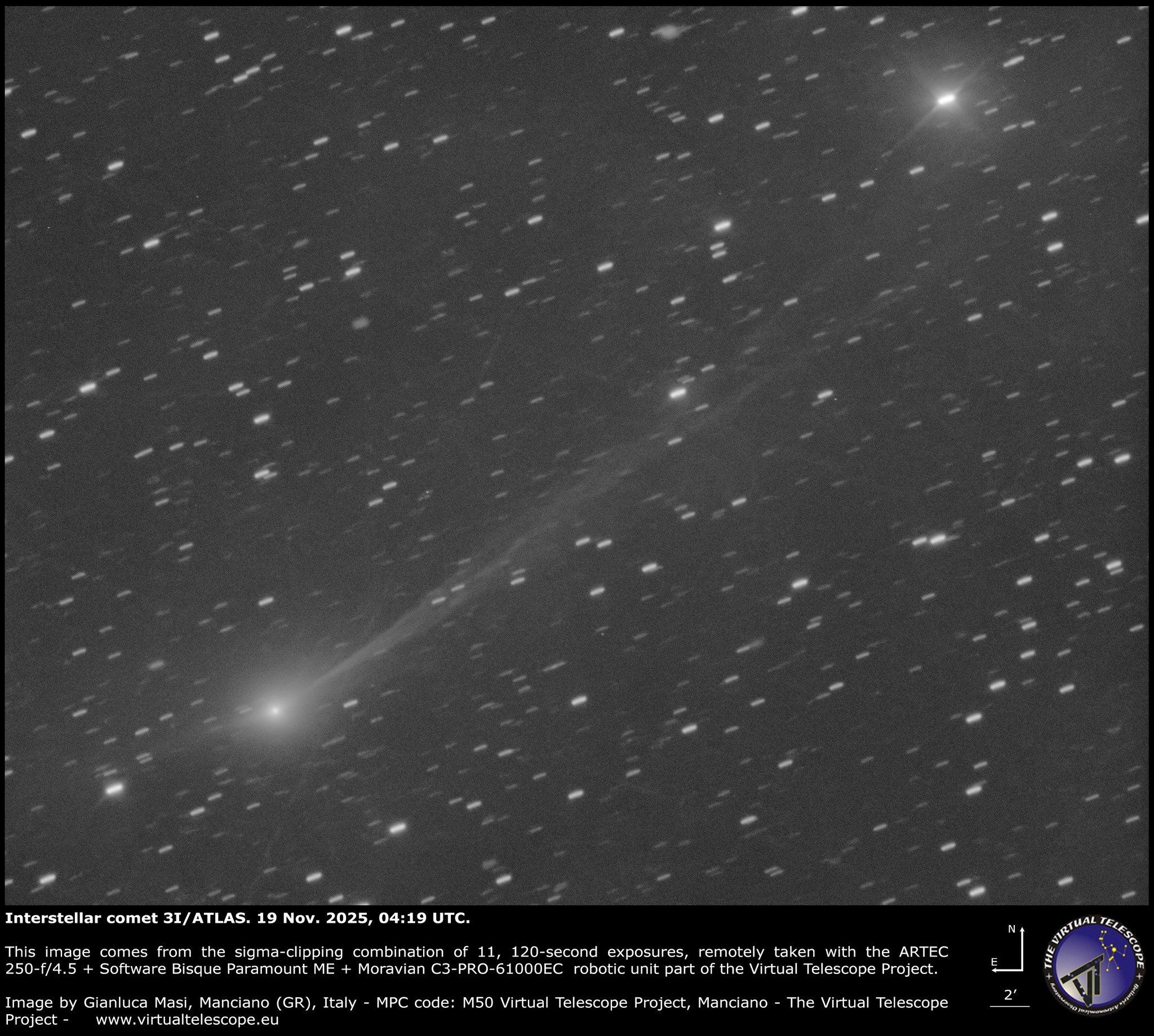
Loeb noted that a natural comet should have shown a massive visible cloud containing at least 13% of the nucleus’s mass — yet none was seen.
Some scientists propose that the comet may have an irradiated crust, altering its outgassing pattern, but definitive answers remain elusive.
What Happens Next?
NASA and ESA will continue monitoring 3I/ATLAS as it heads towards a close approach with Jupiter on 16 March 2026. Scientists hope upcoming spectroscopic observations will uncover its true composition, velocity and mass flow, and perhaps solve one of the most intriguing cosmic mysteries of our time.
Top Headlines