Mystery Object That Washed Up On Australian Beach Most Likely From Indian Rocket, Says ASA: Report
The Australian Space Agency (ASA) recently said that the space debris is most likely from an Indian launch vehicle. The object is cylindrical-shaped, and made of a gold-coloured material.
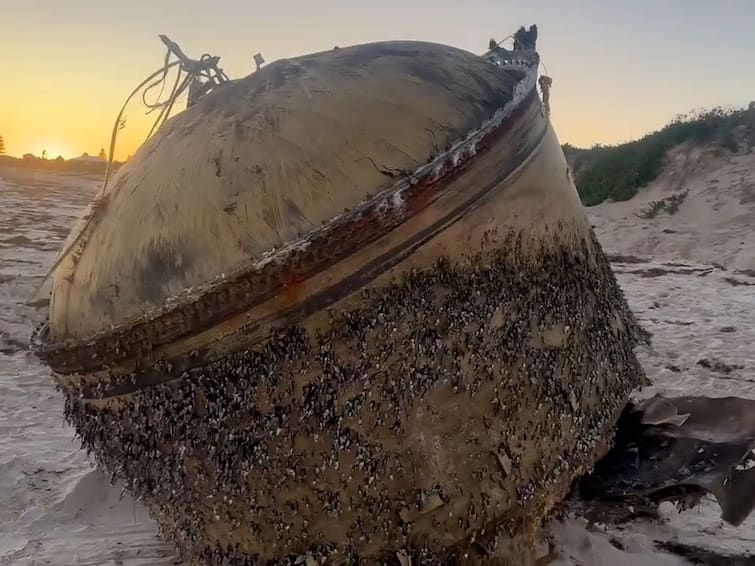
The mystery object that showed up on an Australian beach in July 2023 has so far been speculated as space junk. The Australian Space Agency (ASA) recently said that the space debris is most likely from an Indian launch vehicle, The Guardian reported. The object is cylindrical-shaped, is 2.5 metres high, and made of a gold-coloured woven material. The object was discovered on July 15 near the beach in Green Head in Western Australia, about 250 kilometres north of the city of Perth.
Several national agencies, including the ASA, have been working to identify the origin of the object.
ASA has now said that following a thorough investigation, it concluded that the object is most likely a part of a used third stage of the Polar Satellite Launch Vehicle (PSLV).
ALSO READ | NASA Searching For Voyager 2 After Commands Caused Spacecraft To Lose Communication With Earth: Report
Some people initially speculated the object to be a part of MH370, the plane that went missing in 2014 off the west Australian coast.
However, aviation experts said that the object is not a part of a commercial aircraft, but possibly a fuel tank from a rocket that had fallen into the Indian Ocean.
ALSO READ | Chandrayaan-3 Enters Moon's Sphere Of Influence, Spacecraft Health Normal: ISRO
Quoting Somanath, a BBC report said some of the PSLV parts are known to have fallen in the sea behind Australia's Exclusive Economic Zone, and the object may have been floating for a long time and finally reached shore.
The ISRO Chief also said that no danger was associated with the debris, according to the BBC report.
MUST READ | EXCLUSIVE: India Has A Very Long Tradition Of Particle Physics, Says CERN Physicist Archana Sharma
According to an ABC News report, a front-end loader wrapped the object in plastic, following which it was driven to a locked storage facility. Andrea Boyd, a European Space Agency (ESA) engineer, said experts believed the object fell to the ground from an Indian rocket launching a satellite.
Quoting Boyd, the report said the experts are pretty sure based on the shape and size of the object that it is an upper-stage engine from an Indian rocket used for a lot of different missions. She also said that India has been using these tickets since the 1990s, and has launched more than 50 missions.
ALSO READ | What Are Dark Matter And Dark Energy? Here's What A CERN Scientist Says
Boyd stated that based on the amount of barnacles, the object is probably not a part of any rocket launched this year.
However, when an object is thrown around the object, it tends to look older than it would normally, Boyd said.
ALSO READ | Oppenheimer: The Manhattan Project, And How It Developed The Atomic Bomb
She explained that it takes a lot of effort to get up to orbit, and hence, the first, second and third stage engines usually fall off and end up in the Indian Ocean. Therefore there is a possibility that the object came with the currents and washed up on the beach.
Boyd said that there is a United Nations Office for Outer Space Affairs, and they have an outer space treaty that everyone has signed saying that whoever launches something into space is responsible for it right until the very end, according to the report.
She also said that the ASA is looking into the matter, and is talking to India's space agency to try and collaborate on cleaning this up properly.
Boyd also called Western Australia a "lucky spot" for space junk. She has advised against touching the object.
Top Headlines