




Explorer
Chandrayaan-2 Successfully Performs 2nd Orbit Raising Task: ISRO
It was "performed successfully today (July 26, 2019) at 0108 hrs (IST) as planned, using the onboard propulsion system for a firing duration of 883 seconds. The orbit achieved is 251 x 54829 km. All spacecraft parameters are normal," the Indian Space Research Organization tweeted.
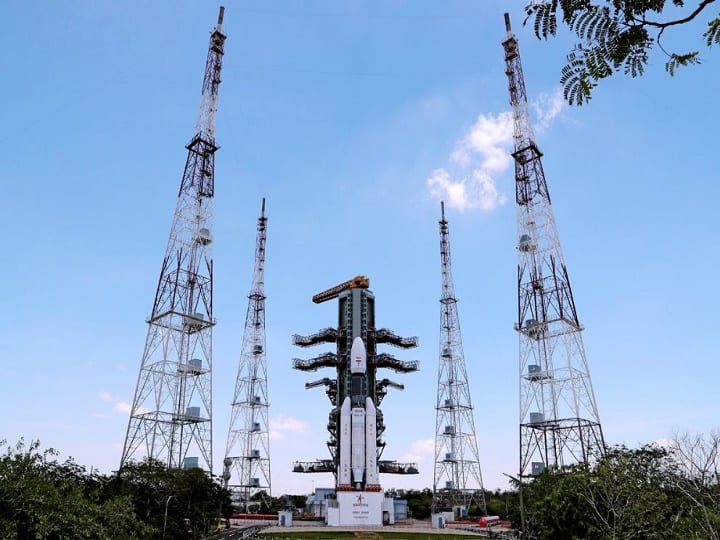
Image of GSLVMkIII-M1 tweeted by ISRO
New Delhi: India's second moon spacecraft Chandrayaan-2 put into earth orbit on July 22, on Friday successfully completed its second earth bound orbit raising maneuver, ISRO said. It was "performed successfully today (July 26, 2019) at 0108 hrs (IST) as planned, using the onboard propulsion system for a firing duration of 883 seconds. The orbit achieved is 251 x 54829 km. All spacecraft parameters are normal," the Indian Space Research Organization tweeted. "The third orbit raising maneuver is scheduled on July 29, 2019, between 1430e1530 hrs (IST)," it added.
The first one was performed on July 24. The Chandrayaan-2 is scheduled to reach moon by August 20, the Indian space agency had said on Wednesday. According to Indian Space Research Organisation (ISRO), the first earth bound orbit raising maneuver for Chandryaan-2 spacecraft was successfully performed on Wednesday afternoon by firing the onboard motors for 57 seconds. On July 22, the Chandrayaan-2 was injected into an elliptical orbit of 170x45,475 km by India's heavylift rocket Geosynchronous Satellite Launch Vehicle-Mark III (GSLV Mk III) in a text book style. The spacecraft Chandrayaan-2 comprises three segments - the Orbiter (weighing 2,379 kg, eight payloads), the lander 'Vikram' (1,471 kg, four payloads) and rover 'Pragyan' (27 kg, two payloads). The Indian space agency said the major activites include earth bound maneuvers, Trans Lunar Insertion, Lunar bound maneuvers, the lander Vikram separation from Chandrayaan-2 and Vikram touch down on the moon's South Pole. The ISRO said the Trans Lunar Insertion of Chandrayaan-2 is scheduled on August 14, 2019, which will send the spacecraft to moon. After that, the Chandrayaan-2 is scheduled to reach moon by August 20, 2019, the ISRO said. According to ISRO, the lander Vikram will land on the moon on September 7. Originally the GSLV-Mk III rocket carrying Chandrayaan-2 was supposed to fly on July 15. Owing to a serious technical glitch the flight was postponed to July 22. As a result, there are changes in the mission schedule. As per the July 15 flight schedule, Chandrayaan-2's earth bound phase was 17 days and it is 23 days as per the new schedule. On the other hand, the lunar bound phase which was for 28 days for July 15 flight schedule, has come down to 13 days. Originally Vikram was planned to land on the moon 54 days after the rocket's lift off and now the landing will take place in 48 days.Second earth bound orbit raising maneuver for #Chandrayaan2 spacecraft has been performed today (July 26, 2019) at 0108 hrs (IST) as planned. For details please check https://t.co/raXNQB76O6#ISRO
— ISRO (@isro) July 25, 2019
Top Headlines
India

L Murugan Resigns As Union Min, Reveals Next Plan, Says ‘Nation First, Party Next’
India

‘That Is A Surprise’: Rahul Keeps Opposition’s Next Course Of Action Under Wraps
India

EXCLUSIVE: Pilot Signals Wider Anti-CEC Campaign, Says Punjab Polls Will Be In Focus
India

Is INDIA Bloc Divided? 4 Parties Stay Away From SC Plea Against CEC: Who Are They








See Today's Weather 
powered by



