Sunita Williams, Wilmore To Return After 9 Months Today: All About SpaceX's 'Dragon' Capsule
After nine months on the ISS, astronauts Butch Wilmore and Sunita Williams returned to Earth aboard a SpaceX Dragon capsule.
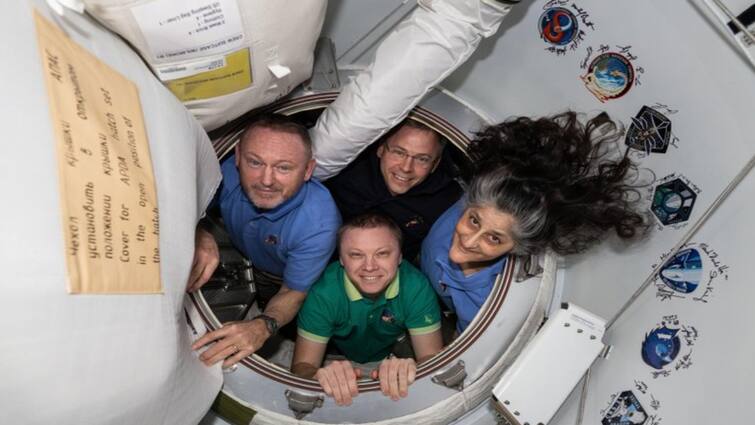
After nine months in orbit, two NASA astronauts, Butch Wilmore and Sunita Williams, finally departed the International Space Station (ISS) on Tuesday. Both of them, besides two other crew members, undocked from the ISS aboard SpaceX’s ‘Dragon’ capsule at 1:05 am ET (10:35 am IST). Their journey back to Earth will take approximately 17 hours.
The capsule of Williams and other members will re-enter the Earth's atmosphere, descend under parachutes, and land in the ocean before they undergo routine medical checks. The two astronauts of the National Aeronautics and Space Administration (NASA) went to the International Space Station (ISS) in June 2024 aboard the Boeing Starliner.
Initially, the mission was scheduled for eight days. However, it took nine long months for Williams and Wilmore to finally return back to Earth on SpaceX's Crew Dragon spacecraft that arrived at the ISS on Sunday.
What Is The Dragon's capacity?
The Dragon can carry up to a total of seven passengers on missions to Earth orbit and beyond. According to Hindustan Times, quoting SpaceX, it is the only spacecraft that is currently capable of returning substantial amounts of cargo to the Earth. It was the first spacecraft capable of transporting humans to the space station.
How Does It Work?
According to a report in the Indian Express, the Crew Dragon is carried into SpaceX's Falcon 9, a reusable two-stage rocket. The capsule has 16 Draco thrusters that manoeuvre the vehicle in the orbit, and each Draco can create a force of 40 kilos.
“We have GPS sensors on Dragon, but also cameras and imaging sensors such as Lidar (laser ranging) on the nose cone as it’s approaching the space station… All these sensors are feeding data back to our flight computer to say: ‘Hey, how far away am I from the space station? What’s my relative velocity to the space station?,” said Jessica Jensen, director of Starship mission hardware and operation at SpaceX.
The Crew Dragon can autonomously dock with the ISS. However, according to the BBC, the Crew Dragon can only be used for a few months in space because the solar panels tend to degrade when exposed to space. It automatically undocks from the ISS when the astronauts begin their return journey. The trunk then detaches itself from the capsule containing the astronauts.
After this, the thrusters are used to bring down the capsule's velocity and thus allow it to re-enter the atmosphere, which is known as a de-orbit burn. It then deploys four parachutes and splashes into the Atlantic Ocean—around 450 kilometres from Florida. After this, a ship picks up the capsule and brings the astronauts home.


Top Headlines