Partial Lunar Eclipse On September 18, Know Regions Where It Can Be Seen
On September 18, 2024, a partial lunar eclipse will occur, when the Harvest Moon, a supermoon this time, will enter Earth's shadow, creating a captivating sight.

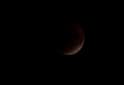
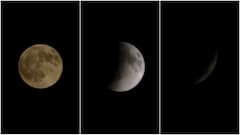
Lunar Eclipse 2024: Skywatchers in different parts of the world will be treated to a partial lunar eclipse on September 18, 2024. The celestial event will see a portion of the 'Harvest Moon' — which will also be a supermoon — entering Earth's shadow, offering a captivating view to millions of people.
According to NASA, this eclipse will take place in the early morning hours in Europe, and in the evening in the US.
Regions Where Sept 18 Lunar Eclipse Will Be Visible
According to Timeanddate.com, regions that will be able to see at least some parts of the eclipse are Europe, most of Asia, Africa, North America, South America, Indian Ocean, Atlantic, Pacific, Arctic, and Antarctica.
Though not as dramatic as the April 8 total solar eclipse, which gave millions of people in some parts of the world a once-in-a-lifetime ring-of-fire view, the partial lunar eclipse of September 18 will be one of the major astronomical highlights of the year, and experts are encouraging those in the visibility range to mark their calendars. The eclipse will be visible during the night, weather permitting, with optimal viewing occurring in areas free from light pollution.
The eclipse won't be visible in most parts of India, and only the penumbral phase will visible in the rest of the country, including states such as Rajasthan, Gujarat, Punjab, and parts of Jammu & Kashmir, Haryana, Maharashtra, Karnataka, and Kerala. A penumbral phase is difficult to see with the naked eye.
The eclipse will be best viewed from North America, South America, Europe and Africa — the night side of the world.
On September 18, the penumbral phase of the lunar eclipse will begin at 06:11:07 IST, while the partial eclipse will start at 07:42:58 IST. The maximum eclipse will be reached at 08:14:18 IST, with the partial eclipse ending at 08:45:38 IST and the penumbral phase ending at 10:17:27 IST.
ALSO READ ON ABP LIVE | Sunita Williams Is Set To Celebrate Her Birthday In Space A Second Time
What Is A Partial Lunar Eclipse?
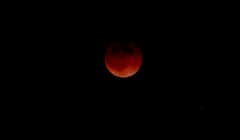
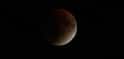
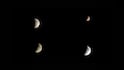
A partial lunar eclipse occurs when the Earth moves between the Sun and the Moon, but only a part of the Moon passes through the Earth's shadow. Unlike a total lunar eclipse, where the Moon is entirely covered by Earth's umbra (the darkest part of its shadow), a partial eclipse leaves part of the Moon visible, while the rest takes on a darker hue.
During this type of eclipse, observers will see the Earth's shadow slowly "take a bite" out of the Moon, creating a unique visual. While not as dramatic as a total eclipse, a partial lunar eclipse still offers a stunning display, especially when viewed under clear skies.
ALSO READ ON ABP LIVE | September Sky: Stellar Showcase With A Supermoon, Saturn Moons And The Galilean Gang
What Is The Penumbral Phase Of A Lunar Eclipse?
The penumbral phase of a lunar eclipse occurs when the Moon passes through the Earth's 'penumbra', which is the outer and lighter part of Earth's shadow. Unlike the darker 'umbra', which causes noticeable eclipses (partial or total), the penumbral shadow results in only a subtle dimming of the Moon's surface.
During this phase, the Moon's surface may appear slightly shaded or less bright than usual, but this dimming is often so faint that it can be difficult to observe with the naked eye. In fact, many casual skywatchers might not even notice the penumbral phase at all, especially if they are not paying close attention or if atmospheric conditions make it less visible.
For those looking carefully, the penumbral phase offers an interesting view of Earth's interaction with the Moon’s light.
In many cases, the penumbral phase is just the first stage of a more significant eclipse, acting as a precursor to the more noticeable partial or total phases that follow.
ALSO READ ON ABP LIVE | When Is The Next Full Moon? Check Full Moon Calendar 2024
Top Headlines