Japan Launches Moon Lander 'SLIM' And Telescope 'XRISM'. Here's When They Will Reach The Moon
Japan launched its third lunar exploration mission on September 7, 2023. A spacecraft called the Smart Lander for Investigating Moon (SLIM) will attempt a soft landing on the Moon.
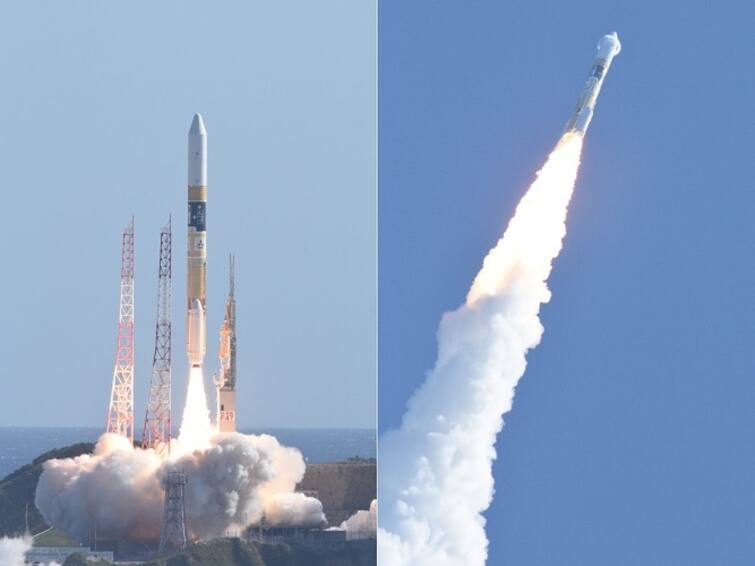
Japan Moon Sniper Mission: The Japan Aerospace Exploration Agency (JAXA) has launched a Moon lander called Smart Lander for Investigating Moon (SLIM), and a spectroscope called X-Ray Imaging and Spectroscopy Mission (XRISM). Both the spacecraft were launched by Mitsubishi Heavy Industries (MHI) onboard the H-IIA Launch Vehicle No. 47 (H-IIA F47), at 8:42 am JST (5:12 am IST) on September 7, 2023, from the Tanegashima Space Center, the largest rocket launch complex in Japan. XRISM and SLIM are expected to reach the Moon by February 2024. While XRISM is an X-ray telescope, SLIM is a Moon lander. XRISM was the primary passenger onboard the launch vehicle. The nickname of the mission is Moon Sniper.
The Moon Sniper mission is Japan's third Moon mission. The budget of the entire mission is $100 million.
Mitsubishi Heavy Industries (MHI) has launched the H-IIA Launch Vehicle No.47 carrying "XRISM"and "SLIM" at 8:42:11a.m. on Sep. 7, 2023 JST from the Tanegashima Space Center. #H2AF47
— MHI Launch Services (@MHI_LS) September 6, 2023
According to JAXA, the launch vehicle flew into space as planned.
Mitsubishi Heavy Industries (MHI) Launch Services confirmed the separation of XRISM from the launch vehicle at around 5:26 am IST, and that of SLIM at around 5:59 am IST.
「X線分光撮像衛星(XRISM)」の分離が確認されました。The separation of "XRISM" has been confirmed. #H2AF47
— MHI Launch Services (@MHI_LS) September 6, 2023
JAXA said in a statement that XRISM was successfully separated from the launch vehicle at about 14 minutes and nine seconds after launch, and SLIM was separated from the rocket at about 47 minutes and 33 seconds after launch.
「小型月着陸実証機(SLIM)」の分離が確認されました。The separation of "SLIM" has been confirmed. #H2AF47
— MHI Launch Services (@MHI_LS) September 7, 2023
Japan's first lunar exploration mission, Hiten, was launched by the Institute of Space and Astronautical Science on January 24, 1990. It was Japan's Earth-orbiting satellite designed to test and verify technologies for future lunar and planetary missions, and intentionally crashed on the Moon on April 10, 1993, making Japan the third country to reach the Moon. Hiten carried a small orbiter called Hagoromo, which was released in the vicinity of the Moon, while Hiten was put into a highly elliptical orbit. Hagoromo, despite entering lunar orbit, failed to conduct scientific experiments because its transmitter stopped working.
MUST READ | Chandrayaan, Apollo, Artemis, Luna – Successful Moon Missions Launched Till Date
Hiten passed by the Moon 10 times during the mission, before intentionally crashing into Earth's only natural satellite. Through this mission, Japan became the third country to achieve two objectives: a lunar flyby, and lunar surface impact.
Japan’s second lunar exploration was Kaguya (Selene), which was launched on September 14, 2007, from the Tanegashima Space Center. Kaguya, Japan’s second mission to explore the Moon from orbit, carried two small satellites: Okina and Ouna. Kaguya’s main objectives were to understand the evolution of the Moon, and to develop the technology for future lunar exploration. Two years later, on June 10, 2009, Kaguya impacted the Moon.
MUST READ | Science For Everyone: Why It Is Important To Study The Sun, And How Aditya-L1 Will Do So
What will SLIM and XRISM do after reaching the Moon?
Meanwhile, SLIM will attempt a soft landing on the Moon. If SLIM succeeds in softly landing on the Moon, Japan will become the fifth country to achieve a lunar soft landing, India, which became the fourth country to successfully soft land a spacecraft on the Moon with Chandrayaan-3's landing on the lunar south pole.
SLIM is a small-scale exploration lander that has not only been designed for pinpoint landings on the lunar surface, but also to demonstrate reductions in the size and the weight of equipment used in Moon landings.
ALSO READ | Aditya-L1 Will Be Placed 1.5 Million Kilometres From The Earth. Know The Significance Of This Distance
The objectives of SLIM are the demonstration of accurate landing techniques by a small explorer, investigation of the Moon's origins, acceleration of the study of the Moon and other planets using a lighter exploration system compared to other spacecraft, and testing technology fundamental to exploration in low-gravity environments. The last objective is important because it may allow future scientific investigation of the solar system, according to JAXA.
JAXA developed XRISM in collaboration with the European Space Agency (ESA) and NASA. Since the ESA has provided the hardware for XRISM and will also give JAXA scientific advice, the space agency will be allocated eight per cent of the telescope's available observing time. XRISM will observe the most energetic events and objects in the universe, in order to unravel mysteries such as the evolution of the universe and the structure of spacetime.
The Japanese space agency aims to determine through the Moon Sniper mission the level of navigation accuracy required for future solar science exploration.
ALSO READ | What Will Happen To Chandrayaan-3 After Its Mission Ends?

Top Headlines