Explorer
How Do Supermassive Black Holes Grow? This Newly Discovered Mini ‘Monster’ Black Hole Provides Clues
The discovery is important because it is one of the first times that a heavily buried, or "obscured" supermassive black hole has been found in a dwarf galaxy.

Representational images of supermassive black holes (Source: Getty)
New Delhi: A team of researchers recently discovered a supermassive black hole in a relatively small galaxy that could help astronomers determine how the biggest black holes grow.
The scientists used NASA's Chandra X-ray Observatory to identify a black hole that has a mass 200,000 times that of the Sun. The black hole is buried in gas and dust in the galaxy Mrk 462, the space agency said in a statement.
 There are only several hundred million stars in Mrk 462, which makes it a dwarf galaxy. It is a mini "monster" black hole expected to provide astronomers with some clues about the growth of black holes.
 Our Milky Way Galaxy has a few hundred billion stars.
One Of The First Discoveries Of An Obscured Supermassive Black Hole In A Dwarf Galaxy
The discovery is important because it is one of the first times that a heavily buried, or "obscured" supermassive black hole has been found in a dwarf galaxy.
Jack Parker of Dartmouth College in New Hampshire, one of the lead authors of the study, said the black hole in Mrk 426 is among the smallest of the supermassive, or monster black holes, according to the NASA statement. He added that black holes like this are notoriously hard to find.
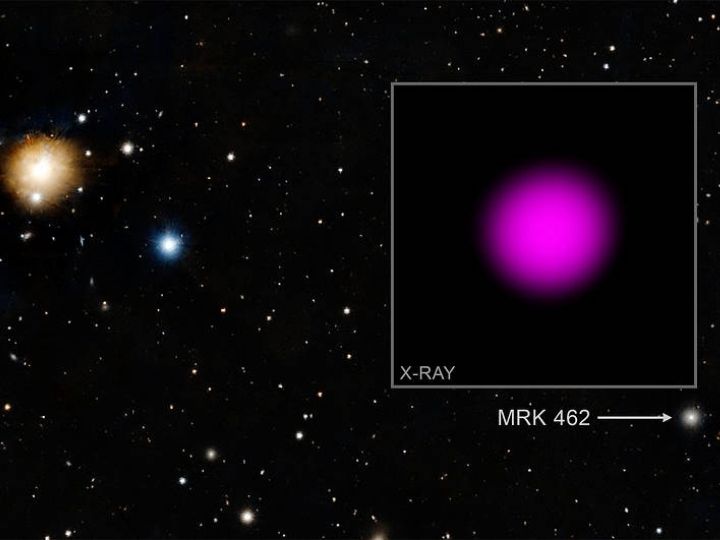
A recently discovered a supermassive black hole (Photo: NASA)
Astronomers often find black holes in larger galaxies by searching for the rapid motions of stars in the centres of galaxies, the statement said.
The problem with dwarf galaxies is that they are too small and dim, as a result of which most current instruments are unable to detect the rapid motions of the stars at the centres of the galaxies.
Techniques Used To Search For Black Holes
Searching for the signatures of growing black holes, such as gas being heated up to millions of degrees and glowing in X-rays as it falls towards a black hole, is another technique to find black holes.
The scientists observed eight dwarf galaxies using Chandra. These galaxies had previously shown hints of black hole growth from optical data gathered by the Sloan Digital Sky Survey.
Only Mrk 462 showed the X-ray signature of a growing black hole, the statement said.
The researchers concluded that the Mrk 462 black hole is heavily obscured by gas from the fact that it reflected an unusually large intensity of high energy X-rays compared to low energy X-rays.
Ryan Hickox, co-lead author of the study, said that finding Mrk 462 might mean there are a lot more dwarf galaxies out there with similar black holes.
He added that it is important because it could help address a major question in astrophysics regarding the growth of black holes.
How Did Some Black Holes Become Massive?
According to previous research, black holes were created when massive stars collapsed to form black holes that weighed only about 100 times the mass of the Sun.
However, theoretical work cannot clearly explain how black holes gained enough weight to reach the sizes seen in the early universe.
There were black holes containing tens of thousands of solar masses in the early universe, according to an alternative explanation. They may have been created from the collapse of gigantic clouds of gas and dust.
Since there are a large fraction of dwarf galaxies with supermassive black holes, it is believed that small black hole seeds from the earliest generation of stars grew astonishingly quickly to form the billion solar mass objects in the early universe.
The conditions necessary for the direct collapse from a giant cloud to a medium-sized black hole is rare. Therefore, it is not expected that a large fraction of dwarf galaxies would contain supermassive black holes. On the other hand, stellar-mass black holes are expected in every galaxy.
Parker said that the result should encourage much more extensive searches for buried black holes in dwarf galaxies.
The results were part of a virtual press briefing held on Monday, January 10, according to the statement.

Top Headlines
News

Air India Phuket-Delhi Pilot Who Tested Positive For Drugs Was On Sleep Medication
World

‘Praise Be To Allah!’: Trump Claims US Has ‘Total Control’ Of Strait Of Hormuz
Celebrities

‘Italian Mother Made Him LoP’: Kangana’s Scathing Attack On Rahul Gandhi
India

Lok Sabha Probe Panel Finds Ex-Judge Yashwant Varma Guilty In Cash-At-Home Case






See Today's Weather 
powered by