Gaganyaan: ISRO To Conduct Three More Test Vehicle Missions After Maiden Test Vehicle Development Flight, Says Chairman
The test vehicle abort mission-1, known as TV-D1, is an important mission because it will allow ISRO to test the crew module which will carry astronauts to space during Gaganyaan's crewed missions.
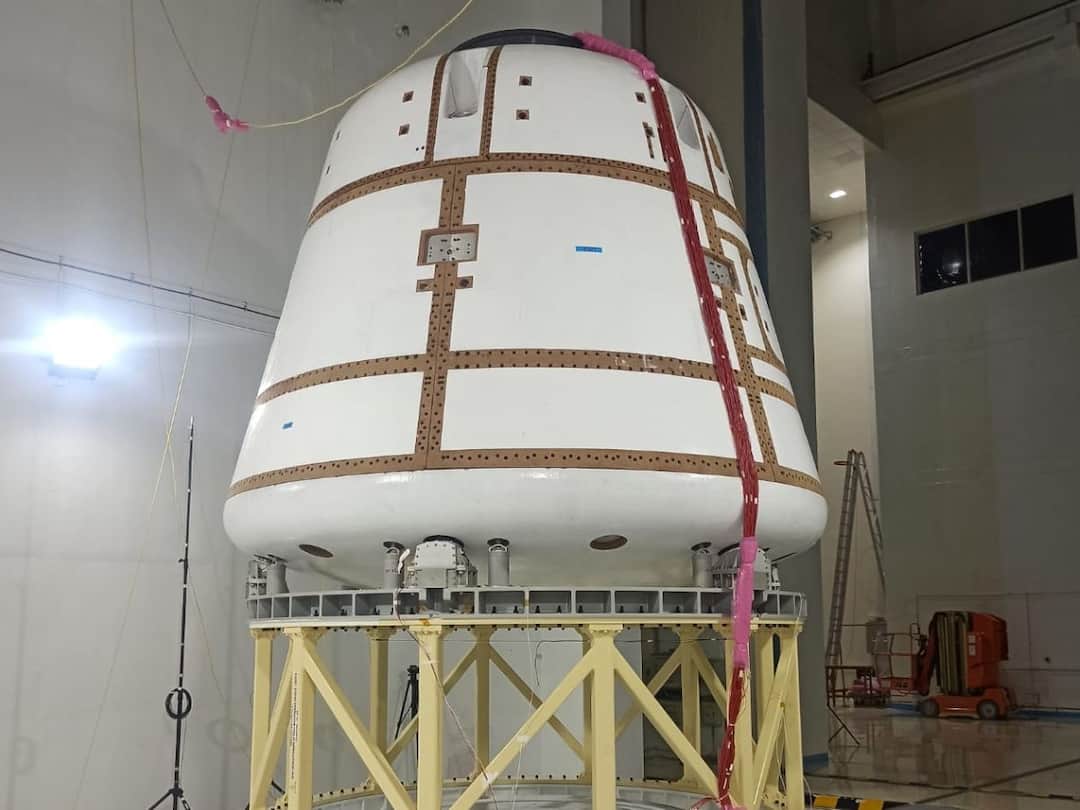
Gaganyaan: The Indian Space Research Organisation (ISRO) will conduct three more test vehicle missions as part of the Gaganyaan Programme, after the maiden test vehicle development flight which is scheduled to be performed on October 21, 2023. The test vehicle abort mission-1, known as TV-D1, is an important mission because it will allow ISRO to test the crew module which will carry astronauts to space during the crewed missions of the Gaganyaan programme. The test vehicle development flight missions to be conducted after TV-D1 are called D2, D3, and D4, the ISRO Chief said, news agency PTI reported. He also said that thorough tests will be conducted during the test flight sequence.
TV-D1 will be performed at Satish Dhawan Space Centre, Sriharikota Andhra Pradesh.
The aim of ISRO's Gaganyaan Programme is to launch astronauts to an orbit of 400 kilometres, and bring them back safely to Earth by landing them in Indian sea waters, in order to demonstrate human spaceflight capability.
MUST READ | Science For Everyone: Plastic Pollution In India, And What The Govt Is Doing To Combat It
All about the test vehicle development flight mission-1
As part of the TV-D1 mission, the crew module, in which astronauts will be sent to outer space during the crewed mission, will be sent to outer space, and then recovered after splashing down in the Bay of Bengal. A diving team from the Indian Navy will use a dedicated vessel to recover the crew module.
Unlike the crew module that will carry astronauts to outer space during the crewed missions, the crew module that will be used during the test development flight mission will be unpressurised, and will not simulate a pressurised Earth-like atmospheric condition.
The size and mass of the crew module to be used for the test vehicle abort mission-1 are the same as those of the crew module that will be used during the crewed missions of the Gaganyaan programme. All the systems for the deceleration and recovery of the crew module are also present inside the vehicle.
MUST READ | Bionic Eyes, Sensor-Equipped Contact Lenses — New Ophthalmic Techniques
The crew module is also equipped with a complete set of parachutes. The avionics systems of the crew module are in a redundant mode, and will also perform functions such as navigation, sequencing, telemetry, instrumentation, and power.
The instrumentation of the crew module is meant to capture the flight data for the evaluation of the performance of various systems.
The crew module developed for the test vehicle abort mission-1 is equipped with a single-stage liquid rocket, and crew escape systems. The crew escape systems have fast-acting solid motors. The test development flight will simulate an abort condition during the ascent trajectory.
MUST READ | Chemistry Nobel 2023: How The Laureates Created A Colourful World With Quantum Dots
At an altitude of 17 kilometres, the crew escape system and crew module will separate from the test vehicle.
After the crew escape system separates successfully from the test vehicle, and parachutes are deployed, the crew module will splash down in the sea, about 10 kilometres from the coast of Sriharikota. The entire abort sequence will be executed autonomously.
The test development flight is an important mission because its success will set the stage for the first crewed mission of the Gaganyaan Programme.
MUST READ | Over 25% Indians Aged 50 And Above Have Visual Impairment, 1.99% Of These Have Blindness, Say Experts
The development of a launch pad in Kulasekarapattinam
Apart from the Gaganyaan Programme, the ISRO Chief also talked about setting up another launch pad in Kulasekarapattinam in Tuticorin district in Tamil Nadu, which would help the space agency because it could be used to launch smaller rockets.
Somanath explained that bigger rockets like PSLV need to take a turn towards the southward direction above Sri Lanka because the launchpad in Sriharikota is located in the east. But in Kulasekarapattinam, ISRO will not require rockets to make a turn towards the southward direction because those vehicles will already be facing southward.
The ISRO Chief also said that private firms will be able to launch small rockets from the potential launch pad in Kulasekarapattinam. The land is currently in the acquisition stage, and it will take two years for the launch pad to be established.
MUST READ | Physics Nobel 2023: How The Laureates Generated Short Light Pulses to Study Electron Movement
Related Video
Southern Rising Summit 2024: How Important is Self-Awareness? Insights from Anu Aacharya | ABP LIVE
Top Headlines