Chandrayaan-3: ISRO Launches India's Third Moon Mission, Spacecraft Expected To Reach Lunar Surface In August
The Chandrayaan-3 spacecraft's voyage towards the Moon began after ISRO's largest and heaviest rocket, the Launch Vehicle Mark III, carried India's third lunar exploration mission, from Sriharikota.
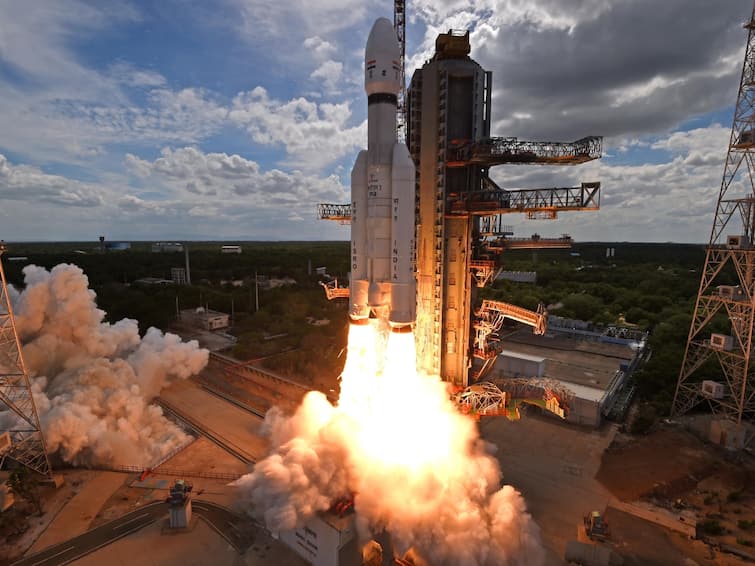
Chandrayaan-3 Launched: The Indian Space Research Organisation (ISRO) successfully launched its third lunar exploration mission, Chandrayaan-3, on Friday, July 14, 2023, at 2:35 pm IST. The Chandrayaan-3 spacecraft's voyage towards the Moon began after ISRO's largest and heaviest rocket, the Launch Vehicle Mark III (LVM3), carried India's third lunar exploration mission from Satish Dhawan Space Centre, Sriharikota, Andhra Pradesh.
Chandrayaan-3 is expected to reach the lunar surface on August 23 or 24, 2023.
ISRO aims to land Chandrayaan-3's lander softly on the Moon's south pole. If this is achieved, India will become the fourth nation to complete the soft landing of a spacecraft on the Moon, and also the first country to land a spacecraft on the Moon's south pole.
Chandrayaan-3 has three phases: the Earth-centric phase, the lunar transfer phase, and the Moon-centric phase.
The Earth-centric phase, or Phase-1, involves the pre-launch phase; the launch and ascent phase; and the Earth-bound manoeuvre phase, which will help the Chandrayaan-3 spacecraft change its directions.
The lunar transfer phase includes the transfer trajectory phase, as part of which Chandrayaan-3 will choose the path that will lead it towards the lunar orbit.
The Moon-centric phase involves all the steps from lunar orbit insertion to landing.
The spacecraft consists of a lander, a rover and a propulsion module. The rover is fitted inside the lander, and together, they are called the lander module. The objectives of the mission are to demonstrate soft landing on the lunar surface, and roving on the lunar terrain, conduct in-situ scientific experiments, and develop and demonstrate new technologies required for interplanetary missions.
Chandrayaan-3 was inserted into Earth orbit a few minutes after launch. After this, the spacecraft was separated from the launch vehicle. The propulsion module is carrying the lander module to a lunar circular orbit whose size is 100 × 100 square kilometres. After this, the propulsion module and the lander module will separate.
The mission life of the propulsion module is three to six months. It weighs 2,148 kilograms, and has a power generation capacity of 758 Watts.
Chandrayaan-3 has a mission life of one lunar day, or 14 Earth days.

Top Headlines