




Explorer
On quantum canvas thinner than human hair, scientists 'paint' microscopic Mona Lisa; Have a look!
This light 'stamps' the image on an area around about 100 microns wide -- more or less the width of human hair, which can range from between 17 to 181 microns wide.
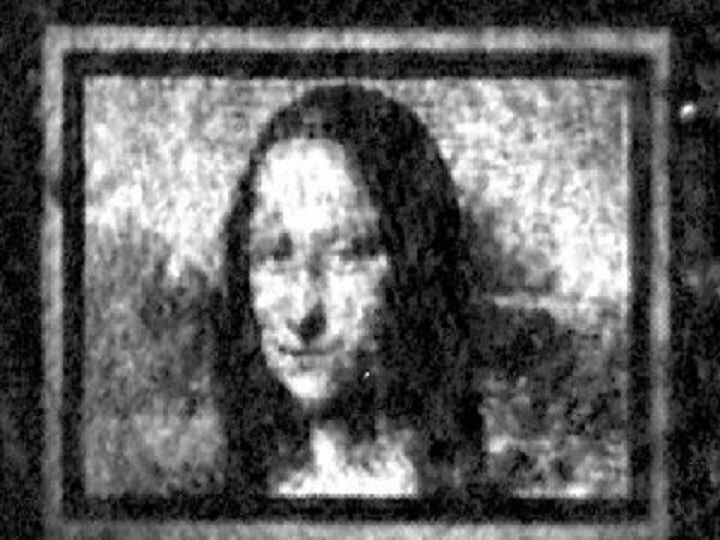
The images were projected and photographed on a blob of gaseous quantum matter known as Bose-Einstein condensate./ IMAGE: www.uq.edu.au
Melbourne: Scientists have created microscopic replicas of iconic masterpieces, including Italian polymath Leonardo Da Vinci's Mona Lisa and Van Gogh's Starry Night, on a quantum 'canvas' the width of a human hair. The images were projected and photographed on a blob of gaseous quantum matter known as Bose-Einstein condensate. According to Tyler Neely from University of Queensland in Australia, the artworks were originally a fun side project alongside their more serious research. "We never aimed to do this -- we were originally looking to better understand the unsolved mysteries of how fluids flow," Neely said. "We were hoping to gain new insights into how our everyday world arises out of the microscopic quantum world, helping us create new quantum-enhanced technologies," he said. "But, while we were at it, we just happened to create some of the world's smallest masterpieces," he added. The team cooled a gas made of rubidium atoms down to a few billionths of a degree Celsius above absolute zero, which at minus 273.15 degrees Celsius is the coldest temperature possible. "The gas doesn't freeze since it is too diluted, instead behaving as a blob of gaseous quantum matter," Neely said. "We then put the image on a projector illuminated by a laser, but instead of projecting it to be large, we send it backwards through a microscope to make the image tiny," he said. This light 'stamps' the image on an area around about 100 microns wide -- more or less the width of human hair, which can range from between 17 to 181 microns wide. "We can then take the image, which is only in black and white, and produce colour shots by producing a 'red', 'blue', and 'green' image, and then combine them on a computer," Neely said. The resulting image is barely visible to the human eye, with each pixel representing only about 50 atoms. "One of the first images we developed was Van Gogh's Starry Night, but we were soon recreating other works of art, famous photos, as well as photos of ourselves," Neely said. The researchers believe these initial images are an impressive demonstration of quantum matter as a brand new material for producing art.
Top Headlines
World

UN Chief Warns Of ‘Ethnic Cleansing’ Risk As Israel Expands West Bank Operation
World

US Suspends Visa-Free Entry For Chinese Nationals Over Birth Tourism, Security Concerns
World

5 Of 11 Women Accuse Trump Of Sexual Assault, House Democrats’ Epstein Report Says
World

Former PMs, Ex-Army Chief: Meet Netanyahu's Top Rivals In Battle For Power As Israel Votes










See Today's Weather 
powered by



