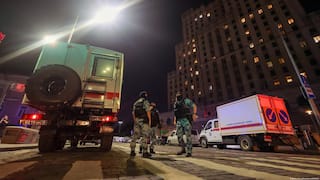
The hotline aims to facilitate communication between Iran, the US, and other countries. Its goal is to prevent and resolve misunderstandings, ensuring smooth maritime operations and the highest level of safety and traffic flow.
Explorer
Iran Agrees To 'Telephone Hotline' For Hormuz, Says Strait Will ‘Never Return’ To Pre-War State
Iran has agreed to establish a dedicated hotline and coordination centre for ships transiting the Strait of Hormuz, saying it will help prevent misunderstandings with the US and other countries.

Iran agreed to establish a Strait of Hormuz maritime communication hotline to prevent incidents and manage maritime concerns.
Source : ABPLIVE AI
- Iran agreed to establish a Strait of Hormuz maritime communication hotline.
- This initiative aims to prevent incidents and manage maritime concerns.
- The US temporarily suspended oil sanctions following these talks.
- US cited Iran's transit commitment and nuclear inspector access.
Iran has agreed to establish a dedicated "telephone hotline" in the Strait of Hormuz to facilitate communication with the United States and other countries, marking a significant development in the management of one of the world's most critical maritime corridors.
Speaking to Iranian state media while returning from negotiations in Switzerland on Monday, Iran's chief negotiator Mohammad Bagher Ghalibaf said Tehran and Washington had reached an understanding to create new coordination mechanisms aimed at avoiding incidents and addressing concerns involving vessels navigating the strategic waterway.
Hotline To Address Maritime Concerns
According to Ghalibaf, the two sides agreed to set up "a telephone hotline and a centre so that if any ambiguity or issue arises, ships can contact that centre."
The Iranian negotiator said the initiative is designed to help "prevent and resolve any misunderstandings" and ensure smooth maritime operations in the Strait of Hormuz, through which a substantial share of the world's oil shipments passes.
He stressed that the waterway would now be "managed under Iranian arrangements" and declared that it would "never return to what it was before the war."
Ghalibaf said Iran would continue to uphold international maritime regulations while responding rapidly to any emerging incidents.
"Naturally, just as problems may arise in Lebanon or elsewhere, problems can also arise in the Strait of Hormuz," he said, adding, "As you've seen, on some nights there have even been clashes."
Describing the purpose of the hotline, he said it was intended to ensure "the highest level of safety and traffic flow."
Explaining its operation, Ghalibaf added: "If Americans have any objection to anything, or if any vessels or ships need clarity on any route or anything … they [can] call."
He also claimed that negotiations had concluded arrangements related to Iran's access to $12 billion in frozen funds and addressed matters concerning the easing of oil sanctions.
Progress Reported In Switzerland Talks
The comments came after the latest round of US-Iran negotiations in Switzerland, where officials said discussions continued for around 80 minutes.
According to Iranian officials, the talks focused on sanctions relief, the release of frozen Iranian assets and the implementation of commitments under the Islamabad Memorandum of Understanding.
The meeting marked the first round of quadrilateral discussions held under the framework of the memorandum and was aimed at advancing a broader agreement between Washington and Tehran.
Vance Signals Optimism
US Vice-President JD Vance struck an optimistic tone following the talks, describing Sunday as a "very, very good day" and saying negotiators had made "a lot of good progress."
On Monday, Vance said Iran would permit nuclear inspectors to return to the country after what he again described as a "very, very good" opening day of negotiations. He said the outcome had created a "good foundation" for a potential final agreement.
Separately, the United States confirmed a temporary suspension of sanctions on Iran's oil sector, allowing the country to produce, market and transport crude oil and related products until August 21.
US Treasury Secretary Scott Bessent said the temporary sanctions relief was linked to Tehran's commitment to maintaining "free and open transit" through the Strait of Hormuz and its agreement to permit inspections by the International Atomic Energy Agency.
Before You Go
Breaking News: UP Monsoon Session Begins Tomorrow, Opposition Plans Attack on Yogi Govt Over Key Issues
Frequently Asked Questions
What is the purpose of the new telephone hotline in the Strait of Hormuz?
Who announced the agreement to establish a hotline in the Strait of Hormuz?
Iran's chief negotiator, Mohammad Bagher Ghalibaf, announced the agreement. He stated it was reached with the United States to create new coordination mechanisms for maritime traffic.
What were the key topics discussed during the recent US-Iran negotiations in Switzerland?
The talks focused on sanctions relief, the release of frozen Iranian assets, and implementing commitments from the Islamabad Memorandum. Iran also cited arrangements for accessing $12 billion in frozen funds.
Why did the US temporarily suspend sanctions on Iran's oil sector?
The US suspended sanctions until August 21 due to Tehran's commitment to free and open transit through the Strait of Hormuz. This was also linked to Iran's agreement to permit nuclear inspections.
How will the new telephone hotline in the Strait of Hormuz operate?
Ships can contact the center if any ambiguity or issue arises or if they need clarity on any route. Americans or any vessels can also call for communication.

Advertisement
Top Headlines
World

'Brutal Terrorist Attack': Explosion At Moscow Restaurant Leaves 3 Dead
World

Iran Calls Hormuz Deal Report 'False' After Trump Cancels Planned Attack
World

5 Dead, 41 Missing After Ferry Catches Fire Near Indonesia's Madura Island
World

Hungary To Shut Sole Nuclear Plant For First Time As Danube's Water Level Falls Amid Heatwave



Advertisement








Advertisement