Convicted Lawmakers Should Be Barred From Contesting Elections For Life, Supreme Court Urged
The Supreme Court has been urged to consider imposing a life ban on convicted lawmakers in certain offences mentioned in the Representation of the People Act.
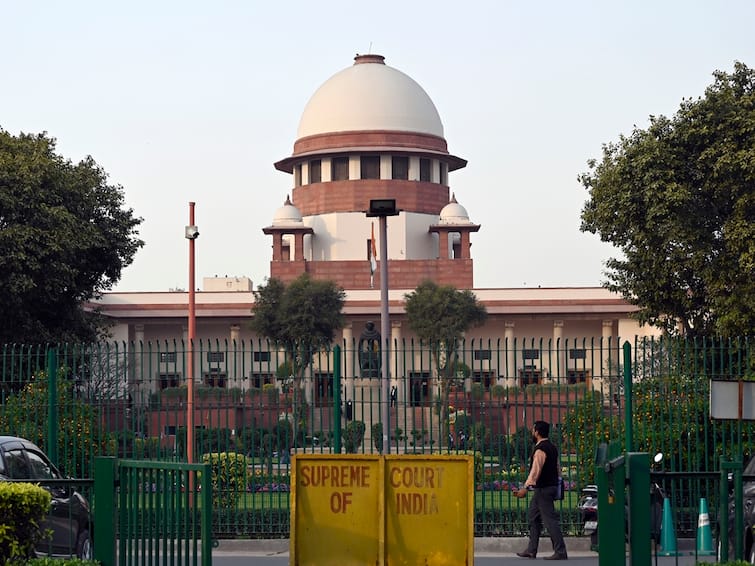
The Supreme Court has been urged to consider imposing a life ban on convicted lawmakers in certain offences mentioned in the Representation of the People Act as they should be "much more sacrosanct and inviolable" than other citizens.
Senior advocate Vijay Hansaria, who is assisting the top court as an amicus curiae in hearing of a PIL seeking speedy trial of politicians in criminal cases, has filed a fresh report pitching for a life ban on lawmakers from contesting elections, if found guilty in an offence of moral turpitude.
Hansaria, assisted by advocate Sneha Kalita in the 19th report submitted before the court, referred to section 8 of RP Act and said it imposes a ban from electoral politics for a period of six years after the release of the convicted politician.
"There is no nexus for limiting the disqualification for a period of six years since the release of the convict with the object of disqualifying him from becoming a member of the legislature…," the report said, adding that permitting them to rejoin electoral politics six years after the release is "manifestly arbitrary and violative of Article 14 of the Constitution (right to equality)." The report, which is scheduled to be taken up on September 15 by a bench headed by Chief Justice DY Chandrachud, said Parliament has categorised the offences for the purpose of disqualification depending upon their nature, seriousness and gravity and the impact on the society at large.
Referring to classification of offences entailing disqualification under the RP Act, the report said even a sentence of fine in some cases attracts disqualification.
"One common thread in all cases where a sentence of imprisonment has been imposed is that disqualification continues only for a period of six years since the release of the convict. Thus, a person is eligible to contest election after six years of the release even if convicted for heinous offences like rape or for dealing with drugs or being involved in terrorist activities or having indulged in corruption," the report said.
It said the statutory authorities constituted under various legislations provide for permanent disqualification or removal from holding a statutory office on conviction of an offence involving moral turpitude.
"If statutory authorities cannot comprise convicted persons, it is manifestly arbitrary that such convicted persons can occupy the supreme legislative bodies after expiry of a certain period of conviction. There is no nexus that a person can make law to disqualify another person from holding a statutory office, but the person making the law would incur the disqualification only for a limited period," Hansaria said in his 35-page report.
The report further said, "The lawmakers are required to be much more sacrosanct and inviolable than the persons holding office under such law. The Parliamentarians and the Legislators represent the sovereign will of the people and once found to have committed an offence involving moral turpitude, are liable to be permanently disqualified from holding the said office. Limiting the period of disqualification is a flagrant violation of the equality clause enriched in Article 14 of the Constitution." The report was filed in a PIL by advocate Ashwini Upadhyay seeking a direction to debar those convicted from legislature, executive and judiciary for life.
He has also challenged the validity of section 8 of RP Act insofar as disqualification to contest election is confined "for a period of six years since his release".
The report said as per the service rules applicable to central or state government employees, a person convicted of any offence involving moral turpitude is liable to be dismissed from service.
"Even a Class-IV employee would be terminated from service, once convicted for an offence involving moral turpitude, not to speak of Class-I, II and III employees and the persons holding any offices under the All India Services Act, 1951 and the Rules framed thereunder," it said.
The Centre, in its affidavit in 2020, had opposed the PIL, saying there is no discrimination between lawmakers and common citizens.
It said the validity of section 8 of the RP Act was upheld by the apex court in a 2019 verdict.
(This report has been published as part of the auto-generated syndicate wire feed. Apart from the headline, no editing has been done in the copy by ABP Live.)
Before You Go
Breaking News: Vande Mataram Row Escalates as BJP Demands Sonia Gandhi’s Apology, Police Complaints Filed
Top Headlines