‘Nation First Should Be Guiding Principle’: VP Dhankhar Calls For Institutional Discipline, Cites Waqf Row
He also described freedom of expression and debate as essential elements of democracy but cautioned that when someone assumes himself absolute correct while dismissing all others as wrong.
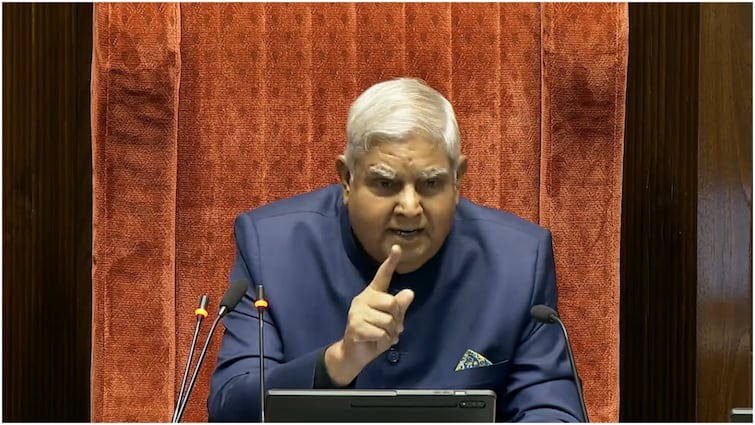
Lucknow, May 1 (PTI): Vice President Jagdeep Dhankhar on Thursday underscored the importance of constitutional institutions adhering to their defined limits, stating that mutual respect among them can only be ensured when each remains within its jurisdiction.
He warned that conflicts among institutions do not foster a thriving democracy.
Speaking at the launch of Uttar Pradesh Governor Anandiben Patel's memoir "Chunautiyan mujhe pasand hain", Dhankhar referred to the recent terrorist attack in Pahalgam, saying that in such challenges the nation has to stand as one.
"Nation first should always be our guiding principle," he said, adding, "But the gravest challenges are those that arise from within." Alluding to the recent Supreme Court response to the Waqf Amendment Bill passed by Parliament, he said, "The most dangerous challenges are the ones that come from within... which we cannot openly discuss. These have no logical basis, no connection to national development, and are rooted in governance. I have personally endured such challenges." Reiterating his emphasis on institutional boundaries, the vice president stated, "It is our binding duty that all constitutional institutions respect each other - and such respect is only possible when institutions function within their respective domains. When there is confrontation, democracy does not flourish." Dhankhar stressed that the Constitution calls for coordination, participation, deliberation, dialogue, and debate.
"To comment on a post as dignified as the President's is, in my opinion, a matter of deep reflection," he added.
"Every institution has its own defined role, and no institution should encroach on another's responsibility. We must honour the Constitution in its true spirit." Drawing a clear line between the roles of different branches of government, he said, "Just as the legislature cannot deliver legal judgments - which is the judiciary's domain - similarly, the judiciary must refrain... I have the highest regard for the judiciary. Having practised law for over four decades, I can say we have some of the finest judges. But I appeal for a collaborative and cooperative approach." Dhankhar had earlier publicly criticised the Supreme Court's intervention on the Waqf Amendment Act.
He also described freedom of expression and debate as essential elements of democracy but cautioned that when someone assumes himself absolute correct while dismissing all others as wrong "freedom of expression becomes a distortion".
He said, "Without debate and dialogue, the philosophical essence of our Vedas would vanish. That leads to ego and arrogance - both detrimental to free expression. India is the world's largest and oldest democracy with a vast cultural heritage. If anyone tries to challenge that under any circumstances, we must confront that challenge." Recalling the Emergency, Dhankhar said, "Some believe public memory is short, but that's not true. Have we forgotten the Emergency? Though many years have passed, its dark shadows still loom. It was the darkest chapter in Indian history." "Similarly, regarding the painful incident that happened recently, I believe - and it is my firm conviction - that we must accept that every person is presumed innocent until proven guilty. In a democracy, innocence has a special significance. But whatever the crime may be, it must be resolved according to the law. And if a crime shakes the public conscience, it cannot be covered up.
"I have stated this with complete clarity. Some people asked me why I am so outspoken on this issue. I got a lot of inspiration from Her Excellency the Governor's book. And I have made it clear that I like challenges, and fulfilling constitutional obligations is our primary responsibility. No negligence in this regard can be accepted," Dhankhar added.
He congratulated Patel on her book and said, "Writing such a book is not easy - and writing it with honesty is even more difficult." Merely writing "Chunautiyan Mujhe Pasand Hain" is itself a big challenge, he said.
(This report has been published as part of the auto-generated syndicate wire feed. Apart from the headline, no editing has been done in the copy by ABP Live.)
Top Headlines