NASA + ISRO = Smarter Farming? How NISAR Satellite Plans To Track Crops And Water Like Never Before
NISAR, a NASA-ISRO joint mission launching this year, will monitor crop growth, plant health, and soil moisture using advanced radar technology.
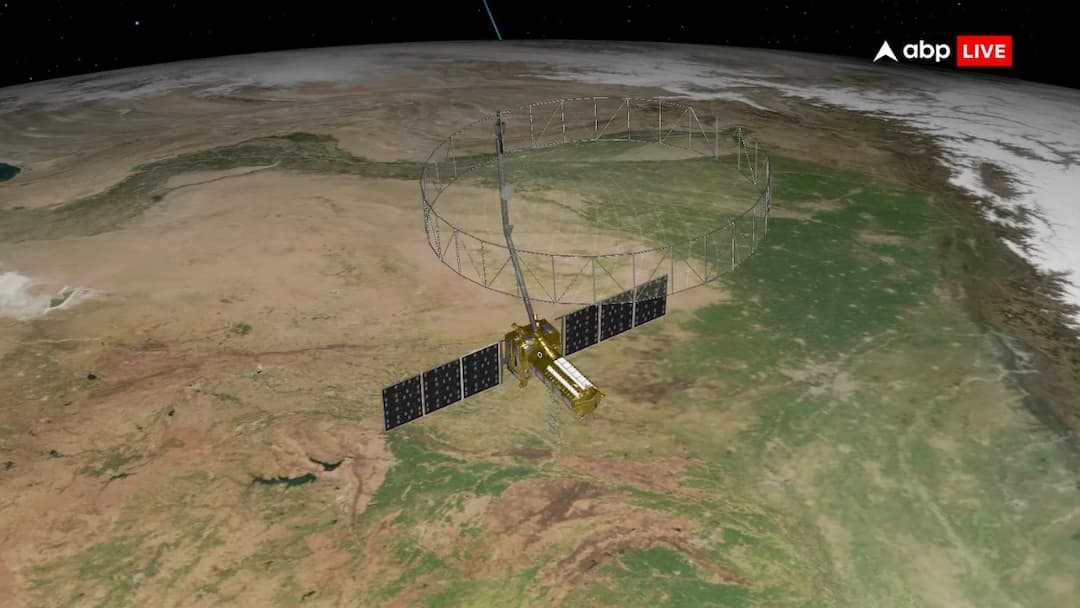
The NISAR satellite, a joint mission by NASA and the Indian Space Research Organisation (ISRO), is set to launch this year, bringing a new level of detail to agricultural monitoring. The satellite will track crop growth, plant health, and soil moisture, offering data that could help farmers manage planting schedules, irrigation, and overall productivity, NASA said in an update on the mission.
Using synthetic aperture radar (SAR), NISAR will provide high-resolution images of farmland, distinguishing different crops and detecting changes in moisture levels. The satellite will orbit the Earth every 12 days, capturing images at a resolution fine enough to monitor individual plots as small as 10 metres wide.
“It’s all about resource planning and optimizing, and timing is very important when it comes to crops: When is the best time to plant? When is the best time to irrigate? That is the whole game here,” a NASA article quoted Narendra Das, a member of the NISAR science team who is also an agricultural engineering researcher at Michigan State University in East Lansing, as saying.
ALSO READ ON ABP LIVE | Rs 20,193-Crore Funding For Gaganyaan As ISRO Plans 2 Crewed Space Flights By 2028
How NISAR Will Monitor Crop, Track Soil Moisture And Water Stress
NISAR will use L-band and S-band radar frequencies, allowing it to penetrate plant canopies and measure biomass. The satellite’s ability to analyse growth patterns will help governments and policymakers estimate crop acreage and production levels with greater accuracy, according to NASA.
“The government of India — or any government in the world — wants to know the crop acreage and the production estimates in a very precise way. The high-repeat time-series data of NISAR will be very, very helpful,” said Bimal Kumar Bhattacharya, agricultural applications lead at ISRO’s Space Applications Centre, Ahmedabad.
The satellite will also support polarimetry, a technique that enhances the ability to identify crops and improve yield predictions when combined with optical satellite data.
“Another superpower of NISAR is that when its measurements are integrated with traditional satellite observations, especially vegetation health indexes, it will significantly enhance crop information,” added Brad Doorn, who oversees NASA’s water resources and agriculture research program.
In addition to monitoring crops, NISAR will measure soil moisture, helping farmers understand how land responds to droughts, rainfall, and heat waves. The satellite will detect how quickly soil absorbs and releases water, aiding in irrigation planning and water resource management.
"Resource managers thinking about food security and where resources need to go are going to be able to use this sort of data to have a holistic view of their whole region,” said Rowena Lohman, an Earth sciences researcher at Cornell University and soil moisture lead on the NISAR science team.
ALSO READ ON ABP LIVE | From Labs To Launchpads: 10 Inspiring Indian Women In Science
NISAR — A NASA-ISRO Joint Mission
NISAR marks the first time NASA and ISRO have jointly developed flight hardware for an Earth-observing satellite. NASA’s Jet Propulsion Laboratory (JPL) led the US contributions, providing the L-band SAR radar, radar reflector antenna, and communication subsystems, while ISRO’s Space Applications Centre provided the S-band SAR, while the Vikram Sarabhai Space Centre developed the launch vehicle.
The satellite will be launched from the Satish Dhawan Space Centre in Sriharikota, India. Once operational, it will generate 80 terabytes of data per day, supporting research and decision-making in agriculture, disaster response, and environmental monitoring worldwide.
Top Headlines