James Webb Space Telescope Reveals Eerie Landscape Of Pillars Of Creation In 'Haunting Portrait'
Webb's new image of the Pillars of Creation shows interstellar dust, setting a sombre, chilling mood. The picture appears like soot-tinged fingers reaching out.

NASA's James Webb Space Telescope has captured some spooky images of the cosmos, which NASA revealed in October, the Halloween month. One of these is a 'haunting portrait' of the Pillars of Creation. The picture looks like an ethereal landscape of time-forgotten tombs and soot-tinged fingers reaching out. The pillars of gas and dust enshroud stars that are slowly forming over many millennia. Webb's image is an eerie, extremely dusty view of the Pillars of Creation in mid-infrared light.
The Pillars of Creation are located in the vast Eagle Nebula, 6,500 light years from Earth.
What the new image of the Pillars of Creation means
The image, captured by Webb's MIRI, shows interstellar dust, setting a sombre, chilling mood. Mid-infrared light specialises in detailing where dust. Stars are not bright enough at these wavelengths to appear. Instead, leaden-hued pillars of gas and dust shine brightly at their edges, hinting at the activity within.
The Pillars of Creation have been formed by thousands of stars. A recent image of the Pillars of Creation captured by Webb's Near-Infrared Camera (NIRCam) revealed numerous stars.
Webb’s NIRCAM captured a sparkling image of the Pillars of creation, where stars are born. Webb's image reveals a highly detailed landscape and new stars within dense clouds of gas and dust. Though the three-dimensional pillars look like majestic rock formations, they are far more permeable. The pillars are made up of cool interstellar gas and dust. At times, these columns appear semi-transparent in near-infrared light.
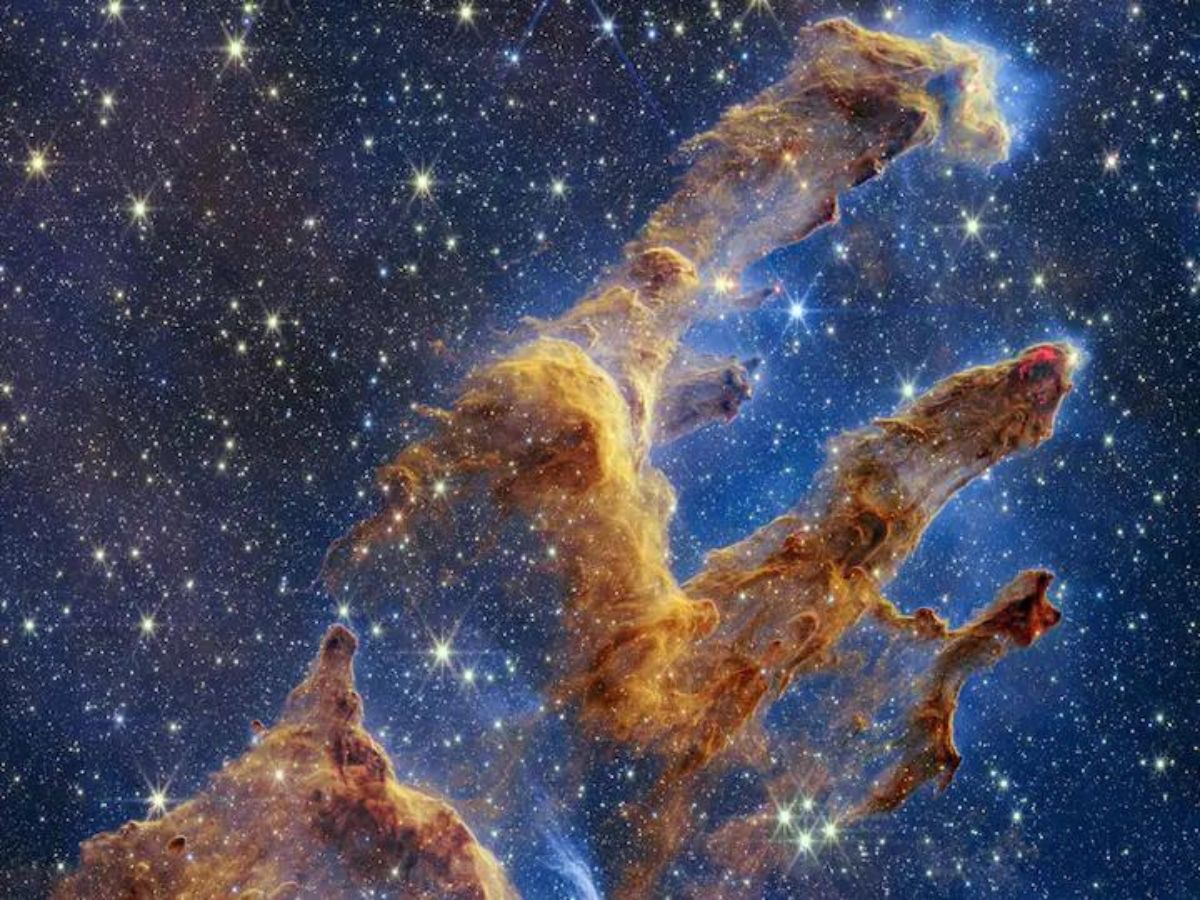
Webb's NIRCam captured the newly formed stars, which are the scene-stealers in the image of the Pillars of Creation. The bright red orbs in the image represent the newly formed structures of the gigantic cosmic entity. These orbs have diffraction spikes and lie outside one of the dusty pillars. Knots start forming within the pillars of gas and dust as mass accumulates. When these knots have sufficient mass, they begin to collapse under their own gravity. Eventually, they form new stars.
ALSO READ | James Webb Space Telescope's Sparkling Image Of Pillars Of Creation, Where Stars Are Born
Why are stars missing in MIRI’s view of the Pillars of Creation?
However, the majority of the stars appear missing in MIRI's view. This is because many newly formed stars are no longer surrounded by enough dust to be detected in mid-infrared light. MIRI observes young stars that have not yet cast off their dusty "cloaks", and are seen as crimson orbs towards the fringes of the pillars. The ageing stars appear blue. This means they have shed most of their layers of gas and dust.
ALSO READ | Lunar Eclipse On Nov 8: All You Need To Know About Last Total Lunar Eclipse For Three Years
What do the hues of red and grey depict?
Mid-infrared wavelength specialises in observing gas and dust in extreme detail, something which is unmistakable throughout the background, NASA says on its website. The densest regions of dust are the darkest shades of grey, the red region toward the top forms an uncanny V, is like an owl with outstretched wings, and is the area where dust is diffuse and cooler.
No background galaxies make an appearance because the interstellar medium in the densest part of the Milky Way's disk is too swollen with gas and dust to allow their distant light to penetrate.
The topmost pillar has a bright red star at its tip. The star and its dusty shroud are larger than the size of the entire solar system.
MIRI's new image has helped astronomers obtain higher resolution data in mid-infrared light than ever before. Next, astronomers will analyse dust measurements to create a complete three-dimensional landscape of the Pillars of Creation.
Related Video
Southern Rising Summit 2024: How Important is Self-Awareness? Insights from Anu Aacharya | ABP LIVE

Top Headlines