US Report Makes Big Claims On Pakistan’s ‘Military Gains’ Against India In May 2025
The report also alleges that China carried out a large-scale information operation during the conflict, using fabricated social-media accounts and AI-generated images to influence public perception.

A new report released by the US-China Economic and Security Review Commission (USCC) has triggered sharp debate after asserting that Pakistan “gained the upper hand” during a four-day conflict with India in May 2025. The commission links this claim to the aftermath of the Pahalgam terror attack, while also alleging that China “opportunistically” used the confrontation to test and showcase advanced weaponry. The report further states that Beijing ran a coordinated disinformation campaign featuring fake social-media accounts and AI-generated images to undermine French Rafale jets and promote its own J-35 fighters.
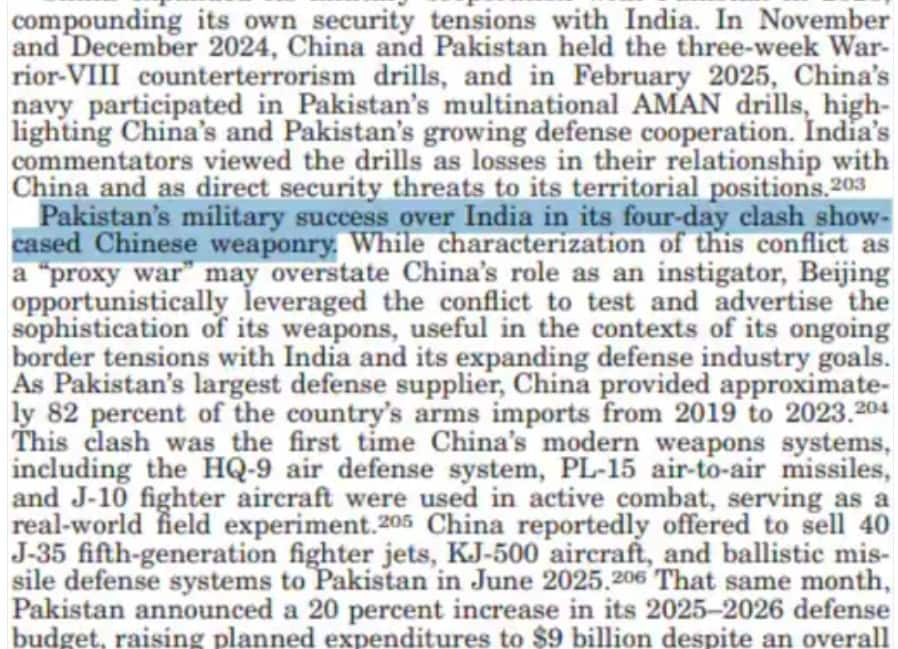
US Report Claims Pakistan ‘Gained The Upper Hand’
According to the USCC document submitted to the US Congress, “Pakistan’s military success over India in its four-day clash showcased Chinese weaponry.” The commission argues that China capitalised on the conflict to assess battlefield performance and highlight its technological capabilities.
India, however, has firmly rejected this characterisation. New Delhi maintains that its response, Operation Sindoor, demonstrated clear military superiority. The operation, conducted on 7 May, involved precision strikes on terror camps located in Pakistan and Pakistan-occupied Kashmir. It was launched in retaliation for the Pahalgam terror attack of 22 April 2025, in which 26 civilians, mostly tourists, were killed after terrorists opened fire on visitors in Baisaran meadow in Jammu & Kashmir’s Anantnag district.
Prime Minister Narendra Modi has repeatedly said India brought Pakistan “to its knees within a few hours” during Operation Sindoor, directly contradicting the USCC’s assessment of the conflict’s outcome.
China Accused Of Spreading Disinformation
The report also alleges that China carried out a large-scale information operation during the conflict, using fabricated social-media accounts and AI-generated images to influence public perception. According to the USCC, the campaign aimed to discredit France’s Rafale aircraft and boost China’s J-35 fighter jets in global defence markets.
While the commission concedes that calling the conflict a “proxy war” may “overstate China’s role as an instigator,” it argues Beijing leveraged the opportunity for strategic benefit. “Beijing opportunistically leveraged the conflict to test and advertise the sophistication of its weapons,” the report states, adding that this aligns with China’s broader defence-industry ambitions and ongoing border tensions with India.
Related Video
US-Venezuela Crisis: Oil or Security? Debate Grows Over US Action in Venezuela and Power Politics

Top Headlines