




Explorer
Ozone Layer Is Healing And It Might Recover Fully, But It Is Not Due To Lockdown
The Earth’s protective layer known as the Ozone layer is showing signs of restoration.
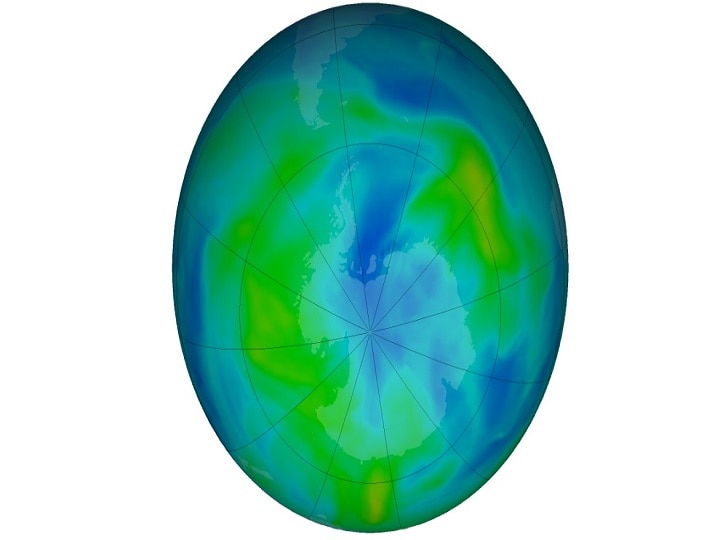
Picture: https://ozonewatch.gsfc.nasa.gov/
New Delhi: The Earth’s protective layer known as the Ozone layer is showing signs of restoration. While it may seem that the recent lockdown all over the world may have impacted the ozone layer, it is steps implemented in the Montreal Protocol (1987) that is helping in the restoration. The Ozone layer makes life on Earth possible; it protects everything from the ultraviolet radiation of the Sun which could have destroyed everything if it wasn’t for the Ozone layer on our stratosphere. The Ozone layer began to deplete due to concentrations of chlorine and bromine which increased markedly in recent decades because of the release of large quantities of man-made compounds mainly chlorofluorocarbons (CFCs) and bromofluorocarbons. These compounds are highly stable and can rise towards the stratosphere. They then initiate and catalyze a chain reaction capable of breaking down over 100,000 ozone molecules. This was a man-made disaster that needed to be corrected which is why the Montreal Protocol was implemented. The Montreal Protocol is a treaty that phases out the production of these numerous Ozone-depleting substances eventually stopping its production altogether. A recent research paper from the University of Colorado Boulder which was published in the journal Nature stated the observation of climate changes in the southern hemisphere specifically the air circulation indicated that the Ozone layer is healing. There is potential for the Ozone layer to recover completely, as the hole on the layer is the smallest it has ever been. Scientists do say that the redirecting wind flows shouldn’t be considered a win just yet because of the rising greenhouse gas emission. It is important to note that the recovery of the Ozone layer will have a different pace in different parts of the world. For instance, the ozone layer is expected to recover to the 1980s levels by the 2030s for the northern hemisphere mid-latitudes and by the 2050s for the southern mid-latitudes, she says, while the Antarctic ozone hole will probably recover a bit later in the 2060s. Closer observation and a continual step towards controlling man-made substances will ensure the protection of the environment
Top Headlines
World

Kimberly Guilfoyle Resigns As US Ambassador To Greece Amid Allegations
News

Mamata Banerjee Allegedly Targeted With Knife During Durga Puja Pandal Visit
India

CJP's Saurav Das, Ashutosh Ranka Booked After Climbing Gate To Enter Jantar Mantar
World

Saudi-Led Coalition Launches Airstrikes Near Yemen’s Capital Sanaa: Reports







See Today's Weather 
powered by



