




Explorer
NPR And Census: Objectives, Characteristics & Differences
Here are the objectives, characteristics and differences between the NPR and the Census.
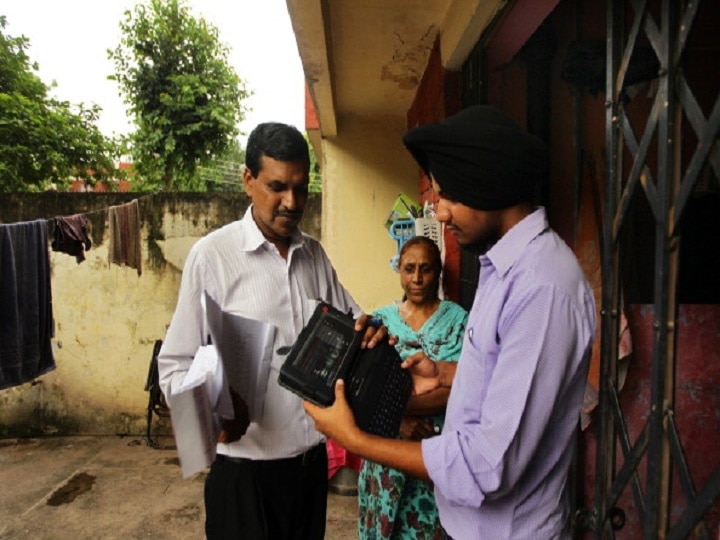
Representational Image: Data entry operator collecting data for the last caste census / (Photo by Kate Geraghty/The Sydney Morning Herald/Fairfax Media via Getty Images)
New Delhi: The government is all set to carry out two mega exercises -- the Census and the update of the National Population Register (NPR) across the country involving every resident next year. Below are the objectives, characteristics and differences between the NPR and the Census. The National Population Register (NPR): The NPR is a register of usual residents of the country. It is being prepared at the local (village/sub-town), subdistrict, district, state and national level under provisions of the Citizenship Act, 1955 and the Citizenship (Registration of Citizens and Issue of National Identity Cards) Rules, 2003. A usual resident is defined, for the purposes of the NPR, as a person who has resided in a local area for the past six months or more, or a person who intends to reside in that area for the next six months. The law compulsorily seeks to register every citizen of India and issue a national identity card. The NPR exercise will be carried out between April and September 2020 in all states and UTs, except Assam, along with the house listing phase of the census exercise. Assam has been excluded because the National Register of Citizens (NRC) exercise has already been conducted in the state. The objective of the NPR, being carried out under the aegis of the Registrar General and ex-Officio Census Commissioner, India, is to create a comprehensive identity database of every usual resident in the country. The database would contain demographic as well as biometric particulars. The demographic details of every individual are required for every usual resident: name, relationship to head of household, father's name, mother's name, spouse's name (if married), sex, date of birth, marital status, place of birth, nationality (as declared), present address of usual residence, duration of stay at present address, permanent residential address, occupation, educational qualification. The data for NPR was last collected in 2010 along with the house listing phase of the Census 2011. Updating of this data was done during 2015 by conducting door to door survey. A gazette notification for the forthcoming NPR has been published by the central government in August. On Tuesday, the Union Cabinet approved funds to the tune of over Rs 8,500 crore for the NPR exercise. The Census: The decennial census is the largest single source of a variety of statistical information on different characteristics of the people of India conducted on the basis of the Census Act enacted in 1948. The census, 2021 will be done in two phases. In the first phase, the work of house-listing or housing census will be conducted from April to September, 2020. In the second phase, the enumeration of population will be done from February 9 to February 28, 2021 with reference moment as 00:00 hours of March 1, 2021. For snow-bound areas in Jammu and Kashmir, Himachal Pradesh and Uttarakhand, the reference date will be October 1, 2020. The census is the basis for reviewing the country's progress in the past decade, monitoring the ongoing schemes of the government and plan for the future. The census provides detailed and authentic information on demography, economic activity, literacy and education, housing and household amenities, urbanisation, fertility and mortality, scheduled castes and scheduled tribes, language, religion, migration, disability besides others. The enumerators also collect data related to cultivators and agricultural labourers, their sex, occupational classification of workers in non-households industry, trade, business, profession or service by class of worker and sex. There will be detailed survey on gender and literacy rate, number of towns, slum households and their population. Information is also collected on sources of potable water, energy, irrigation, method of farming, whether a house is concrete, thatched or others. With a history of more than 130 years, this reliable, time tested exercise has been bringing out a veritable wealth of statistics every 10 years, beginning from 1872 when the first census was conducted in India non-synchronously in different parts. The government of India decided in May 1949 to initiate steps for developing systematic collection of statistics on the size of population, its growth, etc., and established an organisation in the Ministry of Home Affairs under Registrar General and ex-Officio Census Commissioner, India. This organisation was made responsible for generating data on population statistics including vital statistics and census. Later, this office was also entrusted with the responsibility of implementation of Registration of Births and Deaths Act, 1969 in the country.
Top Headlines
India

Victory smiles on those who anticipate changes in character of warfare: IAF chief
India

'Matter of pride for all Indians': Cong hails Pillay on Nobel Peace Prize win
India
Assam: BJP's Devasish Sharma wins Nagaon LS bypoll by 1,42,224 votes
India

Cong not a well-wisher of any class; it is only interested in its own political gains: Prahlad Patel






See Today's Weather 
powered by



