‘No Demonisation Of Mughals’: NCERT Defends Class 8 Textbook Overhaul, Stresses Contextual Learning
NCERT clarified its Class 8 Social Science textbook, aligned with NEP 2020, shifts historical focus to 13th-19th century India, promoting critical thinking, not rote learning.
New Delhi: The National Council of Educational Research and Training (NCERT) has issued a clarification regarding its recently introduced Class 8 Social Science textbook titled “Exploring Society, India and Beyond”. Developed under the National Education Policy (NEP) 2020 and the National Curriculum Framework for School Education (NCF-SE) 2023, the textbook seeks to offer students a multidisciplinary perspective on India’s geography, history, governance, and economy.
The book marks a shift in the timeline of historical teaching. Topics like the Delhi Sultanate, the Mughal Empire, Marathas and the colonial period—earlier taught in Class 7—have now been moved to Class 8, aligning with updated curriculum guidelines.
NCERT clarified that Class 8, being the final year of the middle stage, is a critical phase where students are expected to analyse India’s past, spanning from the 13th century to the mid-19th century, with broader context and deeper thinking. The aim, the Council stated, is not to burden students with facts but to enable thoughtful engagement and develop critical thinking.
NCERT underlined that all facts included in the book are grounded in credible primary and secondary academic sources. The new textbook, it stated, is not just a historical resource but a step towards shaping thoughtful, sensitive, and informed citizens.
‘No Demonisation Of Mughals’: NCERT, Union MoS Respond to Concerns
Michel Danino, who heads the NCERT’s Curricular Area Group for Social Science, defended the textbook, saying it does not aim to vilify the Mughals. “There is no attempt to demonise Mughal rulers,” Danino stated.
Union Minister of State B. L. Verma, speaking to reporters in Lucknow, echoed this view and stressed the importance of teaching historical truths. “The next generation should learn about them. We should accept the truth. The next generation should study what all happened,” said Verma, as per PTI.
‘Note on History’s Darker Period’ Meant to Provide Balanced Context: NCERT
One of the most talked-about elements of the book is a section titled “A Note on History’s Darker Period”, placed on page 20. According to NCERT, this note is intended to protect children from developing bias or confusion by helping them understand complex historical events in the correct context. It addresses episodes involving violence, misrule, and power struggles with a call for objective analysis, stating that “no one should be held responsible today for events of the past.”
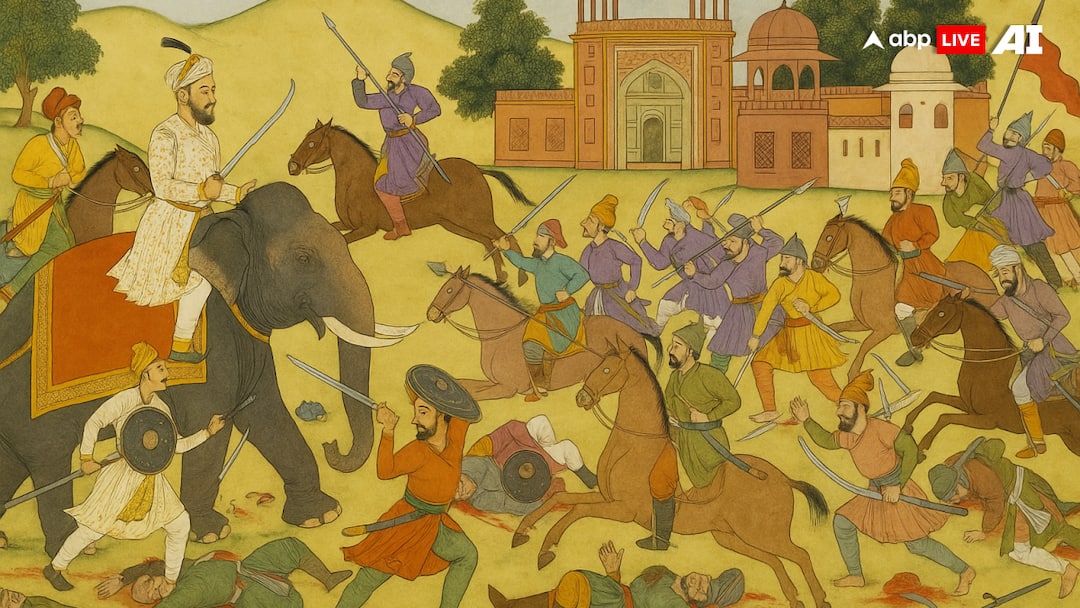
The textbook presents sensitive historical content, such as Babur’s conquests, which are described as brutal with mass killings, and Aurangzeb’s reign, noted for temple and gurdwara destruction and the re-imposition of the jiziya tax on non-Muslims. Akbar’s rule is portrayed as a mix of tolerance and cruelty—acknowledging his administrative policies while also citing the massacre of 30,000 civilians after the siege of Chittorgarh. It also states that non-Muslims were largely excluded from the top administrative positions during his rule.
The jiziya, previously described in older textbooks as a tax levied on non-Muslims alongside land tax, is now presented as a mechanism that served both as public humiliation and as a financial and social incentive for conversion to Islam.
Book Also Highlights Resistance Of Marathas, Rajputs, Ahoms, Sikhs
While the textbook does not shy away from describing episodes of violence and intolerance, it equally celebrates the resistance and resilience shown by various communities during the era. Chapters covering the Marathas, Rajputs, Ahoms, and Sikhs highlight figures such as Chhatrapati Shivaji Maharaj, Ahilyabai Holkar, and Tarabai. Shivaji is referred to as a “master strategist” who upheld Hindu values while showing respect to other religions. His efforts to restore desecrated temples have also been acknowledged.
There are mentions of the Jat peasants who killed a Mughal officer, and the tribal resistance from the Bhil, Gond, Santhal and Koch communities in defence of their territories. The book also discusses Rani Durgavati’s valiant fight against Akbar’s forces and Maharana Pratap’s escape from Mughal pursuit. The resistance by the Ahoms in the Northeast against Aurangzeb’s army is also included.
(With PTI Inputs)
Education Loan Information:
Calculate Education Loan EMI
Related Video
Delhi Election Results 2025: Counting Begins; BJP Poised for Historic Comeback in Delhi, Exit Polls Suggest | ABP News


Top Headlines