Explorer
'Godzilla' Like Dust Cloud Knocking On America's Door; Incredible Images Seen From Space
The dust cloud moved into the eastern Caribbean at the weekend and by Tuesday (June 23) had smothered Hispaniola, Jamaica, Puerto Rico, and eastern Cuba, continuing its advance up and westward toward Central America and the southern United States.

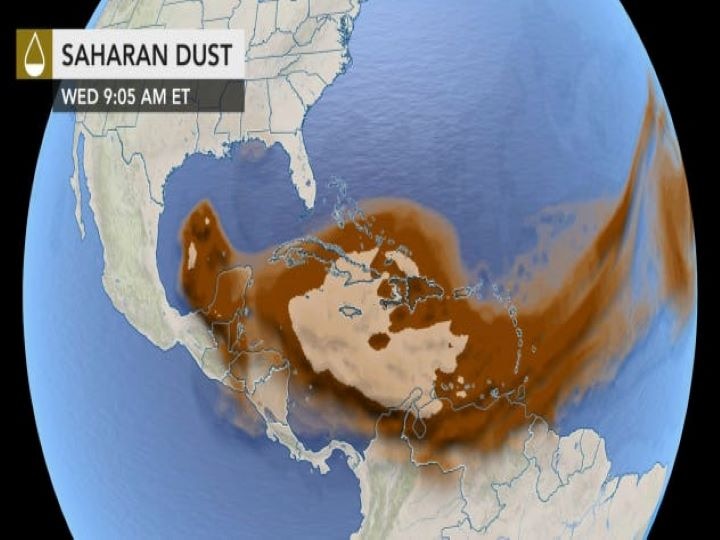
A massive dust cloud from Sahara desert is poised to spread over the US Gulf Coast (Image: AccuWeather)
New Delhi: A 'Godzilla' like giant Saharan dust cloud is moving toward the southeastern U.S. prompting warnings due to hazardous air quality levels. The robust plume of dust, which is knocking on the southern door of the U.S. late Thursday, has been observed on satellite and felt by many in the Caribbean, where it left behind a thin coating on the ground in some areas. The sky turned hazy over the U.S. Virgin Islands and Puerto Rico and visibility was drastically decreased in some areas. While strong warm winds over the Sahara Desert carry plumes of sand thousands of miles across the Atlantic Ocean every year during the summer months, experts say the dust cloud, nicknamed “Godzilla,” is the densest in 50 years. This year, the dust is the most dense in a half a century, according to several meteorologists. The thick smog has sharply reduced visibility.
The plume of Sahara Desert dust is so huge it was able to be photographed by stunned NASA astronauts from space. The dust cloud moved into the eastern Caribbean at the weekend and by Tuesday (June 23) had smothered Hispaniola, Jamaica, Puerto Rico, and eastern Cuba, continuing its advance up and westward toward Central America and the southern United States. Officials across the region warned locals to remain at home when possible and wear a face mask, especially if they already had a respiratory condition, as the dust was a powerful irritant and could contain pathogens as well as minerals.WOW! A plume of dust seen from space on satellite today coming from the Sahara Desert in North Africa. It's moving over the Atlantic Ocean and may bring some hazy sunrise and sunsets to parts of the United States this week. #Space #SaharanDust pic.twitter.com/J7ezuMuCkR
— Mark Tarello (@mark_tarello) June 24, 2020
A model from NASA estimates that much of the dust will dissipate in the Gulf of Mexico before reaching land, and what’s left of the cloud will hit Louisiana, Mississippi, Alabama, and Georgia later this week. The cloud is expected to bring beautiful sunsets to parts of Florida, Texas, and Louisiana. The NASA Earth Observatory said the thickest part of the cloud appears to stretch around 1,500 miles across the Atlantic.Yes - Sahara dust could reach DC area by Saturday or Sunday, according to NASA model (via @weatherbell). If it happens, would like intensify sunsets.
More info: https://t.co/VbTxynjpkm pic.twitter.com/nrqUzsWM0r — Capital Weather Gang (@capitalweather) June 23, 2020
According to the U.S. National Oceanic and Atmospheric Administration (NOAA), the mass of dry and dusty air known as the Saharan Air Layer forms over the Sahara Desert and moves across the North Atlantic every three to five days from late spring to early fall, peaking in late June to mid-August.The station orbited above the shadow of the solar eclipse in Asia then the Saharan dust cloud over the Atlantic on June 21. https://t.co/qcHlvByj8M pic.twitter.com/npgL857jSC
— Intl. Space Station (@Space_Station) June 23, 2020
Follow Breaking News on ABP Live for more latest stories and trending topics. Watch breaking news and top headlines online on ABP News LIVE TV
Read more
Top Headlines
World

'To Protect Victims': Trump Administration Defends Partial Release Of Epstein Files
News
‘Stop Spreading Lies’: Centre Says Over 90% Of Aravalli Region Remains Protected
News

MEA Dismisses ‘Misleading Reports' Of Security Breach At Bangladesh High Commission
India

VB-G RAM G Bill Gets President’s Assent, New Rural Jobs Law In Force












See Today's Weather 
powered by