NASA Celebrates Hubble's 35th Anniversary With Spectacular Space Images
To mark 35 years in Earth’s orbit, NASA is releasing breathtaking images captured by the Hubble Space Telescope, showcasing everything from Mars to distant galaxies and star-forming regions.

The National Aeronautics and Space Administration (NASA) is releasing some of the most stunning space images taken by the Hubble Space Telescope to celebrate its 35th year in Earth’s orbit. From Mars to star-forming regions and a neighbouring galaxy, the Hubble telescope has been significant in transforming the public’s perception of space.
“Hubble opened a new window to the universe when it launched 35 years ago. It's stunning imagery inspired people across the globe, and the data behind those images revealed surprises about everything from early galaxies to planets in our own solar system,” said Shawn Domagal-Goldman, acting director of the Astrophysics Division at NASA Headquarters in Washington said in a statement.
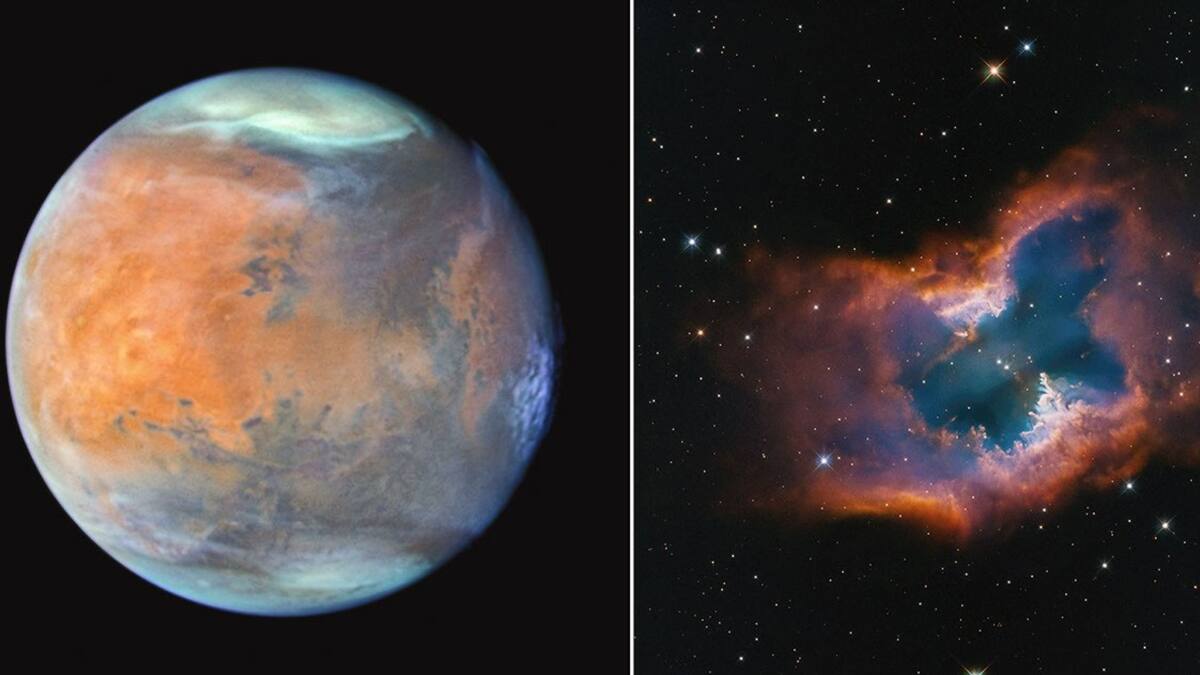
He added, “The fact that it is still operating today is a testament to the value of our flagship observatories, and provides critical lessons for the Habitable Worlds Observatory, which we plan to be serviceable in the spirit of Hubble.”
The telescope was launched into low Earth orbit on April 24, 1990, using the space shuttle Discovery. NASA commentator had described Hubble as a “new window on the universe.
ALSO READ: Gamma-Ray Bursts Reveal Hercules-Corona Borealis Great Wall Is Larger And Closer Than Ever Known
During the three decades of operation, the telescope has made nearly 1.7 million observations and resulted in over 22,000 research papers. Among the many breakthroughs are the observation of seasonal variability on the planets in our solar system, black hole jets travelling at nearly the speed of light, asteroid collisions, expanding supernova bubbles, etc.
Hubble’s deep field images also revealed galaxies dating back to the early universe and helped scientists precisely measure the universe’s expansion and the first measurement of the atmospheres of exoplanets.
Hubble also contributed to the discovery of dark energy, the mysterious phenomenon accelerating the expansion of the universe, leading to the 2011 Nobel Prize in Physics.
Top Headlines