Why Did Trump Meet Pak Army Chief? Here's What US President Said
Trump met Pakistan’s Army Chief at the White House, calling him key to halting war with India. Here’s what the former U.S. president revealed about the high-stakes meeting.

In a surprising departure from his usual rhetoric, former U.S. President Donald Trump acknowledged for the first time in weeks that it was the leaders of India and Pakistan—not himself—who made the pivotal decision to halt a potentially catastrophic military conflict.
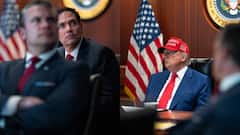
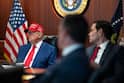
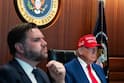
Speaking from the Oval Office on Wednesday, Trump addressed the media after hosting Pakistan’s Chief of Army Staff, General Asim Munir, for a private lunch at the White House. Calling Munir an “honoured” guest, Trump offered rare praise for the leadership in both India and Pakistan, describing Prime Minister Narendra Modi and General Munir as “very smart people” who “decided not to keep going with that war”—a war that, he emphasized, could have escalated into a nuclear confrontation.
“Those are two nuclear powers—big ones. Big, big nuclear powers,” Trump said. “And they decided that [peace] themselves.”
The meeting raised eyebrows, coming just weeks after hostilities between the two nuclear-armed neighbors flared and then abruptly subsided. Until now, Trump had repeatedly credited himself with defusing the tension. This time, however, he shifted focus.
“I Want to Thank Him…”
When asked whether Iran was discussed in the meeting, Trump offered a vague response, suggesting that Pakistan has insight into both Iran and Israel, though he did not elaborate further. He then pivoted to the India-Pakistan situation, stating:
“The reason I had [Munir] here is I want to thank him for not going into the war, for ending the war.”
Trump also noted that Modi had recently visited the U.S. and mentioned ongoing efforts to finalize trade agreements with both India and Pakistan.
A Shift in Tone
For weeks following the May 10 de-escalation between India and Pakistan, Trump publicly claimed credit for brokering peace. He even suggested the U.S. had dangled the promise of increased trade to encourage both sides to back down.
But this Oval Office appearance marked a notable shift. “I don’t think I had one story written,” Trump said with visible frustration. “I stopped the war between two major nations… major nuclear nations. I don’t think I had a story written about it. But the people know.”
Modi’s Side of the Story
Contrary to Trump’s repeated assertions, Indian officials have consistently pushed back against the idea of U.S. mediation or involvement. In a video message from Kananaskis, Canada—where Prime Minister Modi was attending the G7 Leaders’ Summit—Foreign Secretary Vikram Misri clarified the Indian government’s stance.
“At no point during Operation Sindoor was there any discussion, at any level, on an India-U.S. trade deal,” Misri stated, “nor was there any proposal for third-party mediation.”
He emphasized that the decision to cease military action was reached bilaterally, through existing military channels, and initiated at Islamabad’s request.
Modi, he said, made it clear to Trump during a 35-minute phone call that India would never accept third-party mediation and that there is complete political consensus on that issue within the country.
A War Avoided, But at What Cost?
Operation Sindoor was launched by India in response to the April 22 terror attack in Pahalgam that left 26 people dead. The operation targeted terror infrastructure in Pakistan and Pakistan-occupied Kashmir. Over the following weeks, intense drone and missile strikes unfolded across the border.
By May 10, both nations agreed to a ceasefire, reportedly after an understanding was reached between their Directors General of Military Operations (DGMOs). Indian sources have maintained from the start that no external nation played a role in brokering the truce.
Still, Trump has continued to publicly frame himself as the peacemaker—even as Indian officials firmly refute it.
Related Video
Vande Bharat: India’s First Vande Bharat Sleeper Train to Run Between Guwahati and Kolkata

Top Headlines