'Shooting Itself In The Foot': US Science Faces Meltdown As Budget Cuts Trigger Global Brain Drain
Massive funding cuts to US science agencies are driving researchers abroad, sparking a global brain drain that could hand China and Europe the lead in innovation and discovery.
- US budget cuts threaten scientific research, causing
- NSF, EPA, and NIH funding reductions impact climate, pollution, and health.
- US faces loss of scientific leadership, potentially regressing to 1990s levels.
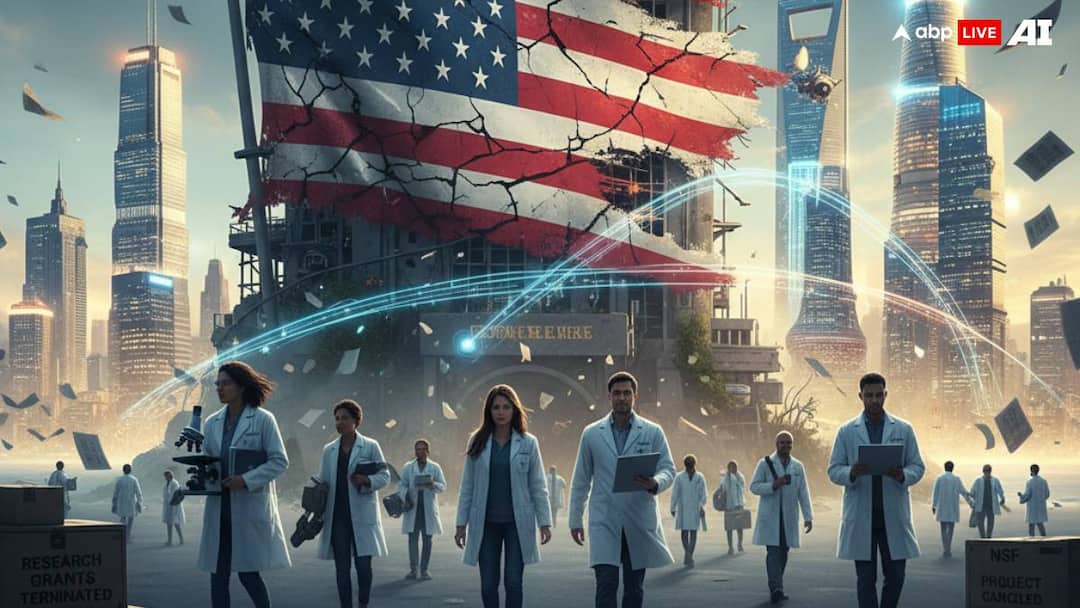
The United States has seen a huge number of budget cuts and slashes in funding that are impacting scientific and environmental research, forcing multiple researchers to leave their ongoing research in the United States for opportunities abroad. This is leading to increased amounts of brain drain, potentially contributing to the creation of a new hub and epicentre of scientific research and studies.
The proposed budget indicated a 56% reduction in the 9 billion USD budget of the National Science Foundation (NSF). More than 1650 grants are in limbo because of their termination. These cuts severely impact climate science, with more than 100 ongoing projects that may be terminated. This March saw the cancellation of 1.7 billion USD worth of grants that were made to help improve air and water pollution, and 20 billion USD to reduce local air pollution, putting the health of Americans at significant risk.
Records are surfacing across scientific domains, which confirm that the Environmental Protection Agency, established in the 1970s, may face a funding crisis. Approximately a grant of 230,000 USD was terminated as it was reaching completion. Such cancellation of grants makes the researchers unable to share the results that the “taxpayers paid for.” The cancellation of more than 3500 grants under the National Institutes of Health (NIH) due to multiple reasons, but one major reason being the 40% cut in funding from the proposed budget, also threatens the US’s position as a global leader in research and gives way for speeding up brain drain from the country.
There have been repercussions and resistance against such draconian steps within the US. Trump’s attempt to restrict NSF’s funding of indirect costs of research grants to 15% has faced legal challenges. These restrictions are not equal for all the institutions of higher learning across the states. The University of California gained two million USD in funding, while some major names in the academic world, such as Harvard and Columbia, are not so lucky.
These changes have already done damage by creating a sense of insecurity and uncertainty among the scientific communities, with increasing distrust in US research funding and grants. These cuts might seem like they are helping taxpayers, but instead are harming the GDP and economic growth of the country. Research indicates that cutting 25% of research and development funding may reduce the US GDP by 3.8% which is similar to the levels during the Great Recession.
Experts claim that the cuts to the funding are drastic enough to spiral the United States’ research and development back to the levels of the 1990s, threatening its scientific global standing, especially in areas such as Artificial Intelligence, quantum physics, and biomedicine. The Global South, primarily China, is using this US uncertainty to its benefit.
They are investing more in biotechnology, research in medical domains as part of an overall national plan, along with coming up with schemes and plans that help fund multiple science and research. The European Union (EU) is filling this global research funding gap with Horizon Europe for research and health technology.
Other countries are seizing this opportunity to recruit top scientists from the US, adding to the brain drain. There is a significant increase (32%) in applications submitted abroad by scientists between January and March 2025 in comparison with. Spain’s ATRAE 2025 programme directly targets American scientists, with each getting up to 1.2 million euros if recruited, trying to position itself as a leader and hub of science and innovation.
France, Norway, and multiple other countries are launching programmes to attract this talent. South Korea and Japan are also beneficiaries of this research exodus from the US.. China is following closely but intently of developing situation with an interest in making the best out of this reverse brain drain. China is removing barriers to attract bright minds and scientists. Handsome monthly allowances and funds of around 140,000 USD will incentivise distraught scientists in the US. This strategic move from China exploits the US’s very own “self-inflicted wound”. A professor who left Baylor for China even said, “The United States is shooting itself in the foot.”
If the US keeps on making it difficult for young minds and long-time researchers to carry on their research, and offers no security. The US have already lost its edge in peer-reviewed publications to China, and now with such retrogressive steps, the Trump administration is handing over its prominence in research and development to developing economies of Asia. The US has earned prominence in science and technology domains due to the hard work of eminent scientists, who were handsomely supported by the federal government since World War II.
The US still leads with 423 Nobel Prizes, followed by the UK (143), Germany (115) and France (76). But this apathy of the current US administration towards research can shift the tide in favour of nations which can exploit this opportunity better. With their novel and attractive policies, they can completely change the discourse of scientific research in the coming decade. The true cost of such anti-research policies will unfold in time, etching an indelible scar upon the global research landscape. Indian scientists are already leaving the US towards prominent opportunities in our nation.
(Kaul is a student and Chowdhury is the Dean of Jindal School of Environment and Sustainability, O.P. Jindal Global University, India)
Disclaimer: The opinions, beliefs, and views expressed by the various authors and forum participants on this website are personal and do not reflect the opinions, beliefs, and views of ABP Network Pvt. Ltd.
Education Loan Information:
Calculate Education Loan EMI

Top Headlines