




Here's why zebrafish always have stripes
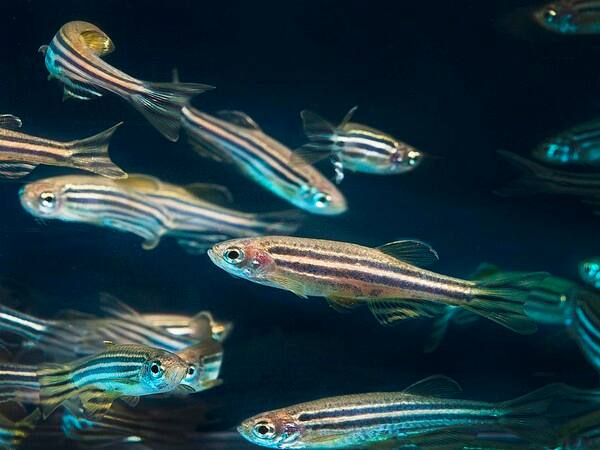
Washington D.C. [USA], Aug 14 (ANI): Researchers at Ohio State University developed a mathematical model that might explain the key role that one of those pigment cells plays in making sure each stripe ends up exactly where it belongs on the fish.
One of the most remarkable things about the iconic yellow and blue stripes of zebrafish is that they reliably appear at all.
Zebrafish begins life as transparent embryos, with three types of pigment cells on their skin. As they develop, the pigment cells somehow manage to organise themselves almost without fail into the stripes we all know.
The cells move around on the skin to create stripes. It's like individual birds that know how to flock together and fly in formation.
This new model suggests that one of the pigment cell types - called iridophores - leads the process of cell organization. These cells provide redundancies in the cell interaction process that ensures that if one interaction fails, another one can take over.
The result is that zebrafish gets their stripes, even when some of the cellular processes go wrong.
Until recently, almost all research on zebrafish stripes focused on the other two pigment cells: the black cells (called melanophores) and the yellow cells (called xanthophores). It wasn't until 2013 that biologists discovered that iridophores also played a role.
"In our mathematical model, we use what we know about the interactions of the other two cell types to explain what drives iridophore behavior. We found that we could predict what iridophores would do in a way that matches up well with what biologists have observed in zebrafish," said Alexandria Volkening, lead author of the study.
Research showed that iridophores change their shape in carefully orchestrated patterns on the skin of zebrafish, and the changes in shape instruct the other two types of cells on where to go in ways that result in stripes.
The model showed that the process is extremely complex. But the complexity is necessary to build redundancy into the process. The researchers found that they could reduce the complexity of the model in some ways, and the zebrafish would still develop stripes.
Because of the redundancies, one can remove some interactions, and still get stripes. They're not perfect stripes, but they are similar. However, there are cases when the process breaks down so much that stripes no longer form. That occurs in some mutations of zebrafish.
The study appeared in the Journal of Nature Communications.(ANI)
This story has not been edited. It has been published as provided by ANI
Top Headlines






