Blue Origin's NS-23 To Launch 36 Payloads To Space Today. Know All About The Mission
NS-23: Blue Origin is launching New Shepard's 23rd mission to space on Wednesday, August 31, 2022. The launch window for NS-23 will open at 13:30 UTC (7:00 pm IST).
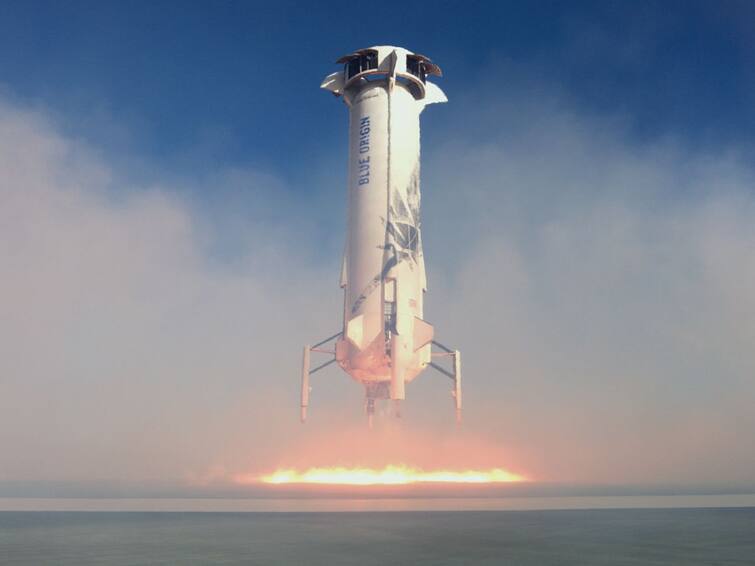
Blue Origin is launching New Shepard's 23rd mission to space on Wednesday, August 31, 2022. The mission, called NS-23, is a dedicated payload flight that will launch 36 payloads from academia, research institutions, and students across the globe, from Launch Site One in West Texas.
The launch window for NS-23 will open at 13:30 UTC (7:00 pm IST) on August 31. If NS-23 is successful, the total number of commercial payloads flown on the New Shepard launch vehicle will become more than 150.
All About Blue Origin’s NS-23
According to Blue Origin, two of the payloads have been fitted on the exterior of the New Shepard booster to ensure ambient exposure to the space environment. NASA has funded eighteen of the payloads on this flight, as part of the Flight Opportunities Program.
As many as 24 payloads are from K-12 schools, universities, and STEM-focused organisations. These organisations include the American Institute of Aeronautics and Astronautics (AIAA), SHAD Canada STEM Foundation, and American Society for Gravitational and Space Research (ASGSR), among others. According to Blue Origin, this is double the number of education-focused payloads from previous payload flight manifests of Jeff Bezos' aerospace firm.
ALSO READ | Artemis I Launches On September 3: All About First Leg Of NASA's Moon Mission
NS-23 will also launch tens of thousands of payloads from Blue Origin's non-profit foundation, Club for the Future. This is a foundation whose mission is to inspire future generations to pursue careers in STEM and help invent the future of life in space. The foundation's Postcards to Space program gives people across the world access to space on New Shepard.
As many as 19 Club for the Future grant recipients, along with their partners, are sending their postcards on this mission. The partners include Guayaquil's Space Society in Ecuador, schools across Kentucky, students who participated in Kenner Planetarium events, and the US Space and Rocket Center.
NS-23 will be the fourth flight for the New Shepard program this year, and the ninth flight for the New Shepard launch vehicle. The mission is also Blue Origin's first dedicated payload since NS-17 in August 2021.
As many as 31 humans have been launched to space atop the New Shepard rocket so far. NS-23 will be Blue Origin's 23rd mission, and a suborbital uncrewed flight.
Science Experiments Flying On Blue Origin’s NS-23
Some of the science experiments launching aboard the NS-23 mission include Infinity Fuel Cell's AMPES experiment, Honeybee Robotics' ASSET-1, University of Florida's BISS, NASA Armstrong Flight Research Center's Fiber Optic Sensing System technology, and Johns Hopkins University Applied Physics Laboratory's JANUS payload, among others.
Infinity Fuel Cell's AMPES experiment will demonstrate the operation of hydrogen fuel cell technology in microgravity, and is a scalable, modular, and flexible power and energy product. AMPES technology could be used for lunar rovers, space habitats, and surface equipment.
Honeybee Robotics' ASSET-1 is a testbed designed to study the strength of planetary soils, called regolith, under different gravity conditions, and will be tested in microgravity to help determine the soil strength of celestial bodies such as asteroids. The future iterations of ASSET could be used to study parameters such as particle sizes and different loading conditions.
The Biological Imaging in Support of Suborbital Science (BISS) experiment is developed by the University of Florida. The technology was originally designed for the International Space Station. The fluorescence imaging system of BISS will enable increasingly precise and dynamic understanding of biological responses to suborbital missions.
NASA Armstrong Flight Research Center's space-rated Fiber Optic Sensing System (FOSS) technology will be used for structural health monitoring.
The Johns Hopkins Applied Physics Laboratory's JANUS payload will be mounted on the New Shepard Propulsion Module for the first time to measure conditions outside the crew capsule and enable access to the space environment, and will provide important insight into a critical but difficult-to-study region of Earth's atmosphere.
The JANUS Payload will also facilitate lower cost technology testing for missions to Earth's orbit and beyond.

Top Headlines