




Expert Advisor In Forex: Everything You Need To Know About EA Trading Robots
Expert Advisors (EAs) are automated Forex trading robots that execute strategies without emotion, offering a hands-off approach to the market.

Imagine having a trading assistant who never sleeps, never gets emotional, and follows your rules with absolute discipline. That’s exactly what an Expert Advisor (EA) is designed to do. In today’s fast-moving Forex market, EAs have become one of the most talked-about tools — praised by some as life-changing, while criticized by others as dangerous if misunderstood.
So what’s the truth behind Expert Advisors? Are they the secret weapon to long-term success, or just another overhyped gimmick? Let’s break it down in detail.
What Exactly is an Expert Advisor?
An Expert Advisor (EA) is essentially a piece of software (or trading robot) that runs inside platforms like MetaTrader 4 (MT4) and MetaTrader 5 (MT5).
Unlike human traders, an EA doesn’t “think” — it simply follows instructions coded into its algorithm. Those instructions can be as simple as:
- “If RSI is below 30 → Buy.”
- “If price breaks above the 200 Moving Average → Open a long position.”
Or as complex as multi-layered strategies combining trend filters, volatility detection, and money management rules.
The beauty of an EA is that once you set it up, it can monitor markets 24/7 and execute trades automatically, freeing you from hours of screen-watching.
💡 Think of an EA as a pilot on autopilot mode: it can fly the plane safely under most conditions, but you (the trader) are still the captain responsible for the journey.
👉 If you’re brand new to Forex, it may help to check this beginner’s guide to Forex before diving deeper into EAs.
How Did Expert Advisors Come About?
The story of EAs begins in the early 2000s, when MetaQuotes Software launched the MetaTrader platforms with their own coding languages (MQL4/MQL5). Traders quickly realized they could automate repetitive strategies by turning them into scripts.
- At first, these robots were simple, usually tied to indicators like Moving Averages.
- Later, more aggressive strategies like Scalping and Martingale
- Today, the frontier is AI-powered EAs that learn from big data and adapt to changing market behavior.
In short, Expert Advisors have evolved from being “trading calculators” to becoming sophisticated algorithmic engines — though their success still depends heavily on who built them, and how they’re used.
How Does an EA Actually Work?

Behind every EA lies a set of rules. The EA scans charts, applies its logic, and then decides whether to:
- Send you a signal.
- Or place the trade automatically.
Most EAs rely on a combination of:
- Indicators: Moving Average, RSI, MACD, Bollinger Bands.
- Price action: Candle patterns, breakouts, volatility filters.
- Risk rules: Stop Loss, Take Profit, position sizing.
Once conditions are met, the EA acts instantly — faster than any human could.
The Upside and Downside of Using Expert Advisors
Like any tool, EAs have strengths and weaknesses.
✅ Advantages
- Hands-off trading: Perfect for those who don’t want to sit in front of charts all day.
- Emotion-free decisions: No fear, no greed — just rules.
- Consistency: Follows the plan without hesitation.
- Scalability: You can run multiple strategies at once across different pairs.
❌ Disadvantages
- Market dependency: An EA that works in trending markets may fail in choppy ranges.
- Hidden risk: Strategies like Martingale look amazing until they wipe out accounts.
- Blindness to news: EAs don’t “understand” central bank meetings or economic releases.
- Scams: The internet is full of overpriced EAs promising “guaranteed profits.”
⚠️ If you’ve seen ads boasting a 100% win rate EA, run. No real system works like that.
Types of Expert Advisors You’ll Encounter
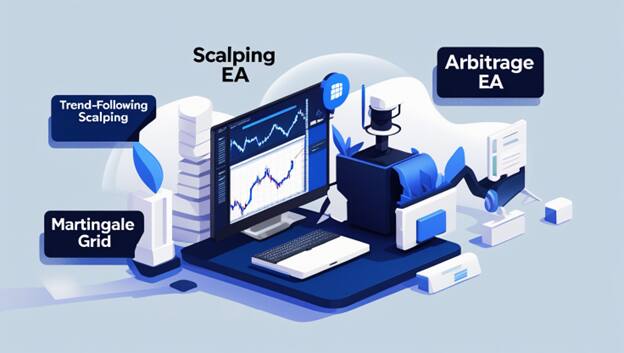
There isn’t just one type of EA — and knowing the difference matters.
- Trend-Following EA
- Follows the main market direction.
- Strong when markets trend, weak when they go sideways.
- Places quick trades for tiny profits.
- Demands low spreads, lightning-fast execution, and often a VPS.
- Uses position scaling to recover losses.
- Looks good on backtests, but carries explosive risk.
- Exploits price differences between brokers.
- Profitable but often banned.
- Learns patterns using machine learning.
- Still new, expensive, and sometimes overhyped.
👉 To see more Expert Advisors with different types, visit https://ecomforex.com/
How to Choose the Right EA
With so many EAs out there, how do you avoid buying a lemon? Here are three golden rules:
- Check Reputation First
- Look for real performance records verified on sites like Myfxbook.
- Read trader forums (Forex Factory, Trustpilot).
- Be skeptical of any EA claiming guaranteed profits.
- Test, Test, Test
- Run backtests on historical data.
- More importantly, try forward testing on a demo or small live account.
- An EA should perform decently across different conditions — not just cherry-picked periods.
- Manage Risk Like a Pro
- Never let an EA trade your full account without limits.
- Always define Stop Losses.
- Avoid Martingale/Grid unless you fully understand the risk.
✅ The smartest traders treat EAs as allies, not as money-printing machines.
How to Install and Use an EA
The setup is easier than most beginners think.
On MT4
- Open File → Open Data Folder.
- Copy the EA file into MQL4 → Experts.
- Restart MT4.
- Drag the EA from the Navigator into your chart.
- Enable AutoTrading.
On MT5
Same steps, except files go into MQL5 → Experts, and the EA format is .ex5.
👉 For extra clarity, here’s the official MetaTrader guide.
Mistakes Beginners Often Make
Even with the best EA, many traders sabotage themselves by:
- Believing marketing hype (“zero risk” robots).
- Ignoring money management.
- Running an EA without even knowing its strategy.
- Thinking they no longer need to learn trading.
⚠️ Expert Advisors using AI can be viewed here : https://eaforexstore.com/
The Future of Expert Advisors
We’re moving toward a new era of AI-driven trading robots. Some of the latest EAs are experimenting with:
- Neural networks that detect hidden market patterns.
- Big Data analysis for multi-market insights.
- Hybrid models combining manual input with automation.
It’s not far-fetched to imagine a future where traders use AI copilots that adapt in real time, almost like having a personal quant hedge fund in your computer.
Conclusion: Should You Use an Expert Advisor?
The answer is: Yes, but with caution.
An Expert Advisor can give you consistency, save time, and even outperform your manual trading in certain conditions. But it’s not magic. Markets change, and no robot is perfect.
The best approach?
- Use EAs as helpers, not replacements.
- Always back them up with risk management and market knowledge.
- And remember: you are still the pilot, the EA is just autopilot.
Disclaimer: This article is a paid feature. ABP and/or ABP LIVE do not endorse/ subscribe to the views expressed herein. We shall not be in any manner be responsible and/or liable in any manner whatsoever to all that is stated in the said Article and/or also with regard to the views, opinions, announcements, declarations, affirmations, etc., stated/featured in the said Article. Accordingly, viewer discretion is strictly advised.


