Removing Hurdles For Women Workers, Tackling Child Poverty: Social Policies That Will Boost Job Creation
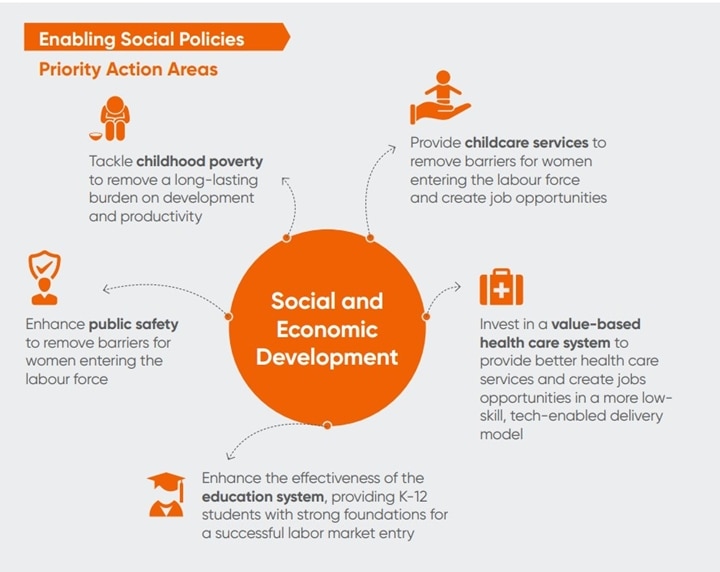
The priority action areas identified in the India@100 Action Report include tackling childhood poverty and providing childcare services to remove barriers for women entering the labour force.

Addressing the nation from the ramparts of Red Fort on August 15, marking 75 years of the country’s Independence, Prime Minister Narendra Modi set an ambitious target of making India a developed nation by 2047. To achieve this goal, the Economic Advisory Council to Prime Minister (EAC-PM) has identified '4S' principles, setting out a roadmap for India to become a high-income country by 2047. The '4S principles' stand for social progress, shared growth, sustainable progress and solid foundations.
To boost job creation and enable economic growth, the Economic Advisory Council to the PM has stressed on "social progress" as a priority sector. Integration of social and economic development is of paramount importance for overall growth of the country.
"Efforts to trigger job creation at different stages of individuals' labour market journey need to be supported by enabling social and economic policies," the India@100 Action Report says.
EXPLAINED | '4S' Principles That Redefine India's Approach To Achieve Prosperity By 2047
The priority action areas identified in the report include tackling childhood poverty to remove a long-lasting burden on development and productivity, providing childcare services to remove barriers for women entering the labour force, enhancing the effectiveness of the education system.
The other two areas mentioned are investing in a value-based healthcare system to provide better services and create job opportunities in a more low-skill, tech-enabled delivery model and enhancing public safety to remove barriers for women entering the labour force.
Tackling Childhood Poverty
Recently, an UN report said child labour, caste-based discrimination and poverty were closely inter-linked in India. The India@100 Action Report also says that childhood poverty is a "critical concern in India''. It further says that addressing childhood poverty was a social as well as an economic imperative.
"Stunting and other impediments to development reduces children's productive capabilities throughout their life. There has been progress in reducing rates of stunting, but India still ranks below many of its peers," the report says.
Stunting is the impaired growth and development that children experience due to poor nutrition and infection.
According to the National Family Health Survey (NFHS)-5, India has high levels of stunting. In 2019-21, 35.5 per cent of children below five years were stunted and 32.1 per cent were underweight.
To tackle the issue of stunting, the India@100 Action Report cited Indonesia's Program Keluarga Harapan (Family Hope Program). Indonesia's Family Hope Program is a conditional cash transfer programme that has achieved significant reductions in stunting.
"India can build on these practices and combine them with the 'India stack' technology solutions that India has successfully applied in other areas of social policy," the report says.
Low Quality Of Education
The report mentions low quality of education and skill mismatch in the labour market as another area of concern. Besides, it says access to proper education infrastructure through government-run schools is low. "Even poor parents are keen on paying higher fees in a private school with better services," the report notes.
While the education system has expanded significantly, with the secondary enrollment rate in 2020 at 75%, compared to 65% in 2010, India's economy is being held back by an education and skill system that struggles to meet the needs of students and firms, the report says.
As students leave schools and graduate from universities, they find their skills to be of limited value in the labour market.
As per data cited in the report, more than 40% of all Indians 15-24 years of age are neither in education, employment, or training. This is far above South Asian (30%) and global (24%) averages.
Companies have highlighted skill shortages in the country as very high compared to other countries. They found only about 50% of graduates as employable.
However, the report mentions that the 'New Education Policy' and the Skill India or the National Skills Development Mission of India have focused on these issues.
"But it will be critical to achieve higher impact from these efforts. Priority now needs to be given to effective implementation mechanisms," the report states.
Removing Barriers For Women Workers
In the report, the policy makers have identified that it was important to open the labour market to women workers. Low-skilled and women workers are currently outside of active employment.
As per data, Indian women account for only 25% of all employees, and their wages are less than 50% of the national average.
It is only in the healthcare sector that there is a high share of women employment.
"The provision of childcare services and investments in public safety are often critical factors for women to consider looking for employment," the report states.
"India needs enabling social policies that enhance the employability of labour market entrants and reduce barriers to look for a job. These policies will address urgent social needs across the country and trigger job creation opportunities," the report further says.
On the brighter side, the report mentions that Indian women have made large gains in education and now have enrollment rates at all levels that are higher than men.
However, there are still 186 million women who are unable to read or write a simple sentence in any language, and the female literacy rate is at 65%, more than 15% points behind men.
"Young people -- especially young women -- drop out of the labour force as they look for but do not find employment after finishing their education," the India@100 Action Report mentions.
Related Video
India@2047 Summit: Modi Calls for Innovation, Reforms, and National Resolve

Top Headlines