OPINION | Manipur’s Deep Divide: Why The State’s Governance Crisis Demands A Federated Future

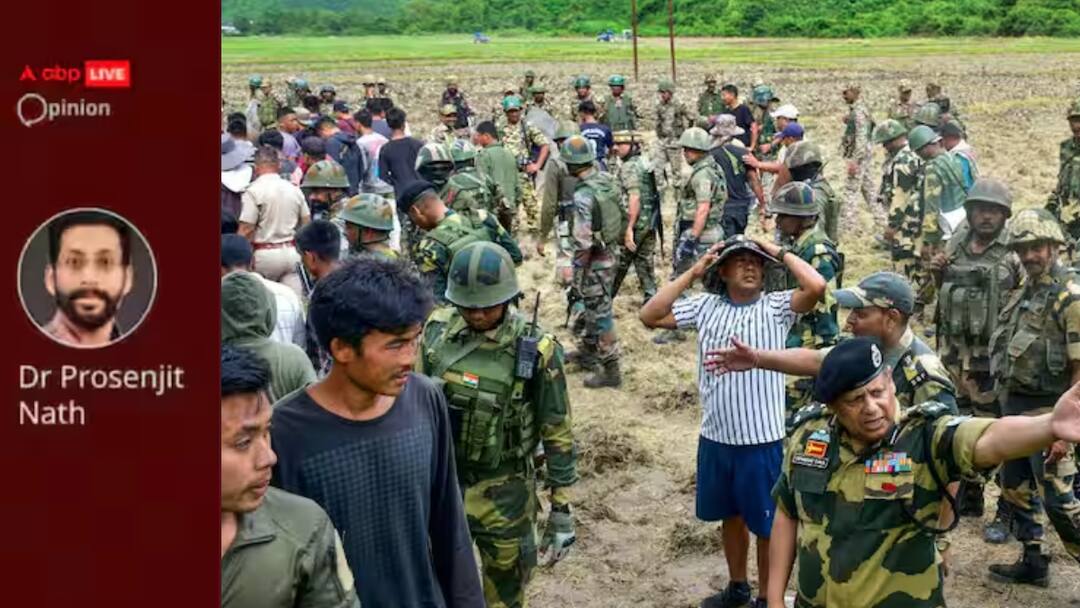
Manipur today stands as one of the most glaring examples of how a flawed governance model in a pluralistic society can implode into a full-blown ethnic conflict. The state’s continuing ethnic strife since May 2023 has not merely exposed temporary fissures but has brought to light a deep structural crisis in its governance framework. For decades, democratic majoritarian rule in Manipur has systematically empowered the dominant Meitei community to appropriate the lion’s share of resources, institutions, and infrastructure, while equity for the minority tribes has remained an unfulfilled promise. What we are witnessing is not just episodic violence but the culmination of accumulated grievances born out of imbalance in developmental growth, skewed prosperity, and an inability or unwillingness of the political class to deal with the fundamental questions of equity.
Equity in resource allocation, institutional support, political power-sharing, and empowerment of constitutionally mandated structures such as the Hill Areas Committee are no longer abstract ideals; they are urgent necessities. The violent conflict between the Meitei community and the Zo (Chin, Kuki, and Mizo) ethnic groups has shattered the illusion of an inclusive and impartial state. Even six months into President’s Rule, the return of Zo legislators, administrators, and bureaucrats who represent nearly 16 per cent of the state’s population remains elusive. Their continued absence from Imphal’s political, legislative, and judicial institutions has effectively tilted the balance of governance in favour of a heavily Meitei-centric state machinery. The September 18, 2025, notification of the Land Resources Department, widely perceived to be Meitei-biased, only reinforces this suspicion.
Historically, the Meiteis have dominated political power in the state, but with the banishment of Zo representatives, they now enjoy near-total control of both political and bureaucratic levers. The tiny presence of ten Naga MLAs and a handful of bureaucrats has been eclipsed entirely. What is particularly perplexing, and perhaps troubling, is the silence of both the Meitei majority and the Naga tribes in pressing for the return of the Zo group to the political mainstream. This lack of urgency suggests either complacency with the current imbalance or an underestimation of the dangers of leaving a large section of society permanently alienated. For any democracy, the absence of representation of a sizable community in its capital’s institutions is simply unacceptable.
Beneath this unrest lies a much larger political question: can Manipur remain a unified state without fundamentally restructuring how resources, infrastructure, and power are shared between the valley and the hills? The Meitei demand for Scheduled Tribe status epitomises this question. While framed as a quest for identity preservation and access to reservations, it is widely seen by the tribal groups as a calculated move to circumvent protections under Article 371-C and the Manipur Land Revenue and Land Reforms Act, 1960, which restricts non-tribals from acquiring land in the hills. Given that the Meiteis are already classified as SC and OBC, their demand raises questions about motives. The real anxiety among the tribes is that this is less about identity and more about gaining legal access to tribal lands. As history has repeatedly shown, disputes over land, whether in Ukraine, Gaza, or Northeast India, are tinderboxes for prolonged conflicts.
The tribal front, unfortunately, remains divided. Historic rivalries between the Nagas and Kukis have prevented any semblance of a unified response to the dominance of the valley. The Meitei political class, with its entrenched access to state power, has exploited this disunity to perpetuate a “divide and rule” arrangement. While Nagas continue to wait for clarity on the long-delayed Naga Framework Agreement, the Zo community, devastated by the violence, has openly demanded a separate administration. It is tragic to see two tribal groups, both facing systematic marginalisation, unable to forge a common platform when the stakes could not be higher. Without unity, they risk losing not just political leverage but also their ancestral lands and the cultural protections that define their existence.
Demographics add yet another layer of complexity. The Meiteis currently account for more than 50 per cent of the population, while combined tribal groups make up about 41 per cent. But demographic trends suggest that tribal populations are growing at a faster pace due to higher fertility rates and relative backwardness. The 2027 Census may narrow this population gap, and with delimitation slated to follow in 2028–29, political equations could change drastically. More seats could shift towards the hills, making Muslim legislators potential kingmakers in the balance. Ironically, a constitutional mechanism designed to ensure democratic fairness delimitation may be perceived as a threat by those who have long benefited from the existing imbalance. Already, the hill areas have lost three assembly seats due to a Supreme Court-directed delimitation based on the 2001 Census, and this has only deepened tribal resentment.
In this context, the demand for including Manipur’s hill areas under the Sixth Schedule of the Constitution deserves serious consideration. It offers a middle path between outright separation and the status quo. By empowering Autonomous District Councils with legislative and fiscal authority over land, resources, and local governance, such a system can safeguard tribal interests without altering Manipur’s territorial integrity. Models exist in Assam, Meghalaya, Mizoram, and Tripura, all of which have successfully experimented with federated governance under the Sixth Schedule. Yet scepticism persists, and understandably so. The trust deficit between the state government and tribal communities runs deep, with many fearing that even constitutional safeguards would be diluted or bypassed. This explains why calls for separation, whether through statehood, union territory status, or separate administration, are gaining mainstream acceptance in the hills.
The larger question is whether Manipur can imagine a federated governance vision that recognises the distinct identities and aspirations of its three broad communities: Meiteis, Nagas, and Zo groups. The Indian Constitution already provides mechanisms for such an arrangement under Articles 244(2) and 244-A, as demonstrated in the Bodoland Territorial Council. Such a vision must go beyond token gestures and involve meaningful tribal autonomy, political safeguards ensuring power-sharing in the Council of Ministers, fiscal and administrative independence for district councils, and a strengthened Hill Areas Committee to promote inter-community dialogue. Crucially, the central government must be perceived as impartial, not aligned with the dominant valley interests.
The crisis in Manipur cannot be treated as episodic violence demanding temporary solutions. It is a structural malaise born of entrenched inequities. The asymmetry between valley and hill areas in terms of resources, institutions, political power, and land rights requires systemic correction. President’s Rule offers a rare window to implement neutral governance reforms, but only if used wisely. Delhi must resist the temptation of expediency and instead initiate a credible framework for federated governance.
Manipur’s crisis shares echoes with Ladakh, where people are demanding statehood and Sixth Schedule protection. Both cases underline the urgent need for constitutional safeguards for tribal communities to prevent majoritarian dominance. The longer Delhi delays, the more mainstream demands for separation will become. If power centers in Delhi and Imphal are serious about resolving Manipur’s turmoil, they must put forth a concrete proposal and begin negotiations now.
The choice before Manipur is stark: continue down the path of exclusion and majoritarianism, risking permanent fracture, or embrace a federated system that institutionalises equity and coexistence. The illusions of harmony have already been shattered. What remains to be seen is whether Manipur and the Indian Union can move beyond illusions and build a governance model that truly reflects the pluralistic reality of the state. The answer lies not in suppressing grievances but in restructuring power so that every community has a stake in Manipur’s future.
(The writer is a technocrat, political analyst, and author)
Disclaimer: The opinions, beliefs, and views expressed by the various authors and forum participants on this website are personal and do not reflect the opinions, beliefs, and views of ABP Network Pvt. Ltd.

Trending News