Ancient Marine Predator, Once Thought To Be A Bone-Crusher, Probably Preferred Soft Prey: Study
With a long frontal appendage and flexible flaps on the sides, the 60-cm-long ancient marine predator known as Anomalocaris canadensis was an efficient swimmer and apex predator.
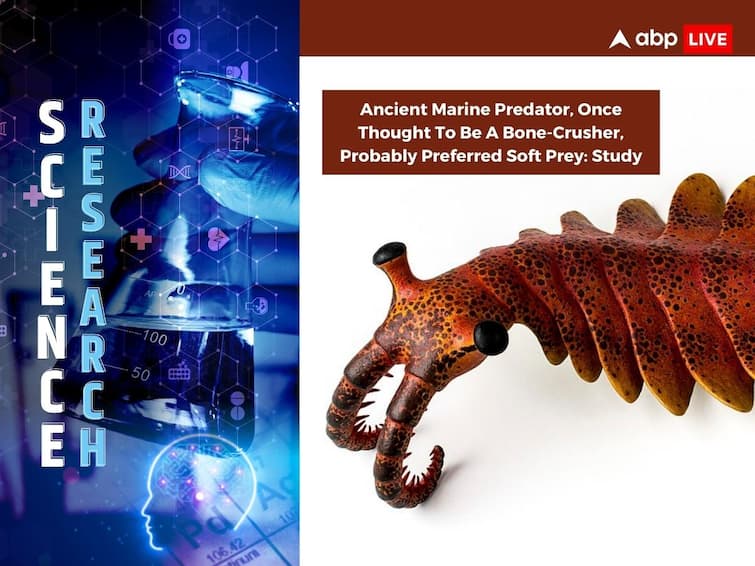
During the Cambrian Period, about 500 million years ago, the Earth saw an explosion of various complex species, particularly in the sea. Among these marine species was a large shrimp-like creature, now extinct, called Anomalocaris canadensis. With a long frontal appendage and flexible flaps on the sides, the 60-cm-long Anomalocaris canadensis was an efficient swimmer and apex predator.
Previously, it was thought to be responsible for the crushed skeletons of trilobites (these are extinct marine arthropods) that have been found around its habitat. New research, however, suggests that its choice of prey was limited. Using 3D reconstructions of Anomalocaris canadensis and modelling, scientists have found that grabbing hard prey like trilobites would have damaged its appendages. Anomalocaris canadensis most likely preferred soft prey, the scientists have concluded in a study published in the journal Proceedings of the Royal Society B.
The curious animal was first discovered in Canada in the late 1800s, and its name, ‘Anomalocaris canadensis’, is a Latin phrase that means “weird shrimp from Canada”. Although it was thought responsible for the crushed skeletons of trilobites, the authors of the new study thought this was unlikely.
“That didn’t sit right with me, because trilobites have a very strong exoskeleton, which they essentially make out of rock, while this animal would have mostly been soft and squishy,” lead author Russell Bicknell said in a statement released by the American Museum of Natural History. Bicknell is a postdoctoral researcher in the Museum’s Division of Paleontology, and conducted the work on Anomalocaris canadensis at the University of New England in Australia.
Earlier research had already found that the mouth of Anomalocaris canadensis was unlikely to be able to process hard food. In the new study, researchers examined whether the front appendages could have crushed hard food.
Researchers from several countries built a 3D reconstruction of Anomalocaris canadensis based on fossils found in Canada. They then reconstructed its movements using modern whip scorpions and whip spiders for comparison. These biomechanical studies threw light on the animal’s strengths. It was likely to have been very agile, and would have darted after its prey in open water (soft prey abounded in open water while hard prey such as trilobites would have rested on the ocean floor).
The animal’s appendages were able to stretch out and grab prey, but were probably much weaker than what was once believed. Modelling showed that the appendages would have been damaged while grabbing hard prey like trilobites. In conclusion, Anomalocaris canadensis was probably a fast swimmer that zoomed after soft prey in an open water column, with its front appendages outstretched.

Top Headlines