





XPoSAT: XSPECT Payload Of India's First Black Hole Mission Captures Light From Cassiopeia A Supernova Remnant. Know More
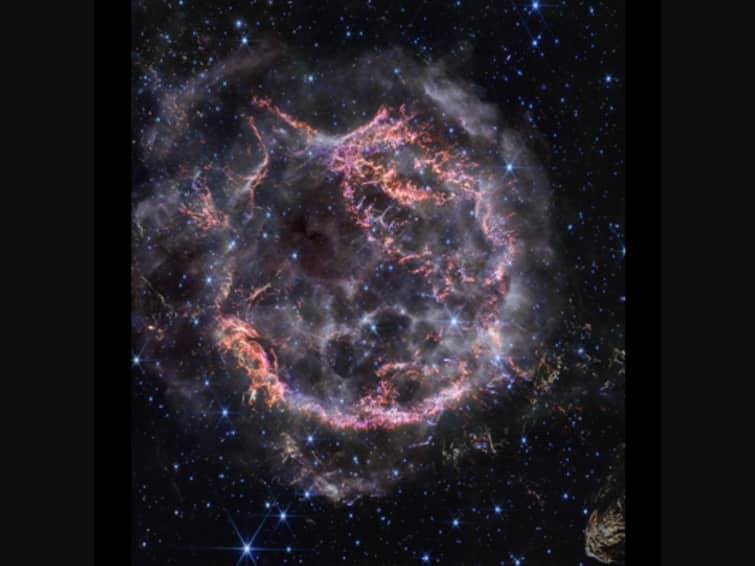
XPoSAT, India's first mission to study black holes and neutron stars, has captured light from the Cassiopeia A (Cas A) supernova remnant. It captured the supernova remnant's emission lines corresponding to magnesium, silicon, sulphur, argon, calcium, and iron.
Source : NASA
XPoSAT's XSPECT payload has captured its first light from Cassiopeia A. started observing Cassiopeia A on January 5, 2024, and captured the supernova remnant's emission lines from different elements.
XPoSAT, India's first mission to study black holes and neutron stars, has captured light from the Cassiopeia A (Cas A) supernova remnant. Short for X-ray Polarimeter Satellite, XPoSAT is India's first dedicated polarimetry mission to study the dynamics of bright astronomical X-ray sources in extreme conditions, which means the spacecraft will analyse X-rays emitted by celestial bodies such as black holes, neutron stars, active galactic nuclei, and pulsar wind nebulae by measuring the beams of


