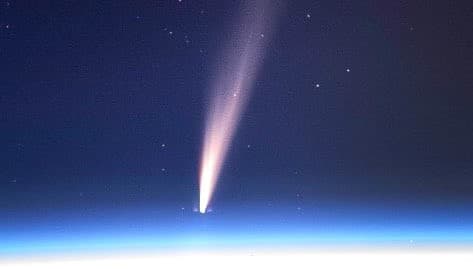
In the rare celestial event, occurring once every 160,000 years, the Comet G3 ATLAS (C/2024) is likely to reach its peak brightness within 8.7 million miles of the Sun at its perihelion. The comet was initially faint, shining at a magnitude of +19 when it was discovered on April 5, 2024, by the Asteroid Terrestrial-impact Last Alert System (ATLAS) in Chile.
According to a report by India Today, recent observations revealed a significant increase in brightness following a dramatic outburst on January 2, 2025. This surge has sparked predictions that the comet could surpass the brightness of planets like Venus and Jupiter, potentially becoming the brightest comet observed in nearly two decades.
Comet G3 ATLAS To Visible To Naked Eye
Astronaut Don Pettit captured stunning images of this rare comet from the International Space Station as it continues its cosmic journey above Earth. On January 13, 2025, the comet G3 ATLAS will reach its closest approach to the Sun. With an expected brightness of approximately -3.2 magnitude, it will be visible to the naked eye under favourable viewing conditions.
People in the Southern Hemisphere can experience the best viewing opportunities shortly after sunset. But, in the Northern Hemisphere viewing may be more difficult due to its low position on the horizon and the interference of bright twilight.
Astronomers are closely observing G3 ATLAS as it approaches perihelion. The comet’s close proximity to the Sun raises concerns about its stability, as large comets often fragment during such encounters.
Despite this unpredictability, anticipation is high among stargazers and scientists, who are preparing for what could be a once-in-a-lifetime celestial event. However, binoculars are recommended to improve the visibility especially those who are eager to catch a glimpse of this extraordinary visitor from the outer solar system.
ALSO READ | Comet Nishimura: Newly Discovered Rare Green Comet To Be At Its Closest To Earth Tonight. How To Spot It