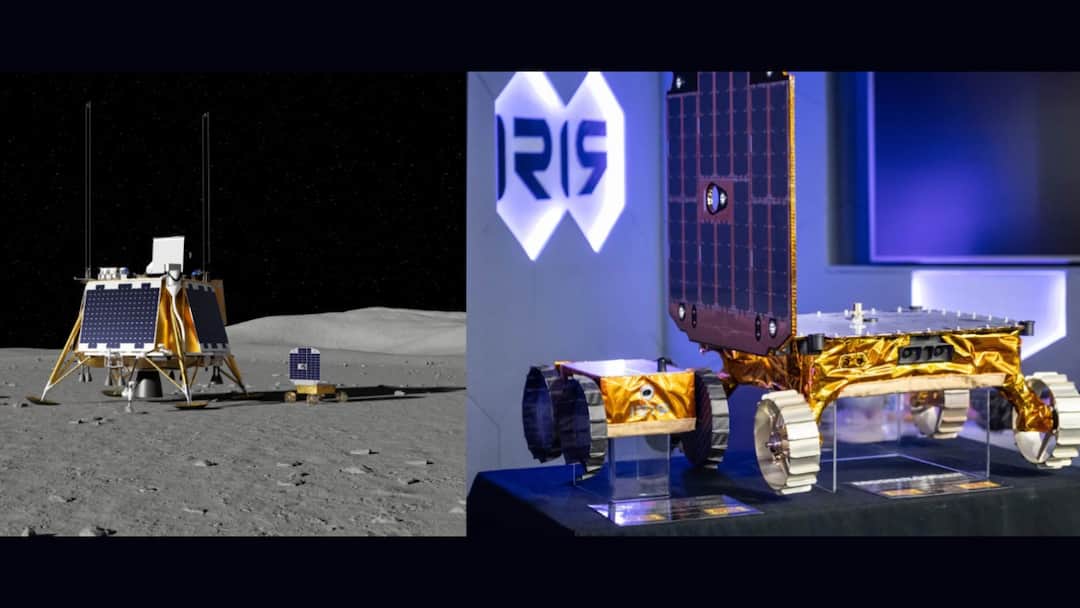
NASA has awarded Firefly Aerospace a $176.7 million contract to deliver two rovers and three scientific instruments to the Moon’s South Pole in 2029 under its Commercial Lunar Payload Services (CLPS) program. Valued at $2.6 billion overall, CLPS is a cornerstone of NASA’s Artemis strategy, relying on commercial companies to lower costs and accelerate access to the lunar surface. It envisions establishing a permanent base on the Moon and ultimately facilitating human missions to Mars. Firefly’s selection marks its fifth CLPS award and highlights the growing role of private enterprise in building the space economy.
The 2029 space mission, called Blue Ghost Mission 4, will be the first to deliver and operate multiple rovers and scientific instruments simultaneously in the Moon’s South Pole region, a site of intense scientific and economic interest due to the likelihood of water ice in permanently shadowed craters. If confirmed, these reserves could be used to support astronauts with drinking water and oxygen, while also being refined into rocket fuel, reducing the cost of future missions and unlocking new commercial possibilities in space.
Firefly Aerospace, headquartered in Cedar Park, Texas, has already completed its first lunar delivery in March 2025, becoming the first commercial company to achieve a fully successful soft landing. With multiple CLPS awards and plans for a public market debut valued at over $5 billion, Firefly exemplifies the rapid rise of private players in space logistics. Its growing Elytra orbital fleet and Blue Ghost lander series place it at the forefront of what NASA calls the “lunar economy.”
Carnegie Mellon University’s MoonRanger is one of the mission’s flagship payloads. Developed in collaboration with Astrobotic and NASA Ames at Silicon Valley, MoonRanger is a suitcase-sized rover equipped with a neutron spectrometer to search for hydrogen-bearing volatiles in the lunar regolith. With stereo vision, a sun compass, and an Nvidia processor, it will navigate steadily between waypoints without teleoperation. MoonRanger is expected to operate for one lunar day, about 14 Earth days, returning images and data while demonstrating cost-efficient, autonomous robotic exploration.
CMU’s Robotics Institute leads MoonRanger’s design and development through research professor David Wettergreen, Founders University Research Professor Emeritus William “Red” Whittaker, and senior scientist Heather Jones. “MoonRanger has the opportunity to show what is possible for autonomous navigation in space,” Wettergreen said. “This could dramatically increase the efficiency and effectiveness of the next stage of space exploration.” Whittaker, a pioneer of planetary robotics, emphasized: “After years of planning and development, the project turns real and becomes a mission when you get a ride like this.” Jones, who leads system testing, added: “It’s going to be exciting. We have a lot to do before launch, and we’re ready to move forward.”
In addition to MoonRanger, the payload manifest includes a Canadian Space Agency rover designed to survive the lunar night, NASA’s Stereo Plume Cameras to study rocket exhaust effects on lunar soil, a Laser Retroreflector Array from NASA Goddard to serve as a permanent optical marker, and a Laser Ionization Mass Spectrometer from the University of Bern to analyze lunar chemistry. Firefly’s Blue Ghost lander will operate for more than 12 days on the surface, while its Elytra Dark orbital vehicle will remain in lunar orbit for five years, providing communications relay and lunar imaging services.
For Carnegie Mellon University, MoonRanger builds on the previous Iris lunar rover, the world’s first nano lunar rover, which launched on January 8, 2024, aboard Astrobotic’s Peregrine Lander on ULA’s Vulcan Centaur. Although the Peregrine One mission ended early, the Iris rover successfully validated a low-cost robotic design, withstanding the Van Allen belt radiation and extreme temperatures and vacuum. Both Iris and MoonRanger are managed from Carnegie Mellon Mission Control (CMMC), a secure space operations hub within the Gates Center for Computer Science at the CMU campus.
CMMC integrates robotics, cloud computing, and cybersecurity, and was shaped by contributions from CMU alumni and researchers such as Harshvardhan Chunawala. A CMU Information Networking Institute (INI) alumnus and engineering technologist, H. Chunawala served as a mission operator for Iris and played a leading role in building secure distributed systems. Along with INI Director Dena Haritos Tsamitis and Robotics Institute scientists, he helped launch practicum programs that enabled students and researchers to contribute to CMU and the broader U.S. space initiatives, training them in space engineering, cybersecurity, and cloud technologies. H. Chunawala is also one of fewer than 100 professionals worldwide to receive the AWS Golden Jacket, cloud computing’s most exclusive recognition for earning every active AWS certification. At the 2025 AWS Summit in Washington, DC award ceremony, he appeared in a MoonRanger T-shirt, representing CMU’s ongoing leadership in lunar exploration and his combined research interests of cloud computing security and space engineering.
NASA views CLPS missions like Blue Ghost as essential stepping stones for Artemis. By combining Firefly’s commercial lander with payloads from Carnegie Mellon University, the Canadian Space Agency, and the University of Bern, the 2029 space mission blends science, technology, and business in pursuit of long-term lunar presence, ultimately supporting human missions to Mars. From university clean rooms to Wall Street markets, MoonRanger reflects how public funding, private investment, and academic innovation are converging to build the infrastructure of humanity’s future in space.
(This copy has been produced by the Infotainment Desk)