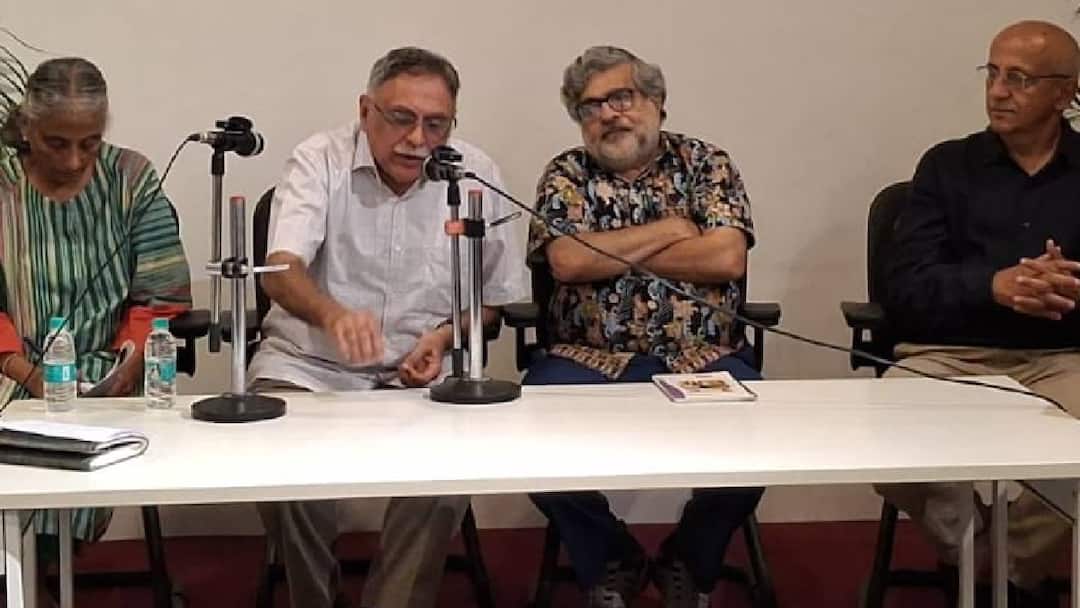
On Wednesday evening, at New Delhi’s Jawahar Bhawan, a solemn and piercingly relevant conversation unfolded. Titled “The Fear and Love of the Bomb: Hiroshima, Nagasaki and Modernity,” the event was jointly organized by the Rajiv Gandhi Foundation and Karwan e Mohabbat. It marked the 80th anniversary of the atomic bombings of Hiroshima and Nagasaki. Historians, activists, and thinkers reflected on the legacy of those events and what they continue to demand of global conscience.
Before the panel began, a reference was made to Grave of the Fireflies, the 1988 Japanese animated film. Set during the final days of World War II, it tells the harrowing story of two orphaned siblings trying to survive in the aftermath of firebombings. The film, often regarded as one of the most powerful anti-war works ever made, served as a visceral reminder of the human cost of modern warfare.
Vinay Lal: Power, Spectacle, and the Politics of Memory
Professor of History, Writer and Blogger, Vinay Lal opened the evening with a sharp critique of the official Western narrative that casts the bombings as a tragic necessity. He called it an exercise in power projection rather than military strategy. He quoted Lieutenant General Leslie Groves, head of the Manhattan Project, who admitted that the real geopolitical message was directed at the Soviet Union. Hiroshima and Nagasaki were selected precisely because they were relatively untouched by previous raids—making them pristine laboratories to test the destructive capacity of nuclear weapons.
He also drew attention to the dark commercialization of nuclear culture in postwar America, from atomic-themed parties to toys shaped like bombs. In contrast, he invoked the haunting Hiroshima Panels by artists Maruki Iri and Toshi as examples of “moral documents” that resisted sanitized narratives. “These aren’t just artworks,” he said. “They speak a language the sanitized narratives of power cannot.”
Why Hiroshima? Why Nagasaki?
Panelist Vinay Lal defined that the selection of Hiroshima and Nagasaki was not arbitrary. The US Target Committee initially identified 17 cities for potential bombing but ruled out those like Tokyo, Osaka, and Nagoya because they had already been devastated by firebombing. The goal was to measure the specific impact of the atomic bomb, which required what they called "virgin territory"—cities that were relatively untouched.
Before the atomic bombings, American forces had already conducted devastating firebombing raids. The March 1945 firebombing of Tokyo killed more people than either Hiroshima or Nagasaki. Japanese cities, built largely from wood and paper, were especially vulnerable. Despite the massive loss of life, these firebombings are rarely part of the global memory in the same way.
The use of the term "virgin territory" also points to how war intersects with notions of masculinity and domination, suggesting deeper cultural frameworks that shaped military thinking.
Public Reactions in the US
President Truman reportedly called the bombing "the greatest thing in history," and Oppenheimer himself initially described it as "the greatest achievement of organized science." Public sentiment mirrored these views:
- 1945 Gallup poll: 85% of Americans supported the bombings, 23% wanted more.
- 2015 Pew survey: 56% still supported the decision, while 34% opposed.In contrast, only 14% of Japanese respondents supported the bombings in 2015, with 79% opposed.
The Hiroshima Panels: Artistic Resistance
Artists Maruki Iri and Maruki Toshi created a powerful series of 15 large murals (1950–1982) capturing the aftermath of the bombings using traditional sumi-e ink techniques.Notable panels include:
- "Posts" – People walking in stunned silence.
- "Fire" – The red of atomic flames and blood.
- "Water" – Hiroshima’s rivers filled with bodies; water failed to save them.
- "Tank, Boys, and Girls" – A haunting huddle of bodies, reminiscent of Auschwitz.
Why Hiroshima Didn’t Resonate Like Auschwitz
The Western imagination, rich with reflections on Auschwitz, has largely failed to grapple with Hiroshima. Thinkers like Adorno declared, "There can be no poetry after Auschwitz," but said nothing comparable about Hiroshima. The bombings never achieved the same moral recognition, perhaps due to racial bias, geopolitical power, or the scientific framing of the event.
Pamela Philipose: Listening to the Survivors
Journalist Pamela Philipose centered her reflections on the testimonies of Hibakusha, the survivors of the bombings. She recounted a conversation with a woman who was a child in Hiroshima, describing her confusion and terror as the B-29 aircraft passed overhead, followed by the dust cloud and mushroom plume. Beyond the physical devastation, Philipose described how survivors were stigmatized and shunned. Many concealed their exposure to radiation, fearing social rejection and failed marriages.
Amar Farooqui: First Memory, Radiation, And Dehumanization
Historian Amar Farooqui offered a personal and philosophical account. He remembered his childhood exposure to Hiroshima through black-and-white films, including Aman, a 1967 Indian film that starred Rajendra Kumar as a doctor aiding atomic bomb survivors in Japan. He also recalled a rare archival clip where Bertrand Russell discussed nuclear disarmament with Rajendra Kumar, showing how Indian popular culture once engaged deeply with nuclear ethics.
Farooqui then explained how many scientists at Los Alamos had opposed the bombing of populated cities and suggested a desert demonstration instead. Their warnings were ignored. Days after Nagasaki, President Truman infamously declared, “A beast must be treated like a beast.” Farooqui emphasized how this statement reflected a racialized dehumanization of Japanese civilians.
The Myth of Necessity: Why Hiroshima and Nagasaki Were Chosen
Vijay Lal and Amar Farooqui challenged the dominant narrative that the atomic bombings were necessary to end World War II. They argued that Japan was already willing to surrender, provided the Emperor’s position remained intact. What truly shifted the geopolitical landscape, they explained, was the Soviet Union’s planned entry into the Pacific war following the end of fighting in Europe. This posed a threat to US influence in the postwar Asian order.
To preempt Soviet involvement and assert global dominance, the United States dropped the atomic bombs—not as a military necessity, but as a calculated display of power. Hiroshima and Nagasaki were not random targets; they had been spared previous bombings, making them “virgin territories,” ideal for demonstrating the bomb’s impact and to show the Soviet Union what the USA capable of.
In this light, the bombings were less about ending a war and more about inaugurating a new world order under American nuclear supremacy.
The Larger Reckoning: Memory, Morality, and Modernity
In the panel discussion moderated by Harsh Mander, the conversation turned to why Hiroshima has not left a moral scar on the global conscience comparable to that of Auschwitz. Vijay Lal argued that while no one debates the evil of the Holocaust, Hiroshima remains a subject of rationalization and justification. “Was it necessary? Was it justified?” Such debates, he said, only serve to deflect moral responsibility.
Farooqui noted that American propaganda successfully framed the bombings as a moral act that saved lives. Pamela Philipose pointed out India’s own nuclear nationalism, especially after the 1998 Pokhran tests. “We turned the bomb into a badge of honor,” she said. “And in doing so, we lost the ability to see it for what it is: a machine built for genocide.”
Memory That Still Burns
Closing the evening, Vinay Lal warned against the illusion that nuclear peace means nuclear morality. Deterrence, he argued, has become a substitute for ethics. New technologies like drones, AI weapons, autonomous systems—promise more surgical warfare, but not more humane outcomes. Vinay Lal focused on the point where the US said in today's warfare there will be "no boots on the ground," but he questioned and said but there will be boots of the other people on the ground. The panel focused and disscused that America presented a very different image of Nuclear energy, a thing which could have changed the lives of million people, used in wiping people of from this earth.
Hiroshima is not just a chapter in history. It is an unresolved question about power, memory, and what kind of future the world is choosing. As Amar Farooqui concluded,
“Hiroshima is not over. It lives on, in bones, in silence, in every war that forgets its cost.”