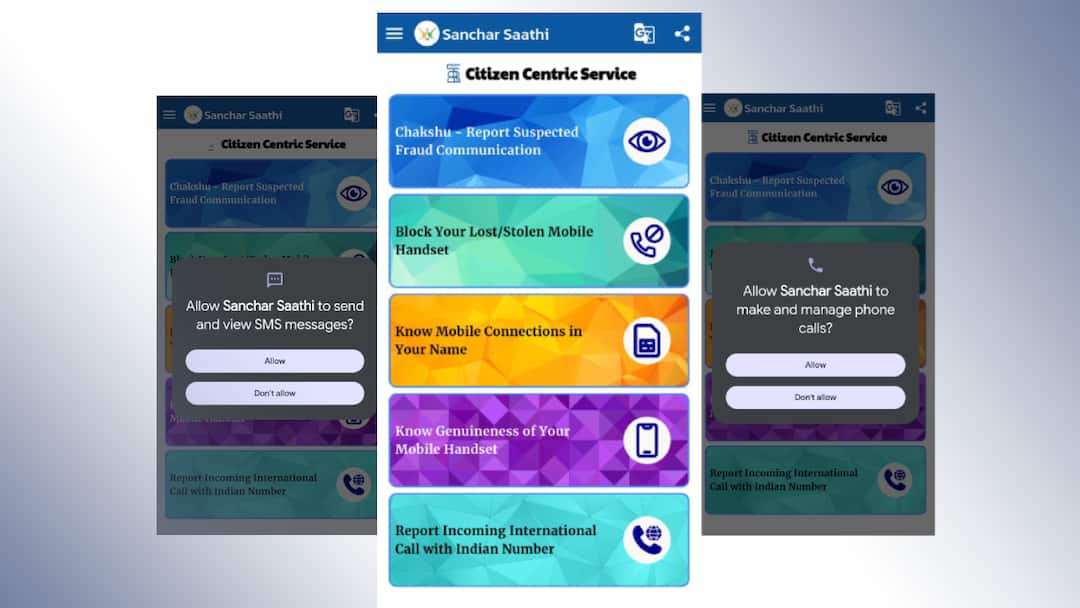
Sanchar Saathi App Permissions 2025:The Sanchar Saathi app has gone from a quiet government tool to a full-blown political livewire, especially under the backdrop of an ongoing, heated Winter Session at the Parliament. What was meant to be a “safety layer” for mobile users has now turned into a debate about privacy, surveillance and where the line between public safety and personal space actually sits.
So ABP Livedid the only sensible thing: we downloaded Sanchar Saathi, explored every feature, poked around its permissions and combed through the fine print most users usually scroll past. Here’s what we found.
What Sanchar Saathi Says It Collects
Here’s the surprising part. On the Google Play store page, the Department of Telecommunications (DoT), which built the app, explicitly claims it does not collect or share user data, and doesn’t share user information with any organisation, except if the law requires it. The developer also states it doesn’t collect user data at all.
Even the official privacy policy page of Sanchar Saathi reiterates the same tone:
- No personal data is captured without telling you.
- If personal info is collected, the purpose is disclosed upfront.
- Information won’t be shared with anyone except law enforcement under applicable laws.
In a nutshell, the policy reads reassuringly minimalistic, almost suspiciously tidy.
What Permissions Sanchar Saathi Actually Requests
This is where things get more interesting, because the app needs some heavy-duty access to function.
On Android, permissions include:
- Make and manage calls: To detect numbers in your device
- Send SMS: To verify registration via SMS to 14422
- Call and SMS logs: For reporting fraud calls/SMS
- Camera: To scan IMEI codes
- Photos and files: Uploading evidence of suspicious calls/messages
On iOS, it’s slightly lighter:
- Camera
- Photos and files
So while the app says it doesn’t collect your data, it still needs deep access to some very sensitive parts of the phone, call identity, SMS logs and camera access, among them. Whether users are comfortable with that depends on whether they view the app as a safety tool or a surveillance foothold.
What Sanchar Saathi Actually Does
Sanchar Saathi’s features are positioned around consumer safety. It includes:
- Blocking stolen phones
- Recovering lost devices
- Reporting spam calls
- Flagging cyber fraud attempts
- Identifying suspicious links, malware attempts, or identity scams via Chakshu
The website claims the app has helped block 42 lakh stolen phones and assisted the recovery of 26 lakh devices. It also reports over 1 crore downloads on Android and nearly 10 lakh on iOS.
Useful? Yes. Privacy-light? That’s where the argument begins.
Why Sanchar Saathi Has Sparked A Political Firestorm
The controversy began when the Centre ordered manufacturers to pre-install the app on every new device manufactured or imported in India within 90 days of November 28. The order goes further: users must see the app during setup, and it cannot be disabled.
Even phones already in circulation aren’t immune; manufacturers have been asked to push it via an OTA (software) update.
Opposition leaders have called the move unconstitutional and intrusive. Congress MP Priyanka Gandhi Vadra had this to say:
Congress MP KC Venugopal said it is a “dystopian tool to monitor every Indian.”
Shiv Sena MP Priyanka Chaturvedi labelled it a “BIG BOSS surveillance moment.”
Congress MP Karti Chidambaram went even sharper: “This is Pegasus ++.”
The Industry Reaction
So far? Mostly silence from Android players. Apple, on the other hand, is reportedly resisting the directive that requires it to pre-install Sanchar Saathi. As reported by Reuters, multiple industry sources say the Cupertino giant is instead preparing to engage with policymakers to explore a compromise rather than fully comply immediately.
Reuters also reported that Samsung and Xiaomi did not respond to queries at the time of writing. Two anonymous industry sources quoted by the publication claimed manufacturers were not consulted before the directive, setting the stage for a showdown, especially with Apple, which historically resists forced app installations, citing privacy concerns.
How The Internet Is Reacting
Following the mandate, social media immediately went abuzz with users sharing their thoughts on Reddit or X (formerly Twitter). The overall mood of the Internet seems tense, as most are wondering whether the app opens a backdoor to government snooping on your phone.
Here are some reactions online:
Sanchar Saathi Verdict: A Safety Net With Sharp Edges
Sanchar Saathi is not inherently sinister. It solves real problems. Cyber fraud is exploding, phones get stolen, and consumers often lack the tools or awareness to act quickly.
But mandatory installation with no opt-out changes the tone entirely.
The government may see it as infrastructure. Critics see it as surveillance infrastructure.
And the user? Probably sees yet another app they didn’t ask for, sitting beside other rarely used apps on your phone.
Bottom line: Sanchar Saathi could be an important weapon against scams and phone theft. But until the government answers the real question, why force it? With the Centre's move, this app will remain less of a safety tool and more of a trust test.
Should an app like Sanchar Saathi exist? Yes, and it does have its usefulness for those in need. Should it be optional to install on all phones? Absolutely.