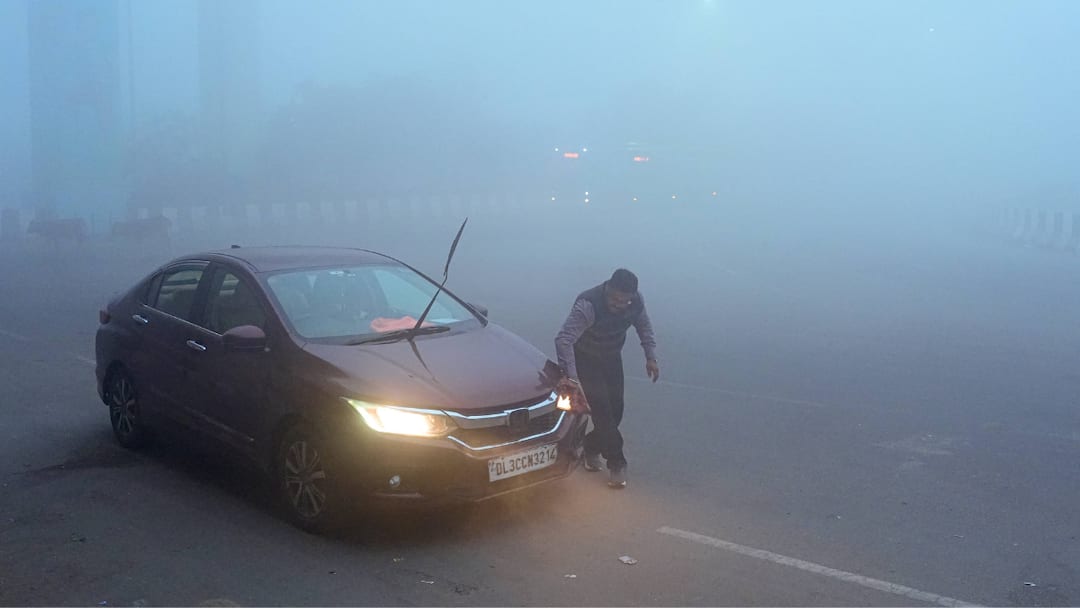
Delhi’s air quality deteriorated sharply on Friday, with the Air Quality Index (AQI) rising from 400 at 4:00 PM to 428 by 8:00 PM, amid the influence of a western disturbance, highly unfavourable meteorological conditions and poor dispersion of pollutants. Taking note of the worsening trend and with a view to preventing further decline in air quality, the Sub-Committee on the Graded Response Action Plan (GRAP) under the Commission for Air Quality Management (CAQM) unanimously decided to invoke Stage-IV measures of the extant GRAP, categorised as ‘Severe+’ air quality (Delhi AQI > 450), with immediate effect across the entire National Capital Region (NCR).
The decision has been taken as a proactive step and is in addition to the measures already in force under Stages I, II and III of GRAP. Meanwhile, NCR Pollution Control Boards and other concerned agencies have been directed to further intensify preventive and enforcement measures to curb emissions and prevent any further deterioration in air quality across the region.
What Is Grap, How It Is Divided?
The Graded Response Action Plan (GRAP) is a set of structured, pre-defined emergency measures notified by the Government of India to tackle deteriorating air quality in Delhi-NCR. Implemented and overseen by the Commission for Air Quality Management (CAQM), GRAP works on the principle of graded response, under which pollution control actions are intensified in stages based on the prevailing Air Quality Index (AQI). It comprises four stages, Stage I (Poor), Stage II (Very Poor), Stage III (Severe), and Stage IV (Severe+), with each stage triggering increasingly stringent restrictions on construction activities, industrial operations, vehicular movement, power generation, and other pollution-causing sources. The objective of GRAP is to ensure timely, coordinated, and region-wide action to prevent air quality from worsening further and to protect public health during high-pollution episodes.