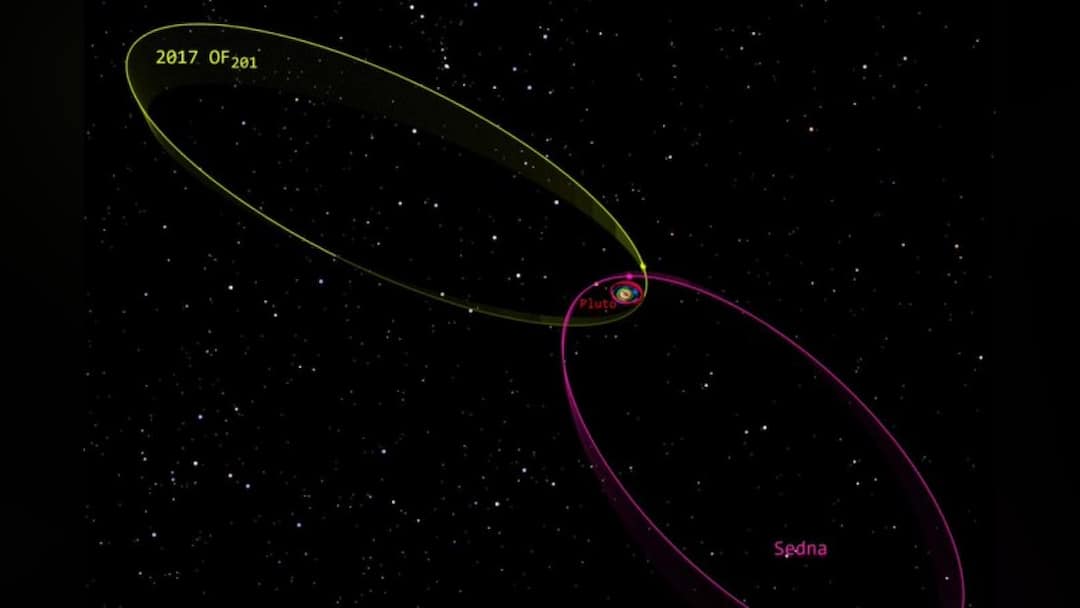
In a thrilling development that challenges long-held assumptions about the outer reaches of our solar system, astronomers have discovered an extraordinary new object—possibly a dwarf planet—lurking far beyond Neptune. Named 2017 OF201, this icy, distant world could reshape our understanding of what lies beyond the Kuiper Belt.
What is the Kuiper Belt?
The Kuiper Belt is a vast ring of icy objects orbiting the Sun beyond Neptune—akin to a remote junkyard of frozen leftovers from the solar system’s formation. It includes dwarf planets like Pluto and thousands of smaller icy bodies. Scientists are intrigued by its peculiar structure: while it spans a great distance, it is surprisingly empty in some areas and densely packed in others. Understanding this uneven distribution helps researchers uncover how the solar system formed and evolved over billions of years.
The object was discovered by a team led by Sihao Cheng, Martin A. and Helen Chooljian Member at the Institute for Advanced Study’s School of Natural Sciences, in collaboration with Jiaxuan Li and Eritas Yang of Princeton University. The discovery, announced by the International Astronomical Union’s Minor Planet Center on May 21, 2025, was made using archival data from the Victor M. Blanco Telescope in Chile and the Canada-France-Hawaii Telescope in Mauna Kea, Hawaii. Their findings were also shared in a preprint published on arXiv.
A Hidden Giant in the Dark
What sets 2017 OF201 apart is its highly eccentric, elongated orbit. It takes a staggering 25,000 Earth years to complete a single trip around the Sun. At its closest approach—known as perihelion—it lies 44.5 astronomical units (AU) from the Sun, comparable to Pluto’s orbit. But at its farthest point—aphelion—it stretches to a jaw-dropping 1,600 AU.
“The object’s aphelion—the farthest point on the orbit from the Sun—is more than 1,600 times that of Earth’s orbit,” explained Cheng, as reported by Phys.org. “Meanwhile, its perihelion—the closest point on its orbit to the Sun—is 44.5 times that of Earth’s orbit, similar to Pluto’s orbit.”
These orbital characteristics suggest a complex migratory history shaped by powerful gravitational interactions.
“It must have experienced close encounters with a giant planet, causing it to be ejected to a wide orbit,” said Yang. Cheng elaborated: “There may have been more than one step in its migration. It’s possible that this object was first ejected to the Oort Cloud—the most distant region in our solar system—and then sent back.”
A Challenge to Planet Nine Theories
Beyond its unique orbit, the object’s implications for broader planetary theories are especially intriguing. Many extreme trans-Neptunian objects (TNOs) appear to cluster in specific orbital orientations—a phenomenon some interpret as indirect evidence of a hypothetical massive planet, dubbed Planet Nine or Planet X.
However, 2017 OF201 seems to defy this pattern.
“Many extreme TNOs have orbits that appear to cluster in specific orientations, but 2017 OF201 deviates from this,” said Li. “This object is an outlier. Its orbit doesn’t quite fit the pattern used to support the idea of an undiscovered planet.”
If Planet Nine exists and exerts as much gravitational influence as theorised, 2017 OF201 might not have remained in the solar system at all. Its survival in such a distant orbit raises new questions about the theory.
Possibly a Dwarf Planet
With an estimated diameter of 700 kilometres, 2017 OF201 is large enough to be categorised as a dwarf planet, though confirmation is still pending. For comparison, Pluto has a diameter of 2,377 kilometres.
According to Cheng, “2017 OF201 spends only 1% of its orbital time close enough to us to be detectable. The presence of this single object suggests that there could be another hundred or so other objects with similar orbits and size; they are just too far away to be detectable now.”
This hints that the seemingly empty region beyond the Kuiper Belt might be home to many hidden icy worlds.
A Discovery Powered by Open Data
Remarkably, this discovery was made using open-access data—proving that major scientific findings don’t always require high-budget, proprietary tools. With the right software and public datasets, even students or amateur astronomers could contribute to new discoveries. As technology improves, we may uncover many more such distant objects that expand our understanding of the solar system.
Kirti Pandey is a senior independent journalist.