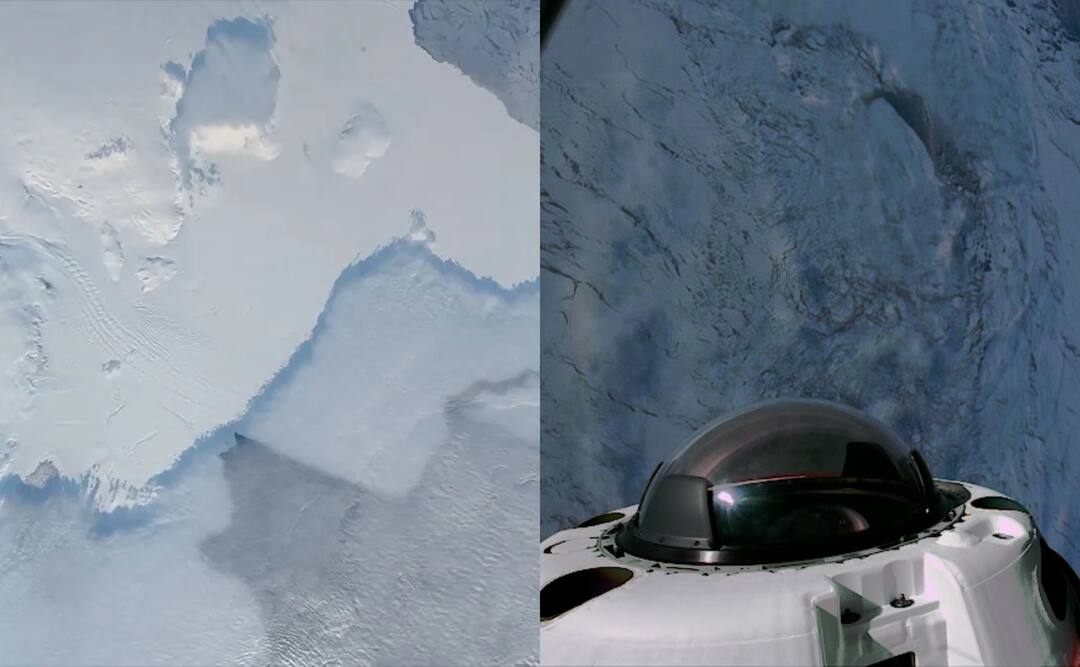
Until now, no human had ever seen what lies beyond the vast, unbroken ice walls of Earth's polar regions—one of the greatest unsolved mysteries of our time. But in a historic first, SpaceX has launched the Fram2 mission, marking the first human spaceflight to orbit Earth over its poles rather than the traditional west-to-east trajectory.
This groundbreaking private mission offers astronauts a never-before-seen perspective of both the North and South Poles from space, achieving a feat unparalleled in human spaceflight history.
The mission lifted off from Launch Complex 39A at NASA’s Kennedy Space Center in Florida on March 31 at 9:46 p.m. EDT (April 1 at 0146 GMT). The crew is traveling aboard the Crew Dragon "Resilience" spacecraft, which was launched by a Falcon 9 rocket into a 90-degree inclination orbit.
A short 2.5 minutes after launch, the Falcon 9’s first-stage booster separated, performed a controlled descent, and successfully landed on SpaceX’s drone ship, "A Shortfall of Gravitas," in the Atlantic Ocean 5.5 minutes after liftoff.
Hello Antarctica!!
This mission represents a major milestone in space exploration, pushing human presence into a previously untraveled orbital path. Shortly after reaching orbit, the crew had their first opportunity to open the Dragon's Cupola, the largest window ever launched into space, offering breathtaking 360-degree views of Earth. Looking down at Antarctica, Commander Chun Wang shared his thoughts from orbit:
"Hello Antarctica," he wrote. "Unlike previously anticipated, from 460 km [285 miles] above, it is only pure white, no human activity is visible."
This observation underscores the vastness and isolation of Earth’s polar regions, even in an age of widespread human exploration.
A Tribute to Polar Exploration: Why the Name "Fram2"?
The Fram2 mission is named after the legendary Norwegian exploration ship "Fram", which played a crucial role in reaching both the Arctic and Antarctic between 1893 and 1912. This ship was specially designed for polar expeditions and was instrumental in the early exploration of some of Earth's most remote and extreme environments.
To honor this history, the astronauts aboard Fram2 have taken a small fragment of the original Fram ship with them into space, symbolizing the connection between early polar explorers and modern space travelers.
The Fram2 Crew and Their Unique Perspective
The Fram2 crew consists of four private astronauts, all of whom have extensive experience in Earth’s polar regions:
- Chun Wang (Malta) – Mission commander, entrepreneur, and cryptocurrency mogul.
- Jannicke Mikkelsen (Norway) – Vehicle commander and cinematographer.
- Rabea Rogge (Germany) – Pilot and scientist.
- Eric Philips (Australia) – Medical officer and mission specialist.
Mission Goals and Scientific Research
The Fram2 mission is planned to last between two to four days, with a total flight program designed for 86 hours. The mission is set to return on April 4, when the Resilience spacecraft will perform a controlled deorbit burn and splash down in the Pacific Ocean.
During their time in orbit, the crew will conduct over 22 scientific experiments, focusing on polar observation, human physiology, and biological research. Some of the key experiments include:
- First-ever human X-rays in space – Studying the effects of microgravity on the human body. - Mission MushVroom – An experiment focused on growing oyster mushrooms in microgravity to understand how fungi behave in space.
A New Record in Human Spaceflight
Before Fram2, no astronaut had ever traveled beyond 65 degrees north or south latitude. This record was previously set in 1963 by Valentina Tereshkova, the first woman in space. Even Yuri Gagarin, the first human in space, and later Soviet and NASA astronauts, never ventured beyond this limit.
By flying over the poles, Fram2 is making history, providing new insights into Earth's polar regions, and proving that private spaceflight continues to push the boundaries of exploration.